

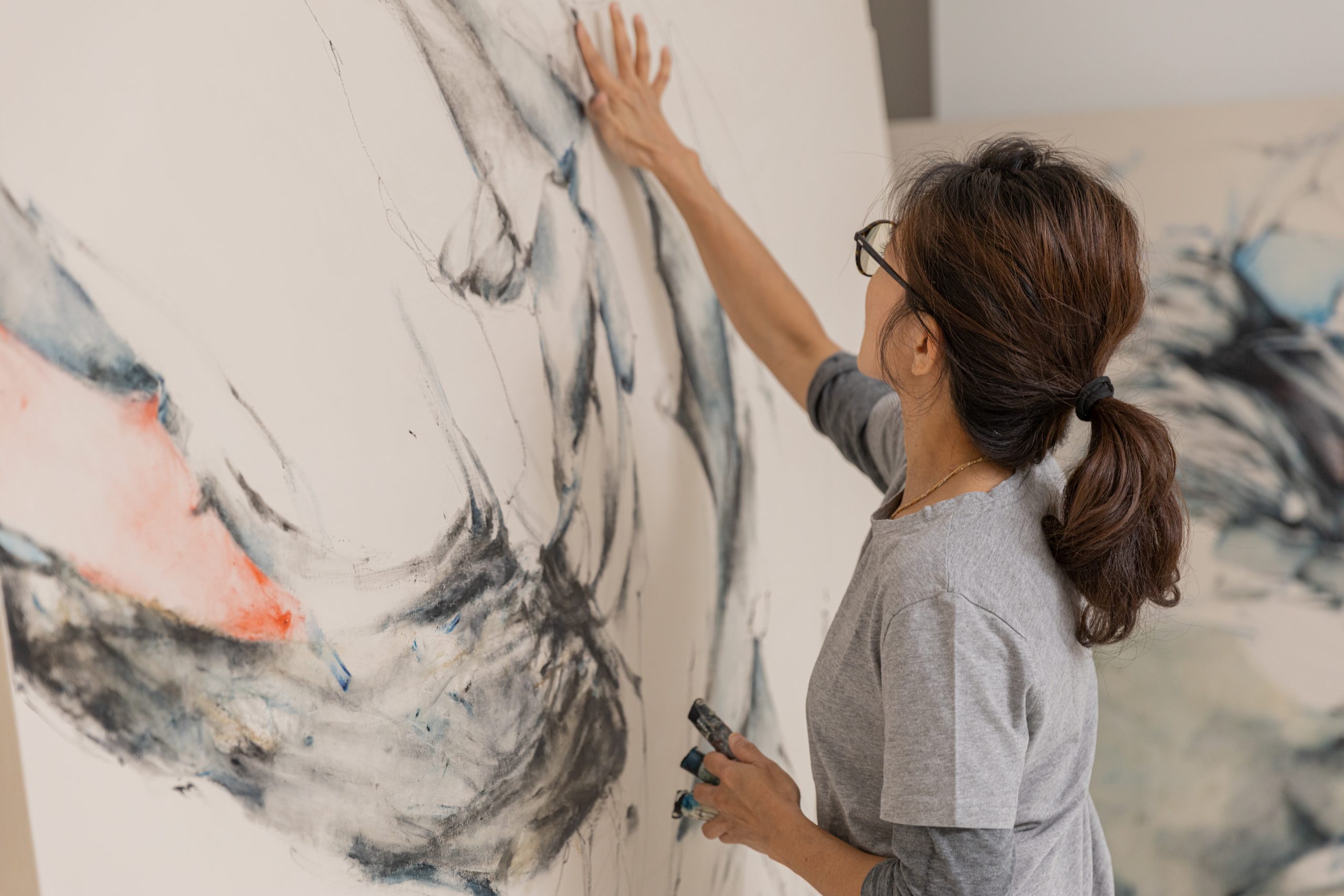
American and Western collectors may not yet be deeply familiar with Christine Ay Tjoe’s work, but the rising Indonesian artist has garnered significant attention in Asia, where she is widely collected and in high demand. Despite a sluggish market—particularly in the ultra-contemporary segment—her auction prices surged 87 percent between 2023 and 2024, culminating in record results this year, especially for her vibrant, tensely dramatic large-scale abstractions. In January, her Lights for the Layer (2011) set a new personal record at Sotheby’s Singapore, fetching $2.15 million—210 percent above its low estimate of $693,100 and surpassing her previous record by $417,300, a 24 percent increase. Between July of 2024 and June of 2025, sixteen works sold across seven auction houses in four countries, generating a combined total of $7 million.
The rise of Indonesian art collectors—young, culturally engaged and increasingly influential—has been a key force behind Ay Tjoe’s expanding market. Indonesia now boasts one of the strongest art markets in Southeast Asia, fueled in part by gotong royong, the nation’s spirit of mutual support. Yet Ay Tjoe’s reach extends far beyond her home country, and her recent solo debut at White Cube in New York unveiled a spellbinding new body of work that is already sparking broader appreciation among American and international collectors alike.

Beyond the record-breaking numbers, standing before Ay Tjoe’s riotous, dramatically gestural abstractions feels like being pulled into a vortex of emotion and sensation—painted tides swelling into waves in an intense psycho-sensorial struggle. Her fleshy abstractions pulse with raw emotional energy, a sanguine palette resonating viscerally with the body itself: flesh, blood and scattered human matter caught in a flux of evolving sensations and infiltrations that continuously reshape it.
There is something fluid and organically instinctual in the way the red-bleeding tides of her compositions move across the canvas like magmatic waves of matter and energy condensed into pigment, settling almost alchemically into new, evocative forms. Yet, as Ay Tjoe explains to Observer when we visited the soon-to-close “Covered and Cover,” her process involves the use of drypoint, so although painting can be more spontaneous, done any time, drypoint also makes it an intensive process, involving many steps.
As the artist explains, her use of reds and magentas evokes parts of the body—blood, skin and bone—while simultaneously alluding to the idea of familial blood ties. “Some parts are dry, bright red, like a collection of relationships in a family that are wrapped up and arranged neatly,” she notes. “With these works, I approached them as having the spirit of ‘volumes,’ rather than just shapes or forms.”
At the same time, the primacy of gestural force—reversed by the artist onto the blank space of the canvas—functions both allegorically and sensorially, suggesting a pursuit of catharsis through the act of painting. In confronting intergenerational trauma, Ay Tjoe also confronts the role of familial silence in burying, dismissing and concealing conflict and pain—silences that inevitably resurface in individual lives, especially when one begins to question their true identity and the deepest essence of their existence.

The layering of translucent washes becomes a visual metaphor for the process of grief—revisiting, revising and revoking it—an effort to metabolize loss and ultimately fortify the self beneath a new skin of awareness. “In this body of work, the continual process of covering and covering again is an effort to visualize the problems in my life to be solved,” Ay Tjoe reflects. “But it is through visualizing the problems in my life on the canvas that shapes and images come to me. My visual practice gives me personal, emotional insight.”
Unaddressed trauma—a silent burden that accumulates beneath the surface of consciousness—is explored here through paint, as the artist dares to descend into those depths, meticulously excavating layers of memory and story that have been deliberately suppressed, actively forgotten, or passively allowed to fade into the shadows of an omertà born of pain or shame. Yet at some point, this buried weight may erupt as an overwhelming mass of untold truths, revealing a subterranean river of pain and unspoken narratives—charged with potent energy, lying dormant until a critical juncture.
This emergence can be profoundly disorienting. Silence—sometimes preserved for generations—is finally broken, not by choice, but by the sheer force of trauma’s return. Ay Tjoe channels this rupture through her process of layering and covering, erasing and reviving successive planes of paint. “In the repeated act of covering, I tell myself that the problem is becoming less and less,” Ay Tjoe reflects. Echoing Seneca, she embraces suffering not as something that weakens the soul but tempers and reveals it. “The goal is to rediscover the positive value of being human and establishing respect between oneself and others.”
Suddenly, her abstractions reveal themselves as potent amorphous metaphors—both in their presence and in their making—for the enduring power of past events to shape the present. They gesture toward the reality that the human psyche, despite its remarkable capacity for resilience and adaptation, cannot indefinitely contain the deep impact of unresolved grief and unspoken trauma—those passed silently from generation to generation, often affecting not only individual lives but entire communities and populations.

At the same time, it is important to consider how Ay Tjoe’s approach to abstraction diverges markedly from Western traditions. She is unafraid to leave white space—an airy dimension of flow, where everything remains open and in motion, yet also a space of silence and denial, where something may have just been erased or removed. Her abstraction is, in this sense, deeply rooted in Eastern philosophical and aesthetic principles. The unfilled space has form and function: “leaving blank” becomes an act of evocation, imagination and meditation on the perpetual flow of qi—the “vital energy,” “breath” or “life force.”
“Next to these forms on my canvases are spaces of absence, emptiness and I can see the relationship between forms and the empty space beside them as meaningful in this way,” she explains. As a member of a Chinese family that values Eastern culture, Ay Tjoe acknowledges the importance of showing respect and appreciation for one’s family and seeking wisdom from her parents. “I wonder about letting go of unanswered questions that cause conflict, and leaving them be.” Grief, emotional restraint, inner turmoil, mortality and the discipline of the self all coexist in Ay Tjoe’s abstractions.
Notably, even as the pigment in Ay Tjoe’s paintings tends to coagulate in plasmatic clusters, there are often tense entanglements of lines visible beneath the surface—traces that guide, frame, or contain the directional flow of color. Trained in graphic art and printmaking, Ay Tjoe came to painting only after years of studying the line. “My paintings revolve around the line, which I smudge, manipulate and attempt to control as my memories and emotions are transferred onto the canvas,” she explains, noting that her practice is as slow and deliberate as the process of persisting in life itself—accepting the unknown and allowing oneself to be vulnerable.
One can sense, almost viscerally, the tension between emotional release and rational containment—a push-pull that echoes the human condition. “The rhythm and contrasts of abstraction are crucial parts of this discovery,” says Ay Tjoe. In this sense, her practice echoes Jung’s belief that what we repress does not disappear, but rather always returns—transfigured in new symbolic forms—until it is faced.

This dynamic animates the exhibition title “Covered and Cover,” suggesting a negotiation between concealment and exposure, chaos and control. “I continued to seek, and sometimes find, control in the process of creating these works,” the artist reflects. “I see my practice as alternating between estranged mixed feelings about death and the acceptance of it.”
In this body of work, the magmatic quality of Ay Tjoe’s abstraction feels more visceral—more blood-like, more corporeal. Compared to earlier pieces, as the artist herself has noticed, these works appear intensely rooted in the realities of flesh, infused with a palpable sense of torment, tension and suffering—both physical and psychological. Ay Tjoe is probing powerful emotions and deep-seated psychological fears, reawakening dormant psychosomatic truths in order to confront them. “There is family history that remains unresolved between me and my late father. I feel the need to keep what was left unspoken as is, now that he has passed,” Ay Tjoe reflects, aware that preserving peace and well-being for the rest of her family is what matters most.
Yet the unaddressed and contained grief remains, surfacing only in symbolically filtered ways, as the irrepressible tides of the unconscious inevitably seek their expurgatory release through paint. In her effort to make sense of the past, Ay Tjoe chooses to keep certain things covered, and to cover them again through the metaphorical, indirect language painting allows. She trusts that understanding and acceptance will come in time, and that what remains unresolved will, eventually, lose its weight.
Ay Tjoe says she always finds a special connection to her work in the moment of creation. Each painterly gesture opens up a new space that transcends the timed and transitory nature of physical sensations and human emotions, and allows instead for that honesty and acceptance, where thoughts, feelings and experiences can be acknowledged beyond the confines of individual trauma, attuned instead to a more universal order.

No matter how spirited or restlessly turbulent, each of Ay Tjoe’s works seems to seek, in the end, a sense of harmony—a possible reconciliation of tension and opposites. “What I create is still in harmony and balance,” she explains. These plasmatic masses continuously coagulate and converge, transforming, evolving and dissolving in tune with their own internal rhythm.
By covering, layering and returning again and again to the surface, Ay Tjoe ultimately suggests that one might arrive at a more integrated rhythm—a kind of acceptance that even includes conflict itself. Her abstraction becomes a language for both expressing and embracing the perpetual cycle between chaos and harmony, life and destruction—a reflection of the entropic essence of existence itself.
More Arts interviews

