

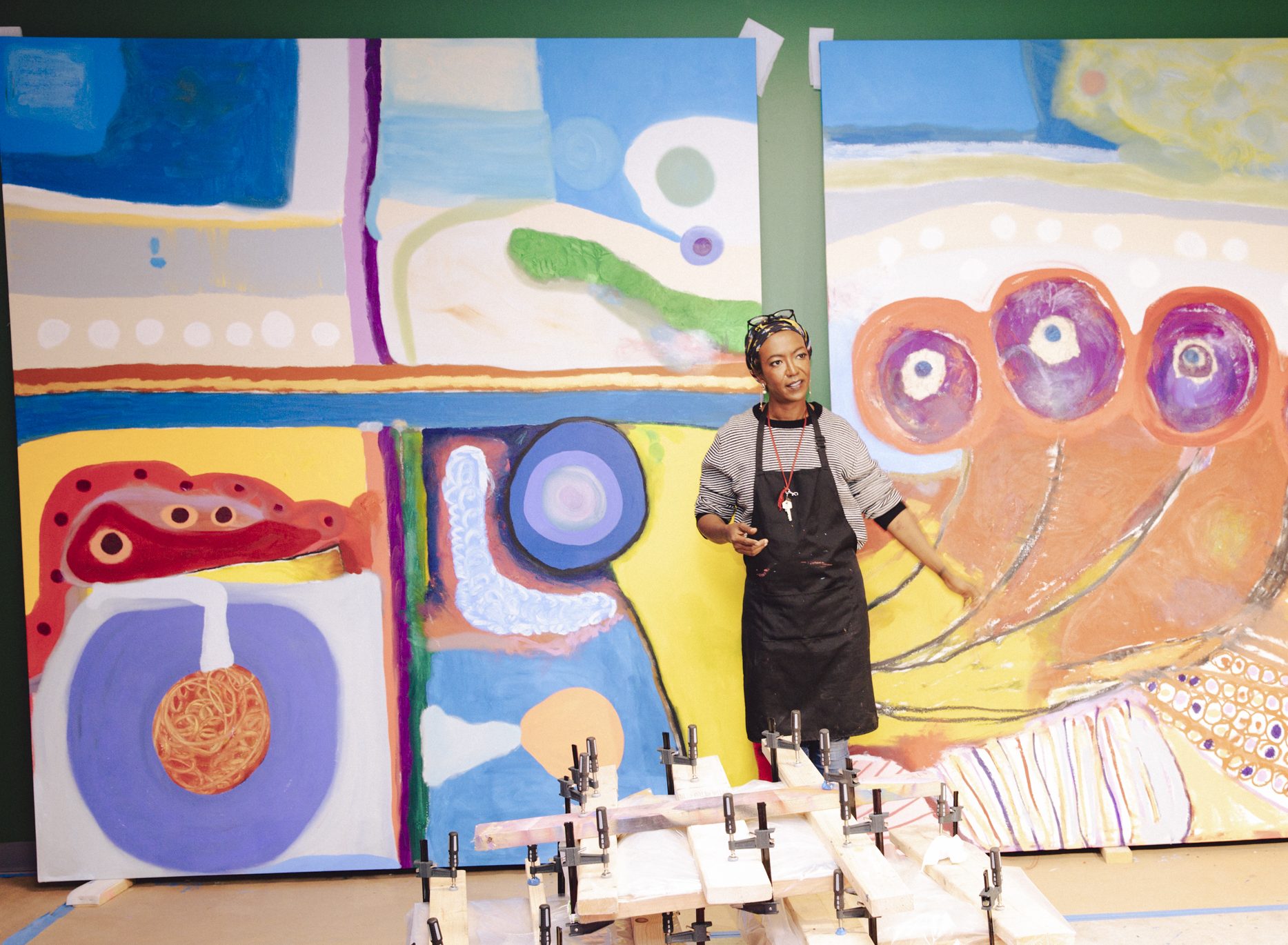
If you’re in the art world long enough, you learn there isn’t as much consensus as there may appear to be. After the second drink, many people are eager to disclose the names of the blue-chip artists whom they don’t enjoy. But Uman (b. 1980) is someone for whom the praise is universal. She is as at home at Hauser & Wirth as she is at the SITE SANTA Fe International, beloved by the toughest critics and most passionate collectors. Last month, she opened her first solo museum show, “After all the things…” in the United States at the Aldrich Museum in Connecticut, and we took the opportunity to hear more about this important exhibition.
This body of work is wonderful and inventive. How did you come to these pieces?
I met [chief curator] Amy Smith-Stewart almost three years ago. She offered me the show. I always felt like I didn’t want to put myself into the institutional world—not against institutions, but it didn’t feel like my place. This was my first time that a museum wanted to do a show with me. It felt comfortable because it came from Amy, and it’s in Connecticut, two hours from my studio. I thought first about doing a suite of paintings in the main room… maybe a sculpture. I had no idea what I would do. It came together at the beginning of this year.
You said you were apprehensive about institutions. Why?
When I started to get commercial success, I felt like that was my lane—to be a commercial artist. I’m not an academic. I’m an outsider, but I never felt like an outsider or an insider. I didn’t want to force my work into that context. But it’s part of the game; artists eventually do a museum show. I could have waited many years, but this felt easier, with not a lot of pressure. Amy is such a great person—sweet, kind—and it was a pleasure to work with her. That made everything feel easy. I felt emboldened to do anything I wanted: large paintings, the video. She said yes to everything. It was a good partnership with the Aldrich, especially Amy.
When the show began coming together earlier this year, was there a moment of inspiration—something that told you what this body of work would be?
I live upstate, and I always talk about loving living in the countryside and loving nature. So the idea was landscapes. But I didn’t want to put myself in a box. I always try to undefine my work. So they’re landscapes that could become interesting through grids, certain colors—landscapes that morph into abstraction. It’s also a love story about my life in New York and upstate New York. That’s why I included the video—just iPhone videos I took every time snow came outside my studio. I’ve been recording them every year since 2012.
I worked on Richard Mayhew’s recent show at Venus Over Manhattan, and in the press materials, you invoke this concept of his, the “mindscape.” Can you speak about how that applies here?
It’s an internal world. I feel the work as I’m doing it. The pieces contain marks I’ve used over the years. When making these works, there were months where I didn’t touch them, then I returned this summer and in the months leading up to the show. It’s a reflection of the year I’ve had—clarity, internal peace. It’s very hard for me to describe anything I do. I always feel on the spot when someone asks what I was thinking. So many things happened this year, and I put it all in the work.

When you say “so many things,” do you mean in the world or in your personal life?
Both. I live in a bubble, but you can’t ignore what’s going on. A lot of chaos. And personally, I’ve had a very inspiring year—a year of change, clarity. I’ve lost people, gained people. Those experiences are in the show. The show is clear because of these past months.
What world events filtered in?
We have this new president. I was scared. I had a residency in England and didn’t want to go until May. I almost canceled. When I finally went, I realized how different it felt to be an American in Europe now. When I returned to JFK, I immediately felt anxiety—like the country is chaotic. I internalize that. I’m an immigrant; I always worry. It’s not part of my narrative as an artist, but it’s out there. And it has nothing to do with the content of the paintings—they’re paintings with color, movement, stillness. But I can’t help feeling the energy shift in the country from last year to this year.
When I look at the paintings, I see soft colors, calmness—but hearing you talk about the year, the more intense marks feel different. Maybe like an exorcism, in the context of what you’re describing.
I like that word, “exorcism.” Yes. That’s how I channel the work. My paintings are very physical. I put a lot, remove, put, remove. I use a lot of pressure. It’s physically laborious to do big paintings. I don’t want anxiety in the paintings, but it comes out. Still, they’re meditative, in my opinion. The one painting that’s less meditative is the lamp in the back room, and the small works on paper. That lamp painting started simple—spray paint on black gesso, but now it’s full of texture.
The press materials say you’re “obsessed” with street lamps. Can you talk about that?
I’m not obsessed, but I was for a while. I lived in a very rural farm country outside Cooperstown. Then I moved to Albany in 2020, my first urban environment in many years. There was a lamp right outside my building. It showed up in drawings—I’ve made dozens. It became a beautiful sculpture form, a metaphor for a eureka moment or idea. A deeper meaning than the lamp itself. For the sculpture, I found metal in a scrapyard in Alameda County outside San Francisco. The glass came from a shop in Oakland. I wanted something like the lamp outside my building.
Conceptually, is the appeal that liminal sense—an industrial object that becomes this accidental moment of grace?
Yeah. Also, I grew up in Mombasa in Kenya. The first thing you see on the streets are lamps. In London, too, the old street lamps. Something feels welcoming—some sense of safety. I like seeing lamps or a house lit at night. It’s cozy, homey. Maybe it’s also returning to an urban area after a decade in the country. I came upstate in 2010. I don’t even have a street lamp in my driveway.
When you talk about upstate, it sounds like you prefer being neither fully remote nor fully urban—one foot in, one foot out. Is that right?
Exactly. I’m done with that chapter. The show was a love letter to my life upstate. Now living in Albany, I’m thinking about where I want to live. I’d love to go back to New York City. But I have a visa, and I’m leaving the country next year. I’ll be living in France. I want to see what it’s like to be somewhere else, what work I can create. I’ve been in isolation, although I’ve maintained my city life and friends. But I’ve had enough of snow and cold.
Are you going to the south of France?
Yes, outside Avignon. A nice town. Lower cost of living. A place to work. I can take the train to Paris when I want. I’ll come back to New York as often as I can. I still love New York State. I’ll always come back.
Last question: what do you want visitors to feel when they leave the show—something not in the press materials?
Very inspired. I don’t want people to take away a message. I never have a message. Some respond, some don’t. I continue to work. I want people to find meditation. To sit, see the show, reflect. I’ve loved painters whose work brings joy. I want people to feel joy. I love to paint. I love to make people feel the work, but there’s no message. It’s not necessary to prove myself or to prove anything.


