

Waves are lapping everywhere you look. Outside, the Atlantic Ocean stretches in front of Tate St Ives over an overcast sandy beach. Inside, multi-channel films of life-giving oceans and rivers are arranged in the gallery’s temple-like space. Emilija Škarnulytė’s works occupy two main gallery rooms in a major eponymous exhibition contending with personal memory and collective history, both understood in expansive terms.
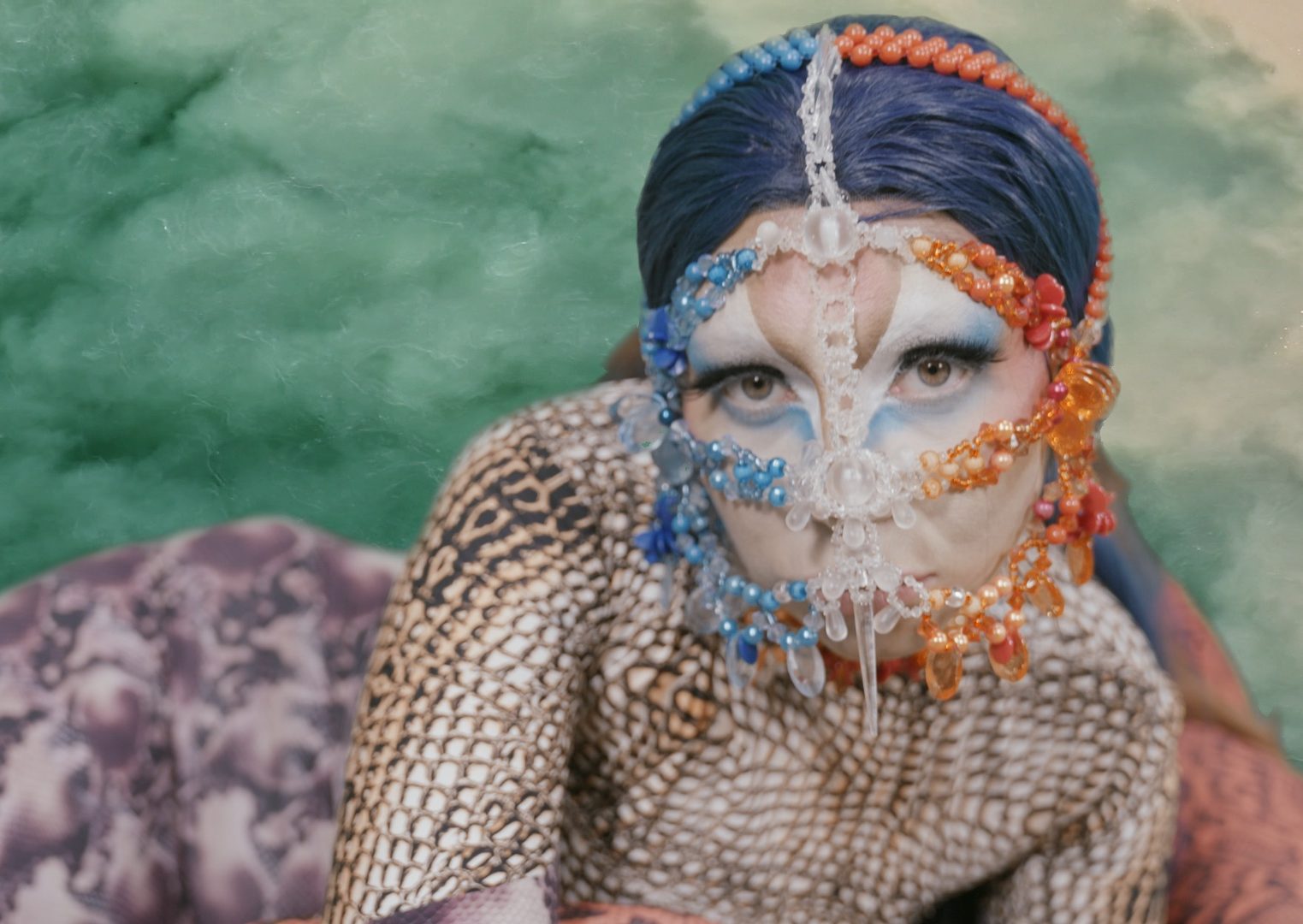
The Lithuania-born artist’s ambitious work is devoted to deep time, speculative archaeology and mythologies. The show starts with Riparia 2023, a photo representing a character emulating the image of a female masked divinity, half human, half reptilian. This sets the tone for “Emilija Škarnulytė,” which focuses on the complex exploration of time and narratives and how strata—geological, mythological and political—intertwine in that meaning-making process.
Aldona (2013) is a short film documenting ritual, the passage of time and political legacies in sensory terms. Aldona, the artist’s grandmother, lost her eyesight during the 1986 Chernobyl nuclear fallout. She lives at the border with Belarus in her traditional home and garden (recently plucked medicinal herbs hang from the room’s ceiling). In the film, remembering and forgetting coalesce into two sides of the same affliction—a familiar dance of the mind for the Homo post-Sovieticus. Without sight, Aldona relies on other senses, including hearing and touch. In some of the film’s most moving scenes, the radio plays ancient tales in her kitchen; in others, Aldona’s fingers explore the face of a gigantic Lenin statue in a sculpture park.

In the second gallery room, lit by blacklight, we come across a collection of sculptures and video channel installations. Here, we transition from personal to collective myths, from material history to spiritual presences and transcendence. Škarnulytė thinks about space and how we move in the exhibition, and we often hover below the surface of what is visible, as if we were marine explorers following a dive line.
Installation elements can be experienced on their own or in relation to one another. If Water Could Weep (Mermaid Tears) (2023-2024), displays lachrymiform-shaped glass phosphorescing in blue and red hues, which evoke the Lithuanian myth of a weeping sea goddess. In Nucleotides (2025), various cell organisms are printed on a wall, providing a visual and physical bedrock, halfway between abstract and organic visualizations. The installation “Wheel of the Goddess” features various videos from 2021 to 2023, playing in a continuous loop on a four-screen central rotunda perforated by four openings, which are conceived as mirroring the architecture of Tate St Ives and the cardinal directions. The four interspaces provide an opening and a fresh way to see the works engage with each other. Films gathered in this rotunda encompass Sunken Cities (2021), peeking above the marine Roman archaeological site of Baiae; Aphotic Zone (2022), filmed four kilometers deep into the Gulf of Mexico to find species surviving global warming and ocean acidification; Riparia (2023), where the artist follows the Rhone River from Swiss glaciers to the French Camargue region featuring serpent-like creatures; as well as Hypoxia (2023), set in the Baltic Sea’s low-oxygen “dead zone.”

Through one aperture, we move from “Wheel of the Goddess” to another video loop channel, “A Liquid Abyss,” projecting films including Æqualia (2023), Rakhne (2023) and t ½ (2019) on the gallery’s end wall. Other works in the show honor Lithuanian artists influential in Škarnulytė’s practice—notably Marija Gimbutas’s pioneering research on archeomythology—and follow Neolithic traces present in England’s Cornwall, explored during an artist residency in the region.
While the sheer number of individual works may seem overwhelming at first, on the scale of a survey, they form a strong, cohesive proposition to help us make sense of relics and memory. Dolmens, megaliths, shapeshifting sea divinities, ancient sites, modern toxic waste, celestial objects and more connect and reconcile despite their apparent tension and opposition. This is our world, the artist seems to tell us, a world that predates—and will outlive—humans, yet remains irascibly shaped by them. Understanding this human embeddedness becomes a driving force.
“Since childhood, I’ve been fascinated by hidden worlds. My experiences of growing up in Lithuania during the final years of the Cold War, surrounded by a sense of decay as an empire fell apart, deepened my interest in what lies beneath the surface,” the artist said in a recent interview.
There’s a reason why humans have always feared the deep seas: it’s a terrifying realm of many unknowns that Škarnulytė slowly peels off, one that conjures incredible beauty, mysteries and the sacrilegious stain of pollution. Many of these films sit at the edge of ecological sci-fi. We visualize the Anthropocene in all its obscenities: the climate crisis, human neglect toward nuclear and other waste, and irreversibly changing ecosystems. Amid this contemplative anxiety, the presence of sirens stands as a symbol of permanence in impermanence, incarnating the force of matrilineage and folk beliefs operating in other spheres and laws. We hear echoes of the Great Mother and Old European goddess myths, including the triple female archetypes of maiden, mother and crone.

Škarnulytė, who graduated with a degree in sculpture, spoke during the show’s preview of “moving images as sculptures.” One of her intentions is to capture texture and dimension in her films. The result is not so much a traditional sculpture as a total meditation that involves architecture, visual immersion and hypnotic sound. This aggregate of aesthetic works beautifully constructs a state of mysticism in which we are invited to roam freely. Realizing this ambition, the artist stages a dialogue between human and nonhuman, material and metaphysical languages that often leaves us wondering about our own ignorance and unmet curiosity as a species briefly hosted in a universe we know so little about.
Through strange, asymmetrical temporalities, we are left to contemplate what resists erosion and forgetfulness. Is decay a step toward an end—death, nothingness—or an evolution to a new state? Who will be the future ancestors to tell our stories, both real and fictional? Committed to the art and act of witnessing, Škarnulytė sketches the outline of an eco-feminine spirituality, a hopeful journey into the recesses of weathering and embodying infused with awe. Her personal cosmology is a phenomenology of time—a temporal awareness and consciousness. Time becomes object and subject, a lens through which everything else can be appraised. For the artist, it is nonlinear, cyclical and bending. She displays those qualities in an intentional scenography that elevates this alchemical show into a breathing, pulsating form of surrender.
More exhibition reviews


