

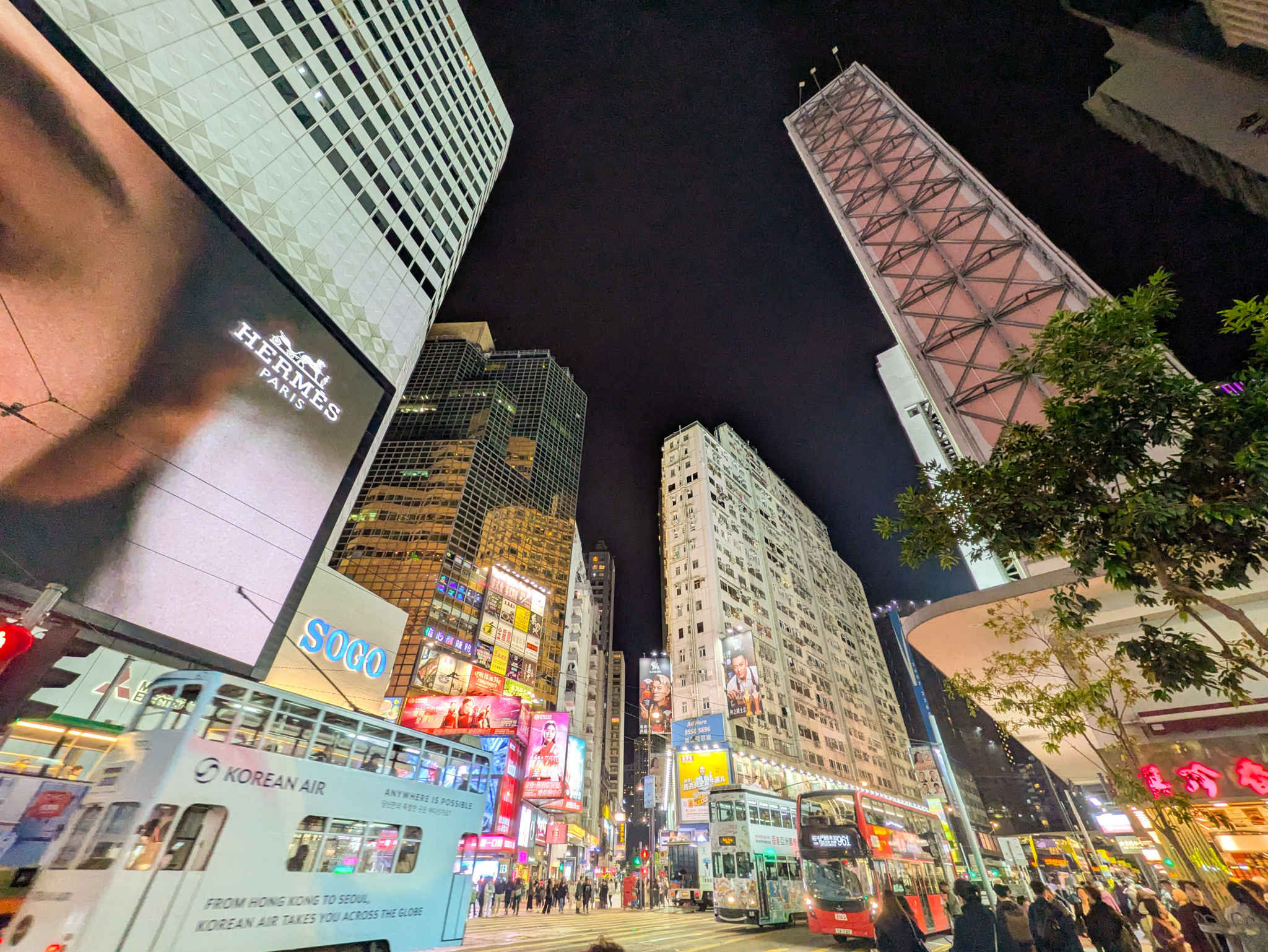
I’ve never been to Asia before, and in the weeks leading up to my art trip to Hong Kong, I experience far more pre-travel anxiety than usual. I obsess over losing an entire day, fret about what to pack, worry about jet lag and fail repeatedly to memorize what is easily the most ambitious itinerary of my growing travelogue series. (Forty-eight hours of art is not long enough when you’re flying halfway round the world.) I also become oddly superstitious, reading portents into everyday moments. This is not my normal, and even now, weeks after returning, I’m still not sure what rattled me so deeply.
But in a strange but welcome twist, the very first leg of my journey offers reassurance: my tough-guy Uber driver plays soothing spa music. Score one for the universe. And then it’s priority check-in, empty security lines at 10 p.m. and smooth sailing all the way into the Delta One lounge, where I snack, study Hong Kong’s art scene and eventually notice I’m already surrounded by artworks: Gregory Block doughnuts, a Miles Jaffe matchbook piece and a balloon work by Patrick Nevins, whose adorable “crayon” painting delighted me in Denver once upon a time.
Am I relaxed? Not exactly. I still believe humans were never meant to fly, but priority boarding gets me into my business-class seat about 40 minutes before takeoff, leaving time to settle in. My husband always says, “You’re just in a room,” and on no plane has that felt more accurate. The Airbus A350 ceilings are unexpectedly high, and I’m tucked into a window cubicle that will be home for the next 15 hours.

In the first few, I explore the amenities of my cube: noise-canceling headphones, a remote that doubles as a video game controller, Bamford toiletries and several storage nooks. I eat a dinner of noodle soup with dumplings while binge-watching The Office and Silicon Valley, sip the airline’s signature in-flight drinks (the non-alcoholic Cathay Delight and the boozy Cloud Nine) and play a little Tetris. I assume they’ll dim the cabin lights after the coffee service—chamomile tea for me—and pretty chocolates, but when I return to my cubicle after changing into pajamas and brushing my teeth, my seat has become a bed and it’s dark. Really dark. And surprisingly quiet. I needn’t have worried about sleeping on the flight. I snooze for roughly nine hours, waking with plenty of time for a couple of cups of coffee before breakfast: pumpkin and crab congee with lots of Lee Kum Kee Guilin-style chili sauce, Singapore Mei Fun and another Cathay Delight.
For all my anxiety, I begin every journey believing something beautiful will happen. And so it already has. This is the calmest, most enjoyable and most delicious flight I’ve ever taken. When we touch down in Hong Kong in the pre-dawn darkness, Yunchan Lim’s recording of Tchaikovsky’s “The Seasons” playing in my headphones, I’ve officially time-traveled through Tuesday, and a big, busy Wednesday awaits. I can’t wait.
Day 1
I arrive in a mostly empty Hong Kong International Airport at roughly 5 a.m., though it’s hard to tell because my body clock is screaming at me incoherently. I blearily make my way to the taxi stands, stopping to double-check which color cab I’m meant to take. (Red.) There’s little to see in the dark until we reach Tsim Sha Tsui, quiet at this hour but brightly lit. The Langham, by contrast, is anything but subdued—Christmas music fills the vast neoclassical lobby, which is dominated by a massive pink Christmas tree.

It’s only just after 6:30 and, naturally, my room isn’t ready, so I head to the dual-level Health Club to freshen up. Sauna’ed and showered, I eat breakfast in the Club Lounge, a space that nods to the brand’s London roots with its button-tufted velvet, gilt wallpaper and chandeliers. There’s a full spread of American breakfast staples, but I go straight for the chicken congee, piling it with century egg and chili sauce, and adding a side of dumplings.
I’m not jet lagged exactly, but I feel gauzy-headed and the world gently rocking around me. I drink a drip coffee, then a flat white, while mapping my way to West Kowloon Art Park and the Hong Kong Palace Museum for the editor’s preview of “Ancient Egypt Unveiled: Treasures from Egyptian Museums,” led by associate curator Wenxin Wang. It’s only about a mile and a half away, and a walk in mild weather seems like the best way to convince my brain it really is Wednesday morning.
Jonathan, the lounge’s ebullient host, is about to store my bag when he gets word that my room is ready. It’s cozy, with curved floor-to-ceiling windows overlooking Dior, Chanel and Cartier storefronts, which I quickly learn is very Hong Kong. The table has been laid with dainty strawberries and hilariously large grapes, plus chilled bottles of Saicho sparkling jasmine tea, a welcome alternative to the usual champagne.

The walk to West Kowloon Art Park is easy, though waterfront construction means more crossings than expected. Still, I arrive at the Hong Kong Palace Museum with time to grab my earpiece and join the tour of 250 treasures from pharaonic times, on loan from seven major museums and the Saqqara archaeological site. The irony is obvious—the first art I see in Hong Kong is Egyptian—but there hasn’t been a major exhibition of Egyptian antiquities here in decades, and it feels special to be part of it.
The show is excellent, presenting ancient Egypt through daily life as much as royalty. “We tried really hard to connect what ancient Egyptians wanted and what modern people want,” Dr. Wang says, noting how challenging the installation was. Organized into four sections—“The Land of Pharaohs,” “The World of Tutankhamun,” “The Secrets of Saqqara” and “Ancient Egypt and the World”—it mixes statues, coffins and gold ornaments with humbler objects: a Senet set, a pigment-stained painter’s palette, sandals, a toilet seat, a 4,000-year-old piece of bread and even several mummified cats.
From there, I move on to “Brilliance: Ming Dynasty Ceramic Treasures from the Palace Museum, 1368–1644,” and then “The Quest for Originality: Contemporary Design and Traditional Craft in Dialogue.” I’ve never been much of a plate-and-vase person, but the latter’s dialogue between historic objects and contemporary Hong Kong designers deepens my appreciation of the porcelain artifacts by several degrees.

I grab lunch in the park, which has everything from fine dining to food trucks, before walking a few hundred meters to the M+, billed as Asia’s first global museum of contemporary visual culture. With 33 galleries, a roof garden and four permanent collections, including one of the world’s strongest holdings of contemporary Chinese art, it deserves hours I don’t have. Beyond works by Qiu Shihua, Kan Xuan, Chang Xugong, Duan Jianyu and Shao Fan, along with Hassan Khan’s fantastic Jewel (2010) and Chiharu Shiota’s immersive Infinite Memory, what stays with me are the music pairings and wall prompts. My favorite asks, “Can sadness be beautiful?”

On my way out, I stumble into “Dream Rooms: Environments by Women Artists 1950s–Now,” where I see people removing their shoes. I’m powerless to resist a hands-on show, and inside is pure delight: Pinaree Sanpitak’s monumental pillow fort, The House Is Crumbling; rebirth via Lygia Clark’s A casa é o corpo: penetração, ovulação, germinação, expulsão (The House is the Body); and, best of all, Judy Chicago’s Feather Room, tucked away around a corner and so blissfully uncrowded.
Back at the hotel, I tour the Langham Art Collection with Emilie Zhang, director of marketing services. In all its common areas, the hotel displays a rotating selection of works by established Chinese artists collected by Langham Hospitality Group chair Ka Shui Lo. Aside from a few fixed pieces, including a particularly Instagrammable painting near the elevator bank, the collection changes constantly. The lone non-Chinese work is a modest Dale Chihuly behind reception; it’s overshadowed by stronger pieces in the lobby, the Palm Court and T’ang Court, the only Cantonese restaurant with a MICHELIN three-star rating and my destination for tonight’s dinner.

Zhang joins me for a glass of champagne before I dive into a tasting menu featuring four courses and dessert. The stuffed crab shell is a Hong Kong classic, with every restaurant claiming supremacy. The Wagyu beef may be the best thing I’ve ever eaten, with the cod fish with honey close behind. Dessert is a classic egg tart and, unexpectedly, a fragrant almond cream soup. Then, as exhausted as I am, I make my way to the Avenue of Stars for “A Symphony of Lights,” the nightly lightshow on the buildings of Hong Kong Island. The waterfront is packed. The show is just okay. Or maybe I’m simply too tired to enjoy it.

Day 2
Tip: If you’re going to have insomnia anywhere, have it in a hotel with deep bathtubs. I find myself wide awake in the middle of the night, maybe because my body thinks it’s the middle of the day or possibly because my first day in Hong Kong was massively overstimulating. I’m moving slowly this morning, and getting out the door is priority one. Because I need to put money on my Octopus card—or so I think. After a quick snack of giant grapes, I speedwalk to a packed 7-11 and watch the people ahead of me at the counter for clues on how to load up my card.
I add funds, but turns out the card with which I will pay my metro and ferry fares came pre-loaded, and I now have enough credit to travel around the city for possibly weeks. Public transit in Hong Kong is cheap: the most expensive peak fare on the Star Ferry from Tsim Sha Tsui to Central is roughly 85 cents. Most metro trips cost between 50 cents and two bucks. But back to the ferry, which is my ride to a breakfast appointment with a PR. The Star Ferry, which crosses Victoria Harbour every 10 minutes or so, is an iconic Hong Kong fixture founded in 1888 as the Kowloon Ferry Company, and while the boats are obviously newer, their look hasn’t changed much. It’s all utterly charming, and I vow to take the ferry as often as possible during my trip.

Citymapper is my go-to app in unfamiliar cities, Hong Kong included. Mostly it works well, but there are two exceptions. One is in Central’s urban canyons, where skyscrapers reflect the signals that tell the app where I am. The other is anywhere an overpass or underpass bisects an intersection or cuts diagonally across a plaza. Hong Kong is a city of levels, threaded with pedestrian pathways that make walking easier but navigation harder. It doesn’t help that many destinations you’d expect to be storefronts are tucked inside buildings, and I wander hopelessly until my PR contact finds me looking lost in front of a Prada.
Next up is a tour of Sotheby’s two-story, 24,000-square-foot Hong Kong Maison, which my colleague Elisa Carollo has covered extensively for Observer. For those unfamiliar, every major Sotheby’s location now includes a retail component, and this one is a testament to its city’s luxury-shopping culture. There are pre-auction exhibition spaces (showing historical works from China, Korea and Japan during my visit), alongside salons that can be reconfigured for privacy or accessibility. “Every salon has a focus: jewelry, watches, wine or handbags,” comms manager Vinchi Wong tells me. “The enclosed space lets clients try pieces on in a more personal way, surrounded by art to create a cohesive environment.”

Walking with Wong, comms manager Fei Yip and head of comms Nancy Wong, I admire a fossilized skeleton of a rare juvenile Gryposaurus, intricately articulated animal-themed jewelry by Buchin Yoshioka, rare vintage wines and luminous jade. “Some clients walk in knowing exactly what they want, like a huge pink diamond; others want to learn,” Nancy Wong says. “Asian collectors, especially, love the educational side—understanding quality, craftsmanship and design. Our specialists are trained to tell those stories.” The highlight for most, though, is the gleaming wood portal and staircase leading down to the maison’s much-lauded exhibition space. “The curves continue all the way down to the ground floor; there are no straight lines, so the space flows naturally,” Yip explains. “When it’s dark, visitors slow their pace, like moving through your home at night. The lighting is focused strictly on the artworks.” Unfortunately, the space is closed during my visit for the installation of “Heaven’s Mandate: Giuseppe Castiglione’s Auspicious Lotus for the Yongzheng Emperor,” so I only get a brief peek.
Then I’m off again, this time to explore Central. This is my one free afternoon, and I’m meeting up with a friend, and sometimes Observer writer, Xinyi Ye, for gallery hopping and sightseeing. We start at David Zwirner, which is showing “Felix Gonzalez-Torres: Somewhere better than this place / Nowhere better than this place,” on view through Feb. 14, 2026. The exhibition includes candy and stack works, the mirror piece Untitled (Fear) (1991), a light string sculpture Untitled (Couple) (1993) and Untitled (Welcome Back Heroes) (1991), with elements extending into the city to emphasize chance. Next is Tang Contemporary, where a solo exhibition of painter Ming Ying’s faceless figurative works invites speculation. (Pace was meant to be our third stop, but the gallery shuttered the space the week before.)

Xinyi then leads me to Tai Kwun, the former Central Police Station Compound turned cultural complex, and it strikes me how nice it is to walk without Citymapper for a while. With a friend, I stumble into corners I would never have found on my own, especially within the maze that is Tai Kwun. There are art galleries here, too, and we check out Finding a Place to Call Home by Philadelphia-based muralist and glass artist Eric Okdeh before making our way through the Central Magistracy and the former Victoria Prison exhibitions that show what these spaces were like before the historic buildings were restored. And then we visit JC Contemporary, home of Tai Kwun Contemporary, which I forget I’m scheduled to visit tomorrow.

After we part ways, I make a quick stop at Pottinger Street, a cobbled path from Hollywood Road to Queen’s Road dating to the 1850s. It hosts a fancy dress market, and during my visit, the sellers have gone all-in on Santa hats, red-and-green garlands and other Christmas trappings. I can’t linger, though, because dinner awaits. Roganic in Causeway Bay is both Michelin-starred and Michelin Green-starred, a farm-to-table restaurant helmed by head chef Adam Catterall. Like many things in Hong Kong, it’s in a mall, though you’d never guess once inside. The warm wood, matte stone and curvingly organic design feel oddly like a natural extension of Sotheby’s glowing portal.

A few things to know about Roganic: the menu is the menu, though it shifts with what’s coming from the farms. There are wine pairings, but I opt for the thoughtful non-alcoholic pairings, all made in-house from ingredients that might otherwise be discarded, in keeping with the restaurant’s low- and no-waste philosophy. The food arrives as a parade of surprises: umami-maximized mushroom mousse, horseradish trout wrapped in a crisp beetroot cylinder, honey-soaked brioche with salted butter, a simple pork croquette that is shockingly good, frozen Yoshida cheese with Alpine plum and caramelized soda bread that eats more like a sundae than a cheese course. I try to stay present with each dish and pairing, noting how salty, bitter, acid and fruity notes balance and echo one another. At some point in the menu, I jot down that it “feels like I’m eating the platonic ideal of food.” But when the final dessert lands, I’m uncomfortably full and two and a half hours have passed. Plan accordingly.
Day 3
It’s hotel transfer day, which for me begins at 5:30 a.m. and not especially well. I’m anxious about making it to a scheduled street art tour, and I’m starting to suspect that biology cannot be ignored. I’m so discombobulated that after a final bowl of congee with century eggs in the Club Lounge, I leave the Langham to check into the Cordis Hong Kong in Mongkok without saying goodbye to my contact there. Then I leave the Cordis without connecting with my contact there, who is gracious about it and happy to reschedule our planned walkthrough for the following morning. Fortunately, getting to the tour meet-up is as straightforward as can be. From my new home base, I walk past Larry Bell’s Happy Man to the metro, take the ferry back to Central, and make my way to a coffee shop near Tai Kwun, where I meet Alexandra Unrein, a self-taught expert on street art and its practitioners.

On our stroll from Central to Sheung Wan, we stop at one of the city’s most photographed spots, Alex Croft’s Graham Street painting inspired by the Yau Ma Tei tenement buildings in Kowloon. From there, we move on to Jaune’s tiny stenciled sanitation workers, Innerfields’s spacewoman, HERA’s reading girl, Mon’s celestial deer and many others. Along the way, Unrein points out several small, solitary statues by Isaac Cordal, tucked high into out-of-the-way places: businesspeople in suits and tourists in shorts gazing down at the city with inscrutable expressions. As for how she learned so much about Hong Kong’s street art scene, Unrein tells me she simply engaged with the artists, showing up where she knew, or suspected, they’d be. “Hong Kong is influenced by New York, where graffiti really grew up and evolved into a mural scene in the 1990s,” she explains. “Here, graffiti only began to appear in the late 1990s, but by 2010, when I arrived, a small group focused on street art had started hosting exhibitions featuring many internationally renowned artists.” That momentum eventually became the annual HKwalls festival, which brings artists from around the world to leave their mark on the city.

Before we part ways, Unrein gives me a copy of her new book, Colourful Hong Kong – Street Art Stories. I flip through it by the pagoda in Hollywood Park, watching turtles play king of the mountain while I eat an Okinawan musubi, a sandwich-like onigiri, Hawaiian by way of Japan, here filled with fried chicken, honey mustard, an egg and Spam. Among the photos in the book are two murals, one from the tour, that feel oddly familiar. It turns out HKwalls artist Alex Senna has also painted in my hometown. Sometimes the world really is surprisingly small.

Next comes more gallery hopping, which is easy on Hollywood Road, once dominated by antique shops and now home to an increasing number of contemporary art spaces. I stop into “SWAG” at Contemporary by Angela Li, a solo show of charming character paintings by artist and gamer Agnes Leung Po Ying, then head to 13A New Street Gallery to meet owner Ruby Fung and see Sinje Lee’s “Childtopia,” the Golden Horse Award-winning actress’s first solo exhibition in Hong Kong. While the show centers on her newer, sweetly childlike circular canvases, my favorites in the show are several earlier, meditative works: Quietly, Ocean and Mother. When I ask Fung about Hong Kong’s art scene, she’s candid. “Buying and selling slowed down after COVID,” she says, “but I do think more people appreciate art now. The government also has a lot of big events and exhibitions in the art and culture sectors. In general, the culture is evolving, but money-wise it might take time for people to really know how to appreciate or invest, or to own a work at home.”
There’s certainly no shortage of places to buy it. Continuing down Hollywood Road, I peer into the window of Liang Yi Museum, open by appointment only (I have no appointment), then step into Gallery 149, also by appointment but welcoming anyway. There I see a striking pairing of Tracey Emin’s gouache Waiting to be with You with contemporary Chinese ink pieces. I also make a brief stop at Illuminati Fine Art, which is showing dramatic brush works by Ng Kwun Lun Tony, Zhou Jin, Chan Keng Tin, Yau Wing Fung and Tony Ng.

Then it’s back to Tai Kwun, where I meet a group of the complex’s reps in front of the JC Contemporary & F Hall Gallery building. They tell me that Tai Kwun Contemporary presents three to eight exhibitions each year across its 1,500-square-meter space, which includes the former Central Police Station compound and a modern addition designed by Herzog & de Meuron, in a program organized into three categories: “New Narratives,” large thematic group shows spotlighting emerging generations (of which “Stay Connected: Navigating the Cloud is one), solo exhibitions commissioning new work by artists who have not shown widely in Asia; and “Pioneers,” monographic shows of major figures.
Exploring “Stay Connected” on my own, I realize how much I missed earlier while walking through with a friend. This time, I take in Ye Funa’s Curated Nails: Diamond Nail Salon installation, Lu Yang’s The Great Adventure of Material World, Gong Jian’s paintings of iconic historical moments and two of my favorites, Cao Fai’s Asia One and What Is Your Favorite Primitive by Li Yi-Fan. I’ve always been a little skeptical of video art, but this show, along with Jewel at M+, is changing my mind. But my favorite work in the exhibition is Sun Yuan and Peng Yu’s Can’t Help Myself, the leaking industrial robot endlessly trying to clean up after itself. I feel an immediate kinship with that robot arm because we’re both just doing our best.

Dinner is at Madame Fu Grand Cafe Chinois, a contemporary dim sum restaurant also in Tai Kwun, which has a series of theatrically themed rooms. One is drenched in tufted Millennial pink, inspired by India Mahdavi’s iconic design for London’s Sketch. Madame Fù’s verandahs feature lamps crafted from Hermès scarves. Meanwhile, my dining room is heavy on dark velvet and leather, clubby and masculine, softened by more delicate art on the walls. The crystal shrimp dumplings are my favorite, with the mushroom truffle close behind, and the roast pork is everything you wish it would be elsewhere. Here, too, there are thoughtful non-alcoholic options. I sip a spiced mango and basil mocktail, then head back across the harbor during the light show, which is far more impressive from the ferry’s upper deck.

Day 4
Biology really won’t be tricked, and I wake before sunrise yet again, this time at 4:30 a.m. It’s too early for breakfast and I’m too mushy-headed to work, so I head to the Cordis’ 41st-floor gym, which is easily the best hotel gym I’ve ever used, if only because there’s nothing quite like plodding along on a treadmill while staring out at the vast, twinkling city below. (I learn later that there’s also a private fitness room guests can reserve for video classes or yoga.) Once the sun is up, I do laps in the open-air rooftop pool with another early bird, then park myself in the hot tub for a luxurious half hour. Back in my room, I flip through the deck of art cards that map the Cordis’s self-guided tour of its extensive collection, overseen by curator Angela Li, whose gallery I visited the day before.
There’s notable art everywhere on the property, reportedly valued at around $4.5 million when the hotel opened and almost certainly a lot more now. In the Club Lounge, I eat breakfast near a striking teal-and-yellow photographic work from German artist and Beijing resident Peter Steinherr. It’s part of his Cocoon series focused on a defining feature of Hong Kong’s urban landscape, the bamboo scaffolding and colorful construction draping that much of the world came to recognize after the tragic Wang Fuk Court fire. In the lobby are works from Ju Ming’s Taichi Series. Xiong Yu’s Feather Light is a favorite, as are Liao Yi Bai’s strange and wonderful chrome animal sculptures and works by Gao Yu, Wang Guangyi and Jiang Shuo.
cordis art image
On my rescheduled walkthrough with hotel rep Julia Leung, she points out a mix of art and amenities, and I’m disappointed I won’t have time to visit the Chuan Spa, whose treatments are built around traditional Chinese Medicine (another experience for next time). On the exhibition front, she explains that the hotel mounts several shows annually through its Art in Residence program, but I’ve arrived between installations. “SurrealHK: The City Reimagined,” featuring work by Tommy Fung of 13A New Street Gallery, had closed just a few weeks earlier.
(I’ll pause here for a brief compare-and-contrast for anyone choosing between the Langham Hong Kong and the Cordis Hong Kong, both operated by Langham Hotels International. The Langham is smaller, cozier and more traditional. You’re addressed by name and surrounded by classical opulence with a distinctly British sensibility. It’s high-end in an old-fashioned way. The Cordis, by contrast, is luxuriently modern. You’re one face among many, but surrounded by an impressive array of amenities and unbeatable views from the upper floors. The Langham’s art collection is thoughtfully curated but mostly unlabeled, while every piece at the Cordis has a placard. The Cordis is flashy and extremely Instagrammable, and attached to one hell of a mall; the Langham feels more like a home.)

I spend my morning with tour guide Agnes Tam, visiting the iconic Wong Tai Sin Temple and the Chi Lin Nunnery, a welcome palate cleanser after days of artful indulgence. We take the metro to the only landlocked district in Hong Kong, chatting the entire time about travel and our different backgrounds. The colorful Taoist temple, built by Leung Yan-am and open to the public since 1956, is a major attraction, and I mean major. Thousands visit daily, and during our stop it’s wall-to-wall people, some practicing kau chim or praying, others snapping photos or gathering luck to take home. Taoism, Tam explains, is inclusive, with everything unified and connected, much like Hong Kong itself. “What makes the city tick is a mix of the old and the new, the East and the West,” she says.

The nearby Buddhist nunnery is everything the temple isn’t. Hushed and serene, it’s widely recognized as the world’s largest handmade wooden building complex, constructed from cypress using Tang Dynasty techniques with interlocking joints and not a single nail. The courtyard holds ancient bonsai and lotus ponds, and inside the halls, where photography is forbidden, are monumental golden statues of the Sakyamuni Buddha and Guanyin, the goddess of mercy. But what’s most striking may be the contrast between the site’s disciplined serenity and the contemporary public housing estates and skyscrapers looming over it.

That contrast continues nearby at Nan Lian Garden, a nine-acre classical garden designed in the Tang Dynasty style and completed in the early 2000s through a partnership between the nunnery and the Hong Kong government. Surrounded by highways and towers, it feels like a true oasis, with koi ponds, cloud-pruned Buddhist pines, immaculate bonsais, a rockery of massive polished stones from across China set in raked gravel, a small gallery of ceramics and a teahouse. There’s also Chi Lin Vegetarian, tucked behind a water feature, where Tam leaves me for lunch. I linger over a light meal watching water slide down the window, then do all my souvenir shopping in the garden shop.

The weather today is the best I’ve enjoyed so far, and I could happily stay longer, but I’m due at the Hong Kong Heritage Museum, a large public museum on the banks of the Shing Mun River dedicated to the city’s culture and creative life. After some confusion about how to cross the river from the metro, I begin with the special exhibition “Legacy of Lingnan School of Painting,” a retrospective of Chao Shao-an that includes stunning depictions of unexpectedly dramatic flora and fauna. Highlights from the permanent collection include the Cantonese Opera Heritage Hall and “Hong Kong Pop 60+,” which traces the flow of pop culture into and out of the city over six decades. I practically sprint through “Buddhist Pilgrimage: Treasures from the Donation of The Tsui Art Foundation,” because I have a dance performance to catch.

Freespace Dance presents forward-looking perspectives on dance from artists across the Asia-Pacific region, and tonight’s program is at the Xiqu Center, a curvaceous open oval building near West Kowloon Art Park I passed on my first day. Several short works, part of a broader festival that includes works in development by independent Hong Kong choreographers, followed by Q&A sessions. Lau Pak-hong’s Step 0, with sound design by Jonathan Ng, is beautiful but controversial. “For me, when I create a piece of work apart from watching with my eyes, I think about how it relates to other people: how can we experience the same thing together?” he says during the Q&A, but some audience members express their uneasiness about being physically drawn into the performance. “There’s a power imbalance between performer and audience—an element of peer pressure,” one notes. Touch also figures into Noon’s Body Capital, but here consent is obtained in advance for a moving, occasionally pornographic reflection on the commercialization of art and the body, social judgment and authenticity. (I have no doubt Body Capital will grow into a compelling full-length work.)

I leave feeling that familiar urge to make art after immersing oneself in it, hustling to make my dinner reservation at the Cordis’s Michelin-starred Ming Court. Outside, rows of clay pots replicate vessels unearthed during the hotel’s construction in 2003, with the 2,000-year-old originals now at the Hong Kong Heritage Museum. Inside, the atmosphere is calm without being stiff. The nine-course tasting menu is ambitious, with highlights including jellyfish, an eight treasure soup that warms me through and a delicate lobster dish. In the contest of stuffed crab shells, Ming Court wins with a version that’s crabbier, lighter on the onion and gently coconutty. Dessert is mango sago cream and a matching fruit-filled mochi. I’m full but not uncomfortably so—the tasting menu portions are refreshingly tiny—and I end the night soaking in my suite’s deep tub.

Day 5

I sleep until almost 6:30 a.m. on my last day of art in Hong Kong. There’s no point trying to drift back off—I can see a thin blade of light creeping above the blackout curtain. Besides, today is my departure day, but I’m also scheduled to visit one more museum so I need to pack up early. I could go back to the pool or have breakfast in the Club Lounge one more time, but yesterday I bought myself a coconut cream bun exactly like the ones I used to eat every day when I lived in Brooklyn, and there’s still some fresh fruit in the room. So I wrap myself in a hotel robe, turn an armchair toward the floor-to-ceiling window and eat my breakfast while watching the city wake up.

First stop: the pool deck for Master Cheung’s Tai Chi class, offered daily for hotel guests. I’ve never done Tai Chi before and have no idea what to expect, but Master Cheung is a wonderful teacher. He leads four of us, all beginners, through six of the art’s 24 forms with patience and humor, and I think I’d like to start every day like this. Next up, I’m speedrunning the Hong Kong Museum of Art; I can’t really give the museum my full attention with airport logistics looming, but what I do see is excellent. I linger longer than planned in “Art of Gifting: The Fuyun Xuan Collection of Chinese Snuff Bottles,” mesmerized by these tiny vessels in their endless colors and configurations.

“Shopping in Canton: China Trade Art in the 18th and 19th Centuries” balances multimedia displays with vivid depictions of the port city, especially the export paintings. “Art Personalised: Masterpieces from the HKMoA” opens with a quiz that points you toward one of four collection groupings most likely to resonate. My personal favorite, though, is “Engaging Past Wisdom: Min Chiu Society at Sixty-five,” because there’s something deeply satisfying about encountering exquisitely made objects, hundreds or even thousands of years old, that were once part of everyday life.

My final stop is the nearby K11 Art Mall, where I briefly wander, marveling at iconic design pieces by figures like Hans Wegner and Børge Mogensen displayed in the walkways. K11 lives up to its name, with art scattered across multiple floors, though finding it can feel like a scavenger hunt. As I browse, I briefly think about how much I didn’t see in five days. Museum shows friends raved about. Galleries shaping Hong Kong’s contemporary art scene. The Tian Tan Buddha and its cable cars. Lion Rock. And somehow I never found a good excuse to ride one of the streetcars in Central. Then I think about how much I did manage to see and how blessed I am to be able to see it.
I spend my last hours in Hong Kong, like many travelers, roaming the vast concourses of Hong Kong International Airport, buying gifts for people back home and marveling at the sheer scale of Terminal 1, one of the world’s largest passenger terminals. There’s plenty of art here too, mostly sculptural and travel-themed, from Monica Tai On-yau’s Little Explorer to Raymond Fung Wing-kee’s Letters from Afar, though it’s as spread out as everything else. There’s even an annual HKIA Arts and Culture Festival, which I’ve just missed. And, of course, there’s Louis Vuitton, Prada, Loro Piana, Valentino, Balenciaga and more, in case you feel like squeezing in one last shopping spree.
When hunger hits, I head down to The Pier, First, one of Cathay Pacific’s lounges, and find an airport oasis. There’s a full-service bar, massages, beautifully appointed showers, private workspaces, day suites for napping and aside from the central common area and snack pantry, it gives strong luxury-hotel energy. In the restaurant, I eat one of the most glorious things I’ve ever tasted: Cathay Pacific executive chef Adrian Upward’s Dan Dan Mein (I found the recipe!), paired with a perfectly sized black tea cocktail.

Still waiting on a gate assignment, I gather my things and backtrack to The Bridge, another Cathay lounge, for a change of scenery. It’s busier than The Pier, but the energy is lively and the Korean dishes on offer that day are solid. I take a latte to a cozy corner and sink into a deep, bowl-like armchair, where I admire the barista’s flawless unicorn latte art and lose myself in the low hum of other people’s conversations. My mind starts wandering and I think back to earlier in the day and my slow walk along the Avenue of Stars with hundreds of others, enjoying the sunshine and photographing the daytime skyline across a glittering Victoria Harbour. On a trip where nearly every minute was spoken for, it was a chance to pause and simply sit with the city. During Tai Chi that morning, a woman from Singapore told me the last time she’d visited Hong Kong was more than 20 years ago. I asked if it had changed much. “No,” she said, “some buildings are taller, but it’s not that different.” Sitting by the water, I think to myself that I don’t want to wait two decades to come back. But if that’s how life unfolds, I hope not much will have changed.


