

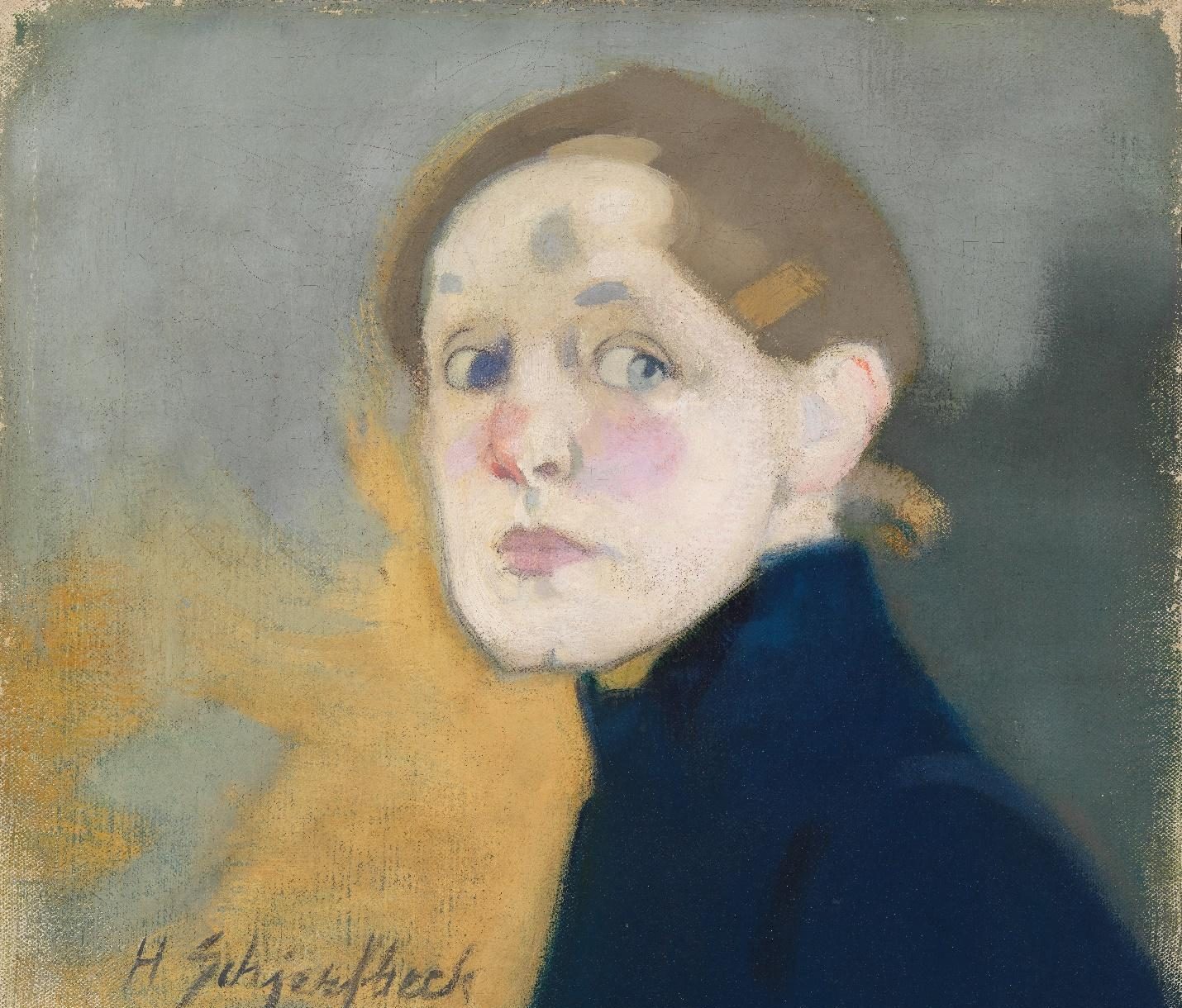
To see an exhibition of an artist’s work without having seen any reproductions or read anything about them is rare. And to encounter the paintings—masterfully installed in a major museum—and find the work powerful, ingenious, even sublime, is akin to an explorer stumbling upon unmapped territory. The experience is so uncommon, you wish you could always see art for the first time, without any images or opinions clouding your view. Such was the feeling when I walked into the exhibition, “Seeing Silence: The Paintings of Helene Schjerfbeck,” at the Met. She has never been shown in the U.S. and has only previously exhibited in Sweden and her native Finland. The work is mesmerizing, requiring the slow and silent absorption all great art deserves.
The paintings are mounted chronologically, allowing viewers to trace the evolution of the artist—a crucial lens through which to understand a life’s work. From her first self-portrait, painted at 22, to her final one at 83, a year before her death, Schjerfbeck’s development is a wonder to witness. It unfolds against the backdrop of recurring illness, a civil war, two world wars, and persistent self-doubt. She lived to paint.

Born in 1862 in Helsinki, Finland, her talent quickly became evident. She was admitted to the Drawing School of the Finnish Art Society at age 11. By 15, she had advanced to a private academy, and at 17, received a travel grant for her painting Wounded Warrior in the Snow. While in Paris, she visited museums and studied the masters, carrying her sketchbook everywhere. Back in Helsinki, she painted Fête Juive, submitted it to the Paris Salon, and was accepted. She was 21. That marked the beginning of a lifelong practice: she produced 40 self-portraits over the course of her life.

Schjerfbeck never married and never had children—all she wanted to do was paint. She continually experimented with materials, pushing herself to the brink of exhaustion. She mixed charcoal, watercolor, gouache and tempera with oil. She scratched the surface with a stylus, exposed underlayers, used sandpaper and rubbed cloth against the canvas to reveal its raw weave. While visiting a fellow painter in Cornwall, she painted “the sea, so blue and bright, the sky blue, and the light so soft you cannot see the horizon.”
At 30, she began teaching, demanding absolute silence in the classroom and disliking questions. Shy and reluctant, she found teaching exhausting and limiting to her practice. Summers were spent in sanatoriums recovering—she was diagnosed with neurasthenia, a depletion of nervous energy causing fatigue and headaches. One wonders if, freed from the burden of teaching, she might have suffered less. At 40, she finally resigned and moved to a small Finnish town to care for her mother for 15 years. Her mother often posed as a model. Schjerfbeck preferred quiet interiors—her paintings implied activity, subject and feeling. She said, “we do not need to enumerate all the details, it is a mere hint that we approach the truth…allowing the work to open up.” It was during this period that her acclaim grew, and a dealer discovered her work. Yet she remained prone to depression, plagued by doubt and was rarely satisfied with what she made.

Her dealer brought her magazines featuring contemporary painters, and she particularly admired El Greco. “I would like to take up El Greco’s palette: white, black, yellow ochre and cinnabar.” She also studied Modigliani, which is evident in the eyes of her self-portraits—each looking in a different direction, one outward and one within. She was always observing the outer world while holding fast to her inner one. These portraits—especially the 20 created in her final two years—reveal both her dedication and her struggle. She unflinchingly exposed herself, ravaged by stomach cancer and physical decay. These final self-portraits, hung on a single curving wall at the Met, are shocking, harrowing and deeply honorable. They depict an aging face, drooping eyes, pursed lips and thinning hair. They are heavily worked, often in oil, tempera and charcoal, scraped and sanded down to the canvas’s very bone. They feel otherworldly, like the Scandinavian light of the Northern climes.

At 82, quite ill, she was set up by her dealer at the Grand Hotel in Stockholm. Though she missed Finland, she kept painting until her death two years later. Her easel and paints remained beside her bed. “Painting is difficult, and it wears you out body and soul when it doesn’t come out right—and yet, it is my only joy in life.” The Met’s show is astonishing—the range of subjects and techniques, the fearless experimentation. The silence in her work is tender, delicate and fierce all at once. In a world dominated by men, despite isolation, illness and self-doubt, she carved out her space. Seeing this exhibition was revelatory—made even more so because she had never been shown in the U.S. before. The Lace Shawl was the first of her paintings to enter a U.S. museum collection, acquired by the Met in 2023. Her voice—shifting, evolving and utterly singular—is one for the ages. We’re lucky she’s finally arrived.
“Seeing Silence: The Paintings of Helene Schjerfbeck” is on view through April 5, 2026, at the Metropolitan Museum of Art.
More in exhibition reviews


