

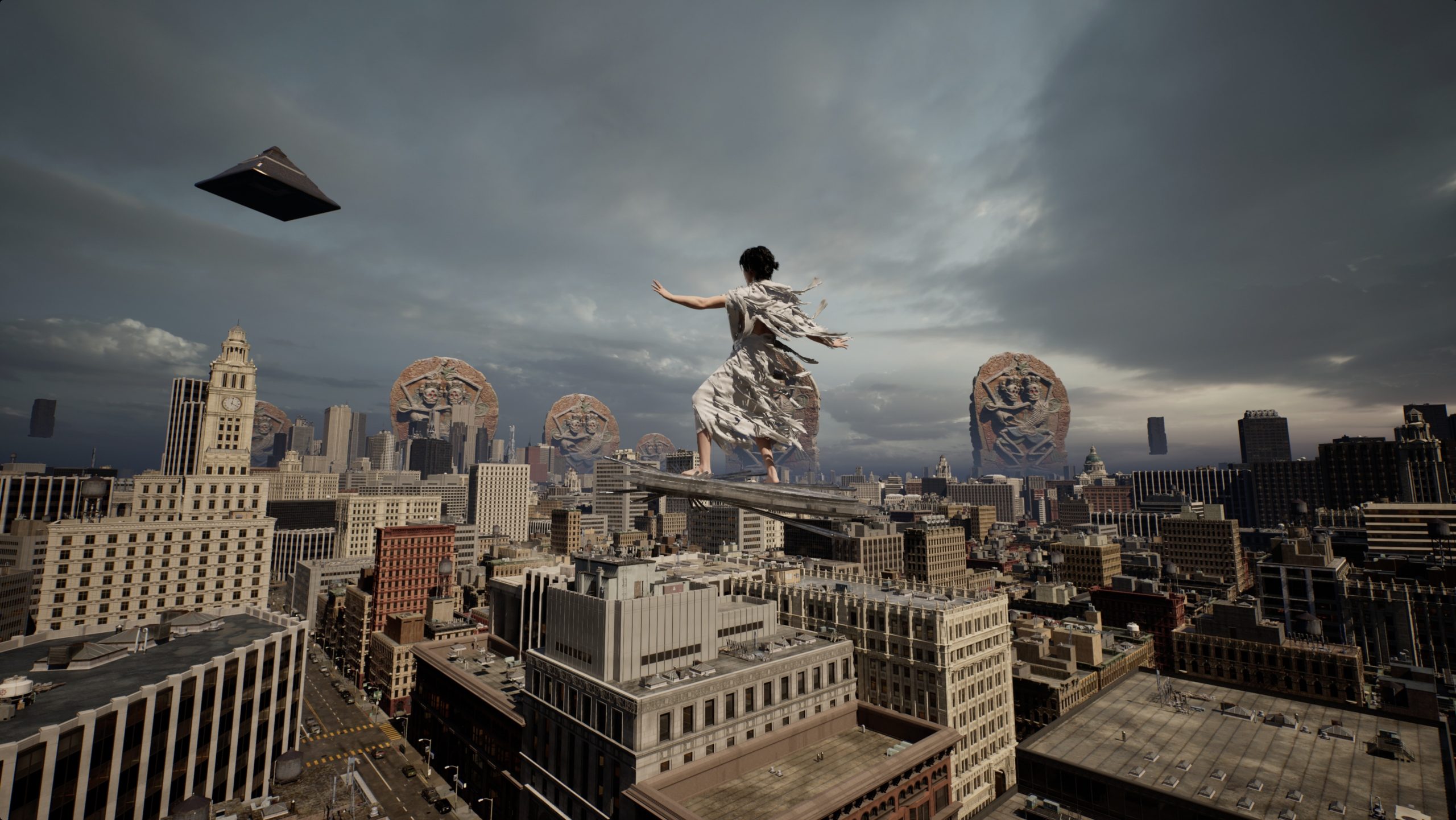
In a long-dormant Venetian-style landmark originally opened in 1924—which once hosted vaudeville and live theater—the nonprofit Julia Stoschek Foundation is reviving a Los Angeles legacy. The Variety Arts Theater will, a century after its opening, will showcase films and videos by Marina Abramović, Doug AItken, Dara Birnbaum, Thomas Demand, Anne Imhof, Arthur Jafa, Mark Leckey, Ana Mendieta and Wolfgang Tillmans, among many others.
Most pieces are plucked from German socialite Julia Stoschek’s art collection, which spans 900 works from the second half of the 20th century onwards, encompassing video, film, single- and multi-channel moving-image installation, multimedia environments and virtual reality. At the theater, a sampling of these will be mixed in with early works, such as those by Méliès and Buñuel. Unfolding across six floors, “What A Wonderful World: An Audiovisual Poem,” on view through March 20, 2026, has been “edited”—his word—by Udo Kittelmann (formerly director of the Nationalgalerie, State Museums of Berlin) into a cinematic panorama. Splicing silent cinema and contemporary moving image into a cross-disciplinary dialogue (some with specific pairings across decades), it yields a complex vision of humanity across 120 years.
Observer spoke to Kittelmann about willfully modifying art world terminology, being firmly anti-black box and the unmistakable constancy of human desires.
How will the L.A.-based Julia Stoschek Foundation connect to the German iterations in Berlin and Düsseldorf? Is this a completely new project or more of a sister site?
Well, it’s connected to Berlin and Düsseldorf just based on Julia Stoschek’s collection about time-based media art. That’s it. The project—which I do not consider anymore as an exhibition—is conceived and was always deeply thought about to be totally independent. It’s made especially for L.A.
Why do you not consider it an exhibition?
It goes with the subtitle of the project: “What a Wonderful World,” subtitled “An Audiovisual Poem.” I consider it as a work of poetry.
When a poem is not on a page, but over six floors in a heritage space, what does that mean, exactly?
So it’s a quite long poem, if you want. I consider each work as one line in a poem. And I took this view mainly for two reasons. One reason is that expectations might differ from the term of “an exhibition.” If you name it a poem, it goes with different expectations. I hope so. Exhibitions have so many formats. But poems… to put a poem on a stage, it’s a more experimental format. It shouldn’t be too static, the whole thing.
How would expectations change by reframing it as a poem?
An exhibition… you can consume it. You easily can walk through an exhibition. And a poem, hopefully—or in my understanding—always needs more concentration to get it, finally, as a whole. It leads more to a general idea. Please watch, listen, think about the whole as one work. In the last few weeks, it came into my mind that it’s a kind of a gesamtkunstwerk, especially within this amazing building. It’s a totally different staging than usually you would find within an exhibition conceived for a gallery show or museum show.

How does the singular setting shape the visitor experience?
We have to go back to the beginning: Everything started about two years ago. Julia always had the dream to have her collection seen in Los Angeles, for obvious reasons: this city is so much a legend about moving images. She considered this as a kind of a love letter to Los Angeles and to the roots of moving images.
On this large scale, you can’t make this kind of a project within an existing museum-related institution. Just imagine 45 works, all time-based: this needs 45 spaces. We didn’t want to have 45 spaces just as black boxes. You’d just go from box to box to box. Now, with the Variety Arts Theater, there’s a big theater, a smaller theater, the ballroom, the former make-up room—all historical, of course—they will give you a totally different atmosphere than if it would be white cube-related.
And we changed the usual opening hours of when you can go to see a museum exhibition or whatever. It starts from 5 p.m. to midnight, from Wednesday to Sunday. Admission is free. People are invited to take their own popcorn. And there is a bar where you can take a break.
That’s very cool. Are the floors bracketed by different periods or themes?
No; it would be, in my understanding, boring to have, let’s say, “chapters.” There is no chronological order at all. We ask people: find your own way. We will not tell people where to go. They really should feel free to go wherever they want for how they will experience the building. Sometimes it happens that there are pairings, especially between silent movies or early cinema pieces with much more contemporary-related productions. It’s not: Okay, now we have these issues that we want to talk about, or we want you to see.
Still, the exhibition notes mention your “engagement with contemporary issues”–can you elaborate?
I will tell you. The idea came into my mind to start to have these pairings—the dialogues, the confrontations—between early cinema pieces, mainly in the time of silent movies and very contemporary parts, to show how nothing has changed on issues. From the beginning onwards, it’s about what humans are longing for. Love, struggling in life, fighting wars and so on. This didn’t change at all. This is what I mean by “it’s so contemporary.”
This is why I chose the title “What a Wonderful World.” Immediately it goes with some doubts: Is the world really wonderful?! And when Louis Armstrong started in the mid-60s to sing this song, it came at a time where we had race riots, especially here in the U.S. It was the time of the Vietnam War and the Flower Power movement… people really were experiencing changes in politics and in society. And in Louis Armstrong’s song—which is a sad song, for sure a melancholic song—he wanted to give hope to the people. And this is very much what the whole project is about.
I want to refer to one title of one work that we are showing by Jon Rafman. And its title is, “Oh, The Humanity!” It’s very much related to humanity, the whole project. The world and life is always a combination between magic and drama and tragedy. This is what we all can feel; that times are changing. Difficult times. But it’s not that we should give up hope! Also, the whole poem comes with a kind of humor.

Humor, as in absurdity?
You might say so, yeah. The first piece you see when you get to the lobby area: you will see the counter, where you get all the information and you will see Walt Disney’s Skeleton Dance, part of Silly Symphony, from 1929, where you can watch an animation in which, during the night, skeletons came again to life and they’re celebrating. What a dance they’re having, what a party! So probably you can say, Wow, even when you are turned into a skeleton, when you’re dead, there might be a future where you can have parties even better than the ones in life! This is the kind of humor that comes in, from time to time.
Thematically, issues are always ongoing, but what about the formal aspects? The medium has changed so vastly.
So, technically—of course—it has changed over the century, radically! So the whole project has every kind of technical format: if it’s in 16 millimeters, it is presented as 16 millimeters. And you have video; you have high resolution LED that comes with a big, big piece by Lu Yang. So you’re also, let’s say, wandering through the progress of technology of how to create moving images. The technology of time-based art really takes efforts to save it. The next generation will say, wow, CDs? No, no—over! Now you have to transform it again.

Is everything shown here from within the collection, or is media being brought in from outside?
These early cinematic images are not from the collection, because Julia Stoschek’s collection starts, let’s say, with works from the ’60s. I would say 90 percent—no, more than 90 percent—is from the collection. I got this privilege to work with this collection: it is so rich. The whole collection is about human capacity. Art at its best is about what human capacity is. It’s not to consume, but about how art can help you to think differently. How it can serve you, as a viewer.
Are there particular artists, within the ensemble that you’re showing, who are provoking a rethinking especially well?
No; as I see it as a whole, I don’t want to pick out a special artist. I can say one or two ideas about pairings. In one room, you can watch Méliès’s Trip to the Moon from 1902. It comes with this vision, how we have the longing to conquer another planet. And it follows with Paul Chan’s Happiness (Finally) after 35,000 Years of Civilization. Chan refers very much to Henry Darger, to this outsider artist and his vision of another planet and how this will be ruled and by whom it will be ruled. Now, people want to get to Mars, instead of taking care of our planet and making this planet a “wonderful world”… why are we failing to make this planet wonderful?
Are there any works that were newly integrated into the collection for the L.A. space?
One piece by Precious Okoyomon.
It must have been so much fun to work on this—and at the same time, there’s so much possibility. Especially with the liberal path around the venue. What was your process?
Well, it’s like a puzzle, but you have to join those pieces together that really will make sense with an idea of one image. And of course, it needs a lot of imagination. It wasn’t so easy, but it was always a pleasure to work on this. This is one reason that I use the term “editor” instead of “curator.” It’s a personal thing. I served for so many years—30 years—as a director and curator for museum institutions. But I started at a time where curators were quite rare. Meanwhile, everything is curated. Menus are curated. Shopping windows are curated. Even parties are curated! And what does it mean, to curate an exhibition—now, a poem? I wanted to stay back from this as my position. What comes more naturally with the poem or with the written word? An editor.

So the term “curator” doesn’t feel meaningful anymore? Is the change specific to this project?
I’m not sure. I’m not sure! I feel so free. I wouldn’t insist on this term—maybe next time I’m a conductor! Or maybe I finally will decide in the future to go back. When I started, it was not even named, a curator. The role was mainly to take care of the artist’s belongings and wishes. And then, okay, we all became curators. Maybe it’s time to rethink this term. Why not? Nothing is written in stone. When times are changing, we have to probably change our attitudes and our wishes.
Are all of the rooms set up like cinemas?
There is only one specific room that is transformed into a more typical cinema. This will go with the 1916 film about Betsy Ross, when she invented the first American flag: a silent film, 60 minutes long. All the other rooms stay as they were historically. The basement, where the former make-up room was, comes with the piece by Wu Tsang about Silver Platter, the transsexual bar here in Los Angeles. Nothing was changed. The room remains historical as when the theater was still going on and active.
What we do is: there will be some carpets around. We have some sofas around, so that people can sit. That’s it. In the main theater, there is a big screen—10 meters wide, which is really huge—and there is special programming that runs for 20 minutes. But it has the old curtains from, I don’t know, the ’40s or ’50s, hanging over the stage.

Some of the rooms are using projections, so as not to interfere with the architecture? Or they all have screens?
Oh, no, no, no, no. It’s the work asked for by the artist: the screens are hanging or are installed. For historical pieces by Paul McCarthy or chris burden, they run on a small monitor. So this is very much about how the artist asked for how to show the pieces. For Cyprien Gaillard’s piece, it comes with a 16-millimeter projection, so it will be presented in 16 millimeters in the old library—and the library is like the library we found.
In the basement, there is a bar where you can take a seat, you can have a drink and you hear piano music. You have no clue where the piano music is coming from, but when you turn around, you go through a little corridor and then you will watch the wonderful, amazing piece by Bunny Rogers of animated piano-playing. The title is Columbine Cafeteria. This is why I said it’s a helter-skelter, yeah? It brings you always into different moods.
There’s not any wall that we painted white. The whole project is relating to freedom. The building was founded in 1924 by a group of women for the Friday Morning Club. And later on, it turned to a variety of things like film screenings, old movie stars, Chaplin and so on—Clark Gable had his first appearance in that building. In the late 70s, early 80s, it became a place for punk concerts. So it’s really running through history.
More Arts Interviews

