

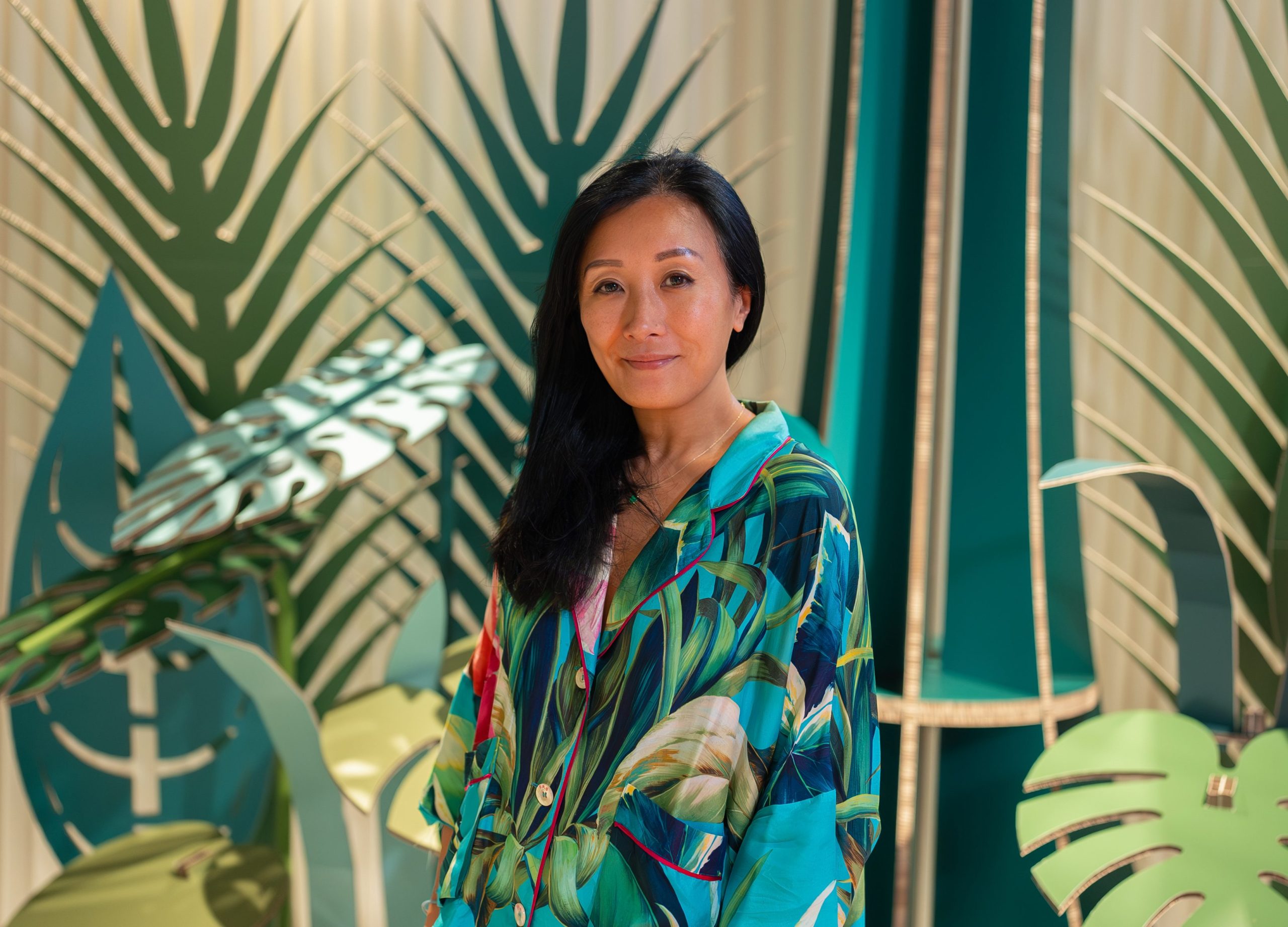
Artist Anita Lam didn’t set out to reinvent the zoo, but after reading John Berger’s Why Look at Animals?, she found herself rethinking the joy they’d once brought her. Questions began to take shape in her mind: What does it mean to confine an animal for human spectatorship? What do our structures of display say about how we view other species and ourselves? These and other inquiries eventually gave rise to “Happy Zoo,” a conceptual art series developed through ALAN (Artists who Love Animals and Nature), the Hong Kong–based nonprofit Lam co-founded and now directs.
There are no cages in Lam’s zoo. No bars or barriers between ‘us’ and ‘them’. And no living creatures on display. Instead, each iteration of the adaptive multimedia xhibition—”BLUTOPIA” in 2023, “Spirit of Sumatra” in 2024, “Wild Togetherland” currently on view at GATE33 Gallery in Hong Kong and “Snowmelt,” which is in development—exists to invite empathy with animals in nature and in human-built environments. At the heart of “Wild Togetherland” is an intriguing question: Where do we belong in the ecosystem of a city?
Lam’s work sits at the intersection of art, ecology, technology and philosophy, but far from being overly academic or depressingly pessimistic—as environmentally focused art shows often are—her approach is playful and, at times, mischievous. Collaborating with artists like Ruby Maky, Stickyline and Carnovsky (Francesco Rugi and Silvia Quintanilla), she builds exhibitions that encompass everything from immersive installations and playable video games to sculpture and interactive works.

There are no dry manifestos printed on the walls, no proclamations of doom. She’s not here to scold or convert. Instead, “Happy Zoo” nudges visitors toward ecological awareness through whimsy, novelty and play because, for Lam, emotional connection is the first step toward behavioral change. In “Wild Togetherland,” stories of urban animals pushed to the margins of human life illustrate how people might better coexist with other species, and many works in the exhibition—including The Collective’s interactive game Toilet Training and Stickyline’s Urban Animal Fables—use humor to expose the absurdity of expecting animals to conform to human-imposed order. Observer caught up with Lam to learn more about the exhibition, how “Happy Zoo” has evolved and why finding common ground with animals matters now more than ever.
ALAN stands for “Artists who Love Animals and Nature.” Broadly, what responsibility do you feel artists bear when it comes to environmental issues?
I think being environmentally conscious is something we all share responsibility for—it’s not just one group or profession. That said, artists have a special role to play. We’re naturally expressive, and we tell stories through what we create. There’s often a lot of emotion, experiences and warmth in art, and that makes it a powerful way to connect with people. Rather than telling the public what they should or shouldn’t do, art opens up space for reflection. It invites curiosity and encourages people to think for themselves. When someone feels emotionally connected, understanding grows naturally, and from that place, people can make their own choices.
Environmental issues are complex, and there isn’t one right way to approach them. Art allows us to explore those complexities, to think differently and to imagine new possibilities. At its heart, it’s about creativity—about stepping outside the usual frameworks and offering room for thought, dialogue and change.
What inspired the “Happy Zoo” exhibition series?
Both Andy, the co-founder of ALAN and I have always loved animals. Growing up, we spent a lot of happy time in zoos and aquariums—it was our way of feeling close to them. Those places are filled with childhood memories, family outings and a sense of wonder, so it’s not easy to suddenly question that experience.
A turning point for me was reading Why Look at Animals? by John Berger. One line really stayed with me: “Everywhere animals disappear. In zoos, they constitute the living monument to their own disappearance.” It made me pause and see zoos from a completely different perspective. It wasn’t about rejecting those memories, but about questioning how our culture, our values and our relationship with animals have been shaped over time. At its core, it became a reflection on humanity itself.
I started to see our relationship with animals as a starting point—a lens through which we could look more deeply into humanity and into the more philosophical aspects of how human nature and development are connected. That’s when a simple but challenging question began to form in my mind: can we reimagine the future of a zoo?
Then the pandemic happened, and it became a shared global experience of confinement. Many people struggled mentally and emotionally, and for the first time, we could truly feel what captivity is like. At the same time, nature began to recover as human activity slowed down. That contrast stayed with us. It felt like an important moment to reflect and perhaps the right time to introduce “Happy Zoo.”
“Happy Zoo” isn’t about copying a traditional zoo or recreating nature through technology. Instead, we use art and interactive technology to explore new ways of reconnecting humans and nature—through emotion, imagination and curiosity. It’s about asking questions rather than offering fixed answers. Hong Kong is a small city, and land is always limited. So instead of building a massive zoo, we approach “Happy Zoo” one chapter at a time, each focusing on different themes and ideas. This way of working has brought unexpected benefits—it makes the project more flexible, scalable and adaptable to different cities and communities, while allowing us to keep learning as we go.
This is the third installment in the series. How has the vision evolved since the first show, and what new territory are you exploring with “Wild Togetherland”?
The first two chapters were more geographically grounded—one focused on the ocean, the other on the rainforest. They allowed us to explore specific ecosystems and the beauty and fragility within them. As we began shaping this new chapter, we paused and asked ourselves: if we’re creating this journey from scratch, why should we follow the layout or logic of a traditional zoo at all? That question opened up new directions. We started looking toward more complex and sometimes uncomfortable topics—ones that feel much closer to our everyday lives.
“Wild Togetherland” focuses on wildlife in the city. It’s a global issue, but it plays out locally, differently in every place. As cities continue to expand, encounters between humans and wildlife become more frequent. Sometimes those encounters are beautiful, but more often, they turn into conflict. This led us to think more deeply about power and imbalance in the societies we share—who holds space, who is given a voice, who is considered a minority and who is silenced.
Urban wildlife becomes a quiet mirror. It gently asks us to reflect on our role in this shared environment—who we are today and who we want to be going forward. “Wild Togetherland” is not meant to give answers, but to offer a shared space: a place to shift perspective, to start conversations or simply to spend time and experience the work.

Many of the works use play, absurdity and silliness to provoke reflection. Why do you feel it’s important to strike a balance between humor or joy and urgency when addressing serious environmental themes?
We’re very aware that the world already feels heavy. Many people are overwhelmed by daily pressures, constant information and ongoing crises. In that context, we see humor as an invitation. Something light can open a door where something serious might push people away—especially when the topic itself carries weight.
For us, laughter is a way to draw people in, absurdity sparks curiosity and makes space for engagement. Once curiosity is there, people often want to look closer, ask questions and stay with the work a little longer. Staying curious keeps us open and alive. That sense of play and openness sits at the core of our creative approach.
Can finding empathy with animals within ourselves reframe how we relate to each other as humans?
That’s a really important question, and in many ways it goes straight to the heart of what “Happy Zoo” is about. I often think of a quote by Gandhi: “The greatness of a nation and its moral progress can be judged by the way its animals are treated.” Animals are the silent majority, and the way we share this planet with them becomes a mirror of how we function as a society. Humans have shaped most of the world into cities. Many wild animals simply can’t adapt to these environments—just as most humans couldn’t survive in the wild. In that sense, animals represent those with less power in a shared system, while humans have become the powerful minority on this planet. Life has never been completely fair or equal and maybe it never will be—but it can be more just.
When we lose awareness of these power dynamics, especially as we redesign the world to be increasingly human-centric, it raises deeper questions. Are we unknowingly accepting a system where only the strongest or most adaptable get to thrive? This kind of mindfulness doesn’t only apply to how we treat animals—it reflects how we relate to one another as humans as well.
As technology continues to advance, empathy becomes even more essential. Knowledge and technology are not the problem; they are tools. What truly matters is how we choose to use them and that requires consciousness. With A.I. developing at a speed we’ve never experienced before, its potential to help or to harm is immense. Without empathy, it’s easy to slowly lose awareness—like frogs in warming
For me, empathy and consciousness are not abstract ideas; they are core human values. If we want to sustain ourselves—not just as individuals, but as a society—we need to actively hold on to them. Finding empathy with animals may be one of the most honest ways to remind ourselves how to care for each other.
How did you select the participating artists and collectives? Was there a guiding principle or shared ethos that tied them together?
Each chapter begins with a clear theme, which gives us an overall structure and sense of direction. Within that framework, we look for artists with distinct voices, practices and ways of thinking. Rather than asking them to fit into a fixed format, we want their individuality to come through—while still sharing a common tone that feels playful, open and inviting. The only real consideration in our collaborations is quite simple and honestly not difficult to meet: that an artist’s past work does not involve harm or abuse toward animals or others. Ideally, they have a natural sensitivity toward animals and nature—but it’s not about whether they love animals. For us, it’s really about respect.
With that in mind, it’s been very meaningful to hear visitors describe our journeys as having warmth—having a kind of “temperature.” Not just depth or critical thinking, but something that feels human and emotionally present. We often think of the process like cooking. Each artist is an ingredient, bringing their own flavor and character. Our role as curators is like that of a chef—not to mask those flavors, but to understand how they work together. When the balance feels right, each artwork can stand on its own, yet something new emerges when they’re experienced together.
For example, our fourth chapter, “Snowmelt,” is an immersive theatrical circus journey premiering this April. It’s a performance-based experience created in collaboration with acrobats from different disciplines, exploring ideas of resilience and agility in nature. Just as nature develops its own “superpowers” to survive crises and change, we believe humans do too. Each of us carries hidden strengths that help us adapt to unexpected challenges. The goal isn’t uniformity, but chemistry. When the works begin to speak to one another, they form a layered journey—one that feels cohesive, while still honoring the richness of each individual voice.
Have you brought or would you consider bringing the “Happy Zoo” series to other urban geographies?
Yes. Absolutely. Bringing “Happy Zoo” to other cities is very much our long-term vision. Almost every city in the world has its own zoo or aquarium, and in a way, that shared structure became our starting point for imagining how “Happy Zoo” could travel. While the themes we explore are global, every city carries its own context, challenges and relationship with nature. That’s why local collaboration is important to us—as an added layer to our existing content. By working with local artists, collectives and communities, each chapter is enriched with new perspectives and can respond more directly to its surroundings, making the experience feel grounded, relevant and connected to place rather than simply transplanted.
In a sense, it’s a reversal of the traditional zoo model. Instead of moving animals across borders, we invite ideas, stories and artworks to travel. Through art, we create a kind of cultural exchange—one that celebrates diversity without captivity. Each city adds a new layer to the project, widening the spectrum and enriching the overall journey. If done well, “Happy Zoo” doesn’t just arrive in a city—it grows with it.
What advice would you give to young artists who want to engage with conservation but aren’t sure how to begin?
First, I really believe it starts with finding what you genuinely care about. Find the topic that moves you—something that feels truthful to your own experience and values. Without that connection, the work can easily become hollow. I once had an artist friend who said he doesn’t like seeing students make art about sustainability simply because it feels “correct” or earns them more recognition. Often, you can sense when there’s no real heart in it, and I think that’s very true.
What’s the point of creating work only to match what society expects or to collect approval if there’s no passion behind it? Art, at its best, should challenge norms and shift perspectives. I often tell my team that people can feel the difference—they can sense whether a work comes from the heart or is created just to exist. To truly engage with conservation, you have to care enough to observe deeply, to question and to understand before responding. From that place, you can raise meaningful questions or offer new perspectives, rather than simply repeating messages or creating something that feels like propaganda. Most of us already know, for example, that using plastic is harmful—but the real question is why and what complexities sit beneath that fact. There are always multiple sides to every story.
I also think this applies beyond conservation. Personally, while I care deeply about the natural world, I’m equally interested in exploring themes like power, bullying and politics within corporate culture—questions such as why “winners take it all.” These interests come directly from lived experience, and they shape how I think and create. For me, honesty in subject matter always comes before choosing a “correct” topic. Without genuine care and curiosity, the work risks becoming superficial—and audiences can feel that immediately. Passion isn’t just an added bonus; it’s the foundation.
More Arts Interviews


