

As California’s viticulture has matured—understood not merely as agricultural production but as a cultural, scientific and ecological practice—a generation of wineries in Sonoma and Napa began to reimagine the estate itself as a space where wine, hospitality and contemporary art could coexist, grounded in terroir-driven storytelling and aesthetic ambition. The Donum Estate was among the first to pioneer this convergence in a deeply intentional way, forging a sensory connection between land, wine and art.
The estate’s name—Donum, from the Latin for “gift”—reflects its ethos. Everything produced here is considered a gift of this extraordinarily fertile land that must be stewarded and protected. Its history traces back to Anne Moller-Racke, a German-born viticulturalist who came to California in 1981 and later led Buena Vista Winery, planting the estate’s original vines. When the family sold Buena Vista in 2001, they kept the Carneros vineyards and renamed the property the Donum Estate. In 2011, Danish entrepreneur Allan Warburg and his wife, Chinese-born art collector Mei Warburg, acquired the property and began transforming it into a site where contemporary sculpture and ecological stewardship would become inseparable from the wine experience.
While the estate’s viticulture has since earned acclaim—producing single-vineyard Pinot Noir and Chardonnay on over 200 hectares of regenerative organic land—what sets Donum apart is its world-class, open-air collection of monumental art. With more than 60 sculptures sited across its hills, it is now one of the largest accessible museum-grade private collections of outdoor sculpture in the world. These works are not static decor, but active participants in a living ecosystem, drawing on the land’s energy and shaping the visitor’s relationship to scale, time and movement.
That ethos of harmony extends beyond the vineyards. A regenerative organic-certified lavender field, olive grove, plum orchard and culinary garden compose a living laboratory of sensory and ecological exchange. Yet the art remains the emotional and spatial center of it all—quietly guiding the experience. What began as a vineyard has evolved into a rare cultural landscape, where sculpture and soil shape one another in real time. Donum is less a winery with art than an open-air museum embedded in the land, where every element—natural and made—serves the same purpose: to cultivate a deeper attunement to beauty.

“It’s about the energy that emerges from the interplay between art and the land,” said Angelica de Vere Mabray, CEO of the Donum Estate, when Observer visited during FOG Design + Art. (Located just over an hour from San Francisco, the estate should be an essential stop for any art enthusiast visiting Fog City.) This year, for the first time, Donum officially partnered with the fair and SFAW, underscoring its commitment to supporting art and culture across the Bay Area.
De Vere Mabray welcomed us to the art-filled Donum Home, the estate’s hospitality center, which was redesigned and renovated by award-winning Danish architect David Thulstrup. Its light-filled interiors blend Scandinavian sensibilities with Eastern harmony, all rooted in California’s materials and natural beauty.
Greeting visitors at the entrance is a towering Yayoi Kusama Pumpkin. Inside, major works from the collection appear throughout the space: an expansive tapestry by El Anatsui flanks the wine display, while overhead, a floating “cloud ceiling” by Tomás Saraceno hovers beside Jeppe Hein’s colorfully playful balloons. A large canvas by Liu Xiaodong anchors a grouping of works by prominent Chinese artists from the post-Tiananmen generation, including Yue Minjun and Zhang Huan. In another room, a glass cylinder encases Ai Weiwei’s hand-painted Sunflower Seeds—originally created for his iconic Turbine Hall commission, in which he filled the space with more than 100 million individual porcelain seeds to draw attention to the artisanal labor behind mass production and the mythology of conformity in China.

Beyond expansive glass doors, the estate’s lush greenery foregrounds California’s mountains and San Francisco Bay, in a landscape punctuated by monumental artworks. On the terrace, a pink-tinted polyurethane fountain by Lynda Benglis flows with shifting currents, its organic form constantly in motion. Farther down the path, a head by Jaume Plensa towers, while a more recent work by William Kentridge appears downhill in dialogue with Zhang Wang’s Artificial Rock No. 28.
Dated 2001, Zhang’s sculpture was the first installed at the Donum Estate. The artist used stainless steel to create a handmade, three-dimensional rubbing of natural Jiashan stone, embodying a tension between organic formations and human-made imitations. “That connection is really intentional. The ideas of healthy soils, regenerative agriculture, responsible stewardship and farming are core to our belief system. They’re deeply integrated into how we think about the art, the wine and everything else at Donum. All of it reinforces that bond between the land and the experience,” emphasized de Vere Mabray.
Allan and Mei Warburg now live full-time in Hong Kong, while maintaining homes in Beijing, Shanghai and San Francisco. Allan Warburg, born in Denmark, frequently traveled to Asia with his parents and studied Chinese in college before enrolling at Yunnan University. He began his career in the trading industry, ultimately settling in China, where he met Mei. The two shared a passion for both art and wine and began collecting early—particularly works by the emerging Chinese artists of the time. “When they purchased Donum, they brought that first work by Zhang Wang with them, without any concrete plan to build what would eventually become one of the world’s most significant contemporary sculpture collections,” de Vere Mabray said. “Everything else unfolded organically from there.”
The estate was originally founded in 2001 as a winery, with no plans for hosting visitors. It wasn’t until nearly a decade later, as artworks began to arrive, that the property began evolving in a new direction. The Warburgs started collecting large-scale sculpture in 2015, and soon after, they began intentionally dedicating works to the estate, collecting not just for themselves but for the land and its future. Still, it was only in 2019, with the arrival of de Vere Mabray as CEO, that art became strategically embedded in Donum’s identity. “We start thinking much more intentionally about programming and how people experience Donum not just through wine, but through the intersection of art, land and place,” de Vere Mabray explained. “At that point, the collection comprised around 40 works; today it has grown significantly, and continues to shape how the estate is experienced.”

Today, it’s home to nearly 60 artworks, with new additions installed at an irregular pace, depending on the artists’ schedules and production timelines. Nearly half the pieces are site-specific commissions by artists who’ve spent time on the property, engaging with its environment and responding to the land. The curatorial direction is guided not by an external consultant or brand identity, but by the Warburgs’ taste, affections and personal relationships with the artists.
Although they’ve kept a low profile and chosen not to brand the collection under their name, the Warburgs still make all key decisions. “In most cases, they’ve built real friendships with the artists, who are involved in choosing the precise location of each work,” de Vere Mabray said.
She gestures to a sculpture by William Kentridge as a clear example. “He came to Donum a few years ago with his wife while he was at Berkeley for a symposium. He walked the property, spent time here and chose this specific location for the work,” de Vere Mabray recounted. “That’s generally how it happens. When they acquire something, there’s a real conversation with the artist about where it belongs and where the energy is right.”
Before venturing deeper into the green hills of the estate, we stop at a pavilion dedicated to Louise Bourgeois’s iconic Crouching Spider. This particular work is one of the few the artist created using metal construction materials she gathered in New York before fusing and welding them by hand. Due to its sensitivity, the sculpture requires an indoor, climate-controlled environment for proper preservation. In the same room, her The Mirror presents a distorted reflective surface, seemingly devoured by the vital interplay of predator and prey, winner and victim—the very dynamics that shape every ecosystem.

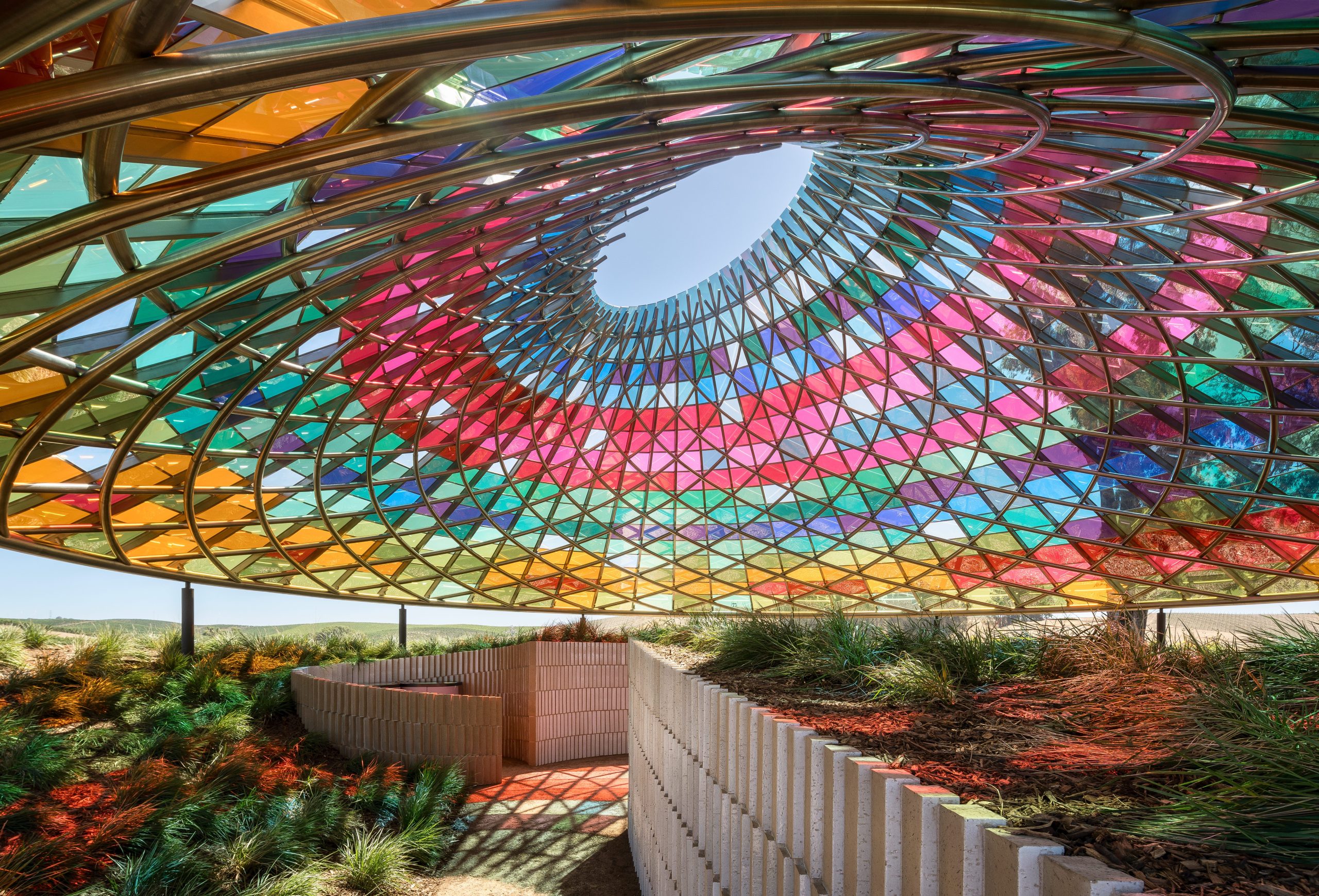
Just outside, Mikado Tree by Pascale Marthine Tayou rises from the landscape. Another signature site on the property is the Vertical Panorama Pavilion, conceived by Olafur Eliasson’s studio in collaboration with architect Sebastian Behmann. An immersive architectural and emotional experience, the rainbow-hued structure functions as a multisensory instrument—inviting visitors to reconnect with nature and recalibrate to its rhythms. Its conical canopy acts as a kind of calendar, centered on a north-facing oculus and glazed with 832 laminated glass panels in varying hues. Each panel corresponds to data gathered at the estate by Eliasson’s design studio, representing annual averages of solar radiation, wind intensity, temperature and humidity.
“His studio flew from Berlin to install it. A concrete pad was poured here; the work was fabricated and assembled in Berlin, then brought to Donum and reconstructed on site,” de Vere Mabray shared. “Olafur was standing right here with Sebastian Berman, and he pointed out that when you stand here, you’re shoulder-width apart, fully grounded—literally planted in the earth. You have a 360-degree view, and while you’re standing here, you can smell the soil, hear the grasses moving, and hear the birds. It’s deeply immersive and completely rooted in this place.”

Indeed, much of the art is organically and symbiotically rooted within the land. A particularly moving example is the estate’s Sensory Garden, which has been completely reimagined through Yang Bao’s immersive multisensory installation HYPERSPACE. Designed to blend seamlessly with the natural environment, the work responds to and converses with its surroundings: encircling a central pyramid, nine sculptural elements generate a spatial soundscape—a site-specific composition by Bao that shifts with wind, temperature and humidity.
Donum grows three lavender varietals, and each summer, an entire hillside blooms into an ocean of purple. Originally, the estate’s lavender was planted on the very site where Bao’s installation now stands. But repeated failures led the Donum team to consult botanists who diagnosed Phytophthora—a soil-borne pathogen that attacks lavender roots coping with poor drainage. Instead of fighting the land, the team relocated the lavender to higher ground, where it now thrives. The cleared site became the foundation Bao—who is both a chemist and a composer—used to reimagine the terrain, helping it heal through art.
There’s a spiritual dimension running through many of the artists’ installations at Donum, according to de Vere Mabray. One such work is Doug AItken’s Sonic Mountain (Sonoma), located in the Eucalyptus Grove. Measuring 45 feet in diameter and composed of 365 chimes—one for each day of the year—the sculpture is a living instrument activated by the Carneros breeze, one of Donum’s most persistent natural forces. While Aitken has engaged environmental themes in recent projects—most notably in his 2025 exhibition at Regen Projects—this installation marks a subtle and unexpected shift. Rather than addressing ecological urgency through overt imagery or a conceptual framework rooted in institutional critique, the artist operates here in a more spiritual register, privileging sensation and attunement.

The land speaks to the art just as the art speaks to the land—there’s a clear dialogue between the two. “It’s incredibly powerful, De Vere Mabray said. “That’s really what we hope people take away: an understanding of that possible exchange of energy between art and landscape.” Seen in person, sculptures feel embedded in their environment, not simply installed on it. Rather than functioning as a curated series of standalone works, the collection operates as part of a larger, site-specific system in which form, material and placement respond directly to the terrain.
This sense of integration runs throughout the estate. Sculptures are situated with intention—some echoing the contours of the land, others drawing attention to its shifts in light, texture or scale. The same attention applied to cultivating Pinot Noir and Chardonnay is visible in how artworks are commissioned and positioned. The result is not just aesthetic harmony, but a layered visitor experience that bridges visual art, agriculture and landscape. Here, art doesn’t compete with the landscape, and the landscape doesn’t merely serve as a backdrop. Each reinforces the other, creating a rhythm of encounter that feels designed to sharpen awareness—not just of the estate, but of the viewer’s own place within it.


