

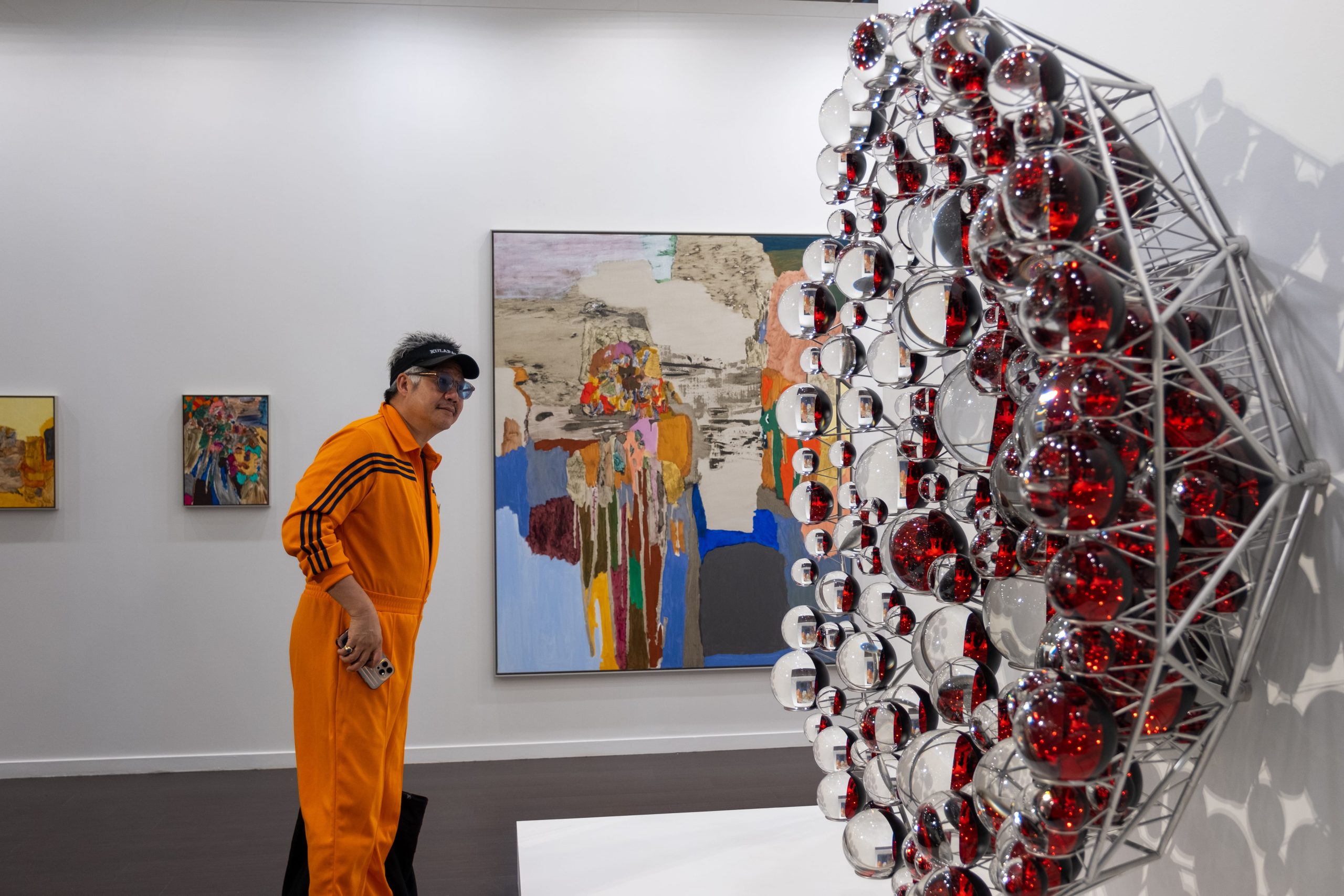
Visiting India Art Fair on the heels of Art Basel Qatar made the latter feel, in hindsight, as though it had failed to deliver on its original promise—leaning too heavily on the comfort cushion of international blue-chip galleries at its main venue and relegating regional discoveries to a peripheral role, despite emphasizing the importance of the region. In contrast, visiting India Art Fair is, first and foremost, an exercise in humility—acknowledging how much you don’t yet know, offering a broad enough view of a vibrant scene and being willing to learn. From there, one is carried into an ecosystem that is both remarkably dynamic and genuinely welcoming, eager to share just how much is happening on the ground. One quickly learns that, despite its internal complexities, India’s art scene is now so self-reliant that, at least from a market perspective, it no longer needs validation from abroad.
As India’s economy continues to grow—expanding at roughly 8 percent annually and emerging as one of the world’s fastest-growing major economies—recent trade agreements with the U.S. and Europe are helping lower barriers and expand market access. Its rapidly evolving art scene and cultural industries are well positioned to sustain that upward momentum. “You can’t really separate the art market from everything else. It’s all very symbiotic. The economy is doing well, there’s a housing boom, people are building homes, and the domestic market is strong,” the fair’s director Jaya Asokan told Observer. “We’re not reliant solely on the international market—because the domestic one is very solid. For this fair, for instance, we have collectors coming from very small cities all across India. They’re extremely wealthy, and they come here.”
According to data from the Hurun India Art List 2025, works by the country’s most successful artists registered record sales of ₹310 crore (about $37 million), marking a moderate 3 percent year-on-year increase. Auction sale volumes also rose sharply, with 995 lots sold—up 26 percent year-on-year. And while Anish Kapoor maintained the top position, 78 percent of featured artists saw their cumulative sales value rise.
After learning in a recent interview with leading gallerist Rishini Vadhera that the number of galleries on their street alone had grown from four to fifteen in just one year, we set out to see firsthand what was happening. What we found was a market rapidly professionalizing, consolidating an increasingly layered ecosystem of players at different levels and becoming more self-sufficient as its collector base expands through multigenerational patrons, who hosted some of the week’s most sumptuous festivities, and new audiences discovering contemporary art for the first time.

India Art Fair has just closed its 17th edition at NSIC Exhibition Grounds in New Delhi. When Observer visited on the first public day, the fairground was in full swing, with a constant flow of visitors from morning to evening—not just browsing and socializing, but actively engaging, asking about the art as much as about prices and availability, even as many works had already sold during the preview.
As a first-time India Art Fair attendee, and a first-time visitor to the country more broadly, I was struck by the prevalence of English in conversations across the fairground. India officially recognizes 22 major languages alongside hundreds of regional ones—Hindi, Tamil, Telugu, Bengali, Marathi, Malayalam, Punjabi, Gujarati, Kannada and many more. English serves as a bridge language, eliminating barriers that can exist at other regional fairs and making India Art Fair especially accessible to international visitors, particularly curators and museum directors. This year, representatives from institutions such as the Munch Museum in Oslo and LACMA were among those spotted. The timing also coincided with the Kochi Biennale, helping boost attendance, as many were heading there next to catch a Marina Abramović performance. But the reality is that India’s art market is, at this point, entirely self-sufficient and no longer reliant on international buyers, supported instead by a strong and expanding base of domestic demand.
Circulating among booths and comparing figures, we quickly understood the fair’s formula for success: there is something for every pocket, from promising young artists priced under $1,000 to six- and seven-figure works by local masters and internationally established names. “I think the evolution of India’s art market—especially over the last ten years—has really reached an inflection point: international attention on South Asian art has reached new highs and India Art Fair meets that moment. Indian artists are now being recognized on a global scale,” Asokan noted. “From the very beginning, the art fair played a pivotal role in creating a platform and building a structure around it. We were instrumental in bringing together not only galleries but also institutions,” she added, noting how this groundwork helped drive the market forward in a cohesive way, commercially and otherwise. Today, the results are visible: Mumbai and Delhi have expanding gallery districts of their own, while other centers are emerging, including Bangalore for digital art and Kochi through the ongoing impact of its Biennale.
With 94 galleries and 24 major art institutions participating, India Art Fair now offers one of the most comprehensive snapshots of the country’s diverse artistic voices and regional scenes, alongside its growing global reach. This is underscored by the rising presence of international galleries—among them Galleria Continua, neugerriemschneider, the design-focused Carpenters Workshop Gallery and, for the first time, David Zwirner—all of which have developed relationships in India through the artists they represent or the collectors they’ve cultivated.

Yet India Art Fair is intentionally structured to remain predominantly regional, maintaining an 80-20 balance rather than pursuing a more international tilt. “The beauty of our fair is that it’s fundamentally a regional fair, and that’s something we want to protect,” the fair’s director said, acknowledging that this year they had around 30 international galleries and institutions, and from what she heard, they’ve all done well from the very preview day. “There is clearly an appetite now also for collecting internationally.”
Zwirner brought a spiritually charged, symbolically layered booth featuring works by Marcel Dzama and Chris Ofili, alongside the timeless totemic energy of Huma Bhabha and, of course, an iconic Infinity Dots painting by Yayoi Kusama—works that resonate with India’s rich mythological and religious imaginaries through transcultural parallels. The gallery’s debut at the fair paid off, resulting in a number of sales, including two sculptures by Huma Bhabha, a painting by Suzan Frecon and a photograph by Wolfgang Tillmans.
Nearby, Galleria Continua presented one of the fair’s most expansive booths, pairing leading Indian artists they represent—including Shilpa Gupta, Nikhil Chopra and Anish Kapoor—with large-scale works by international figures such as Daniel Buren, Michelangelo Pistoletto’s mirror pieces and Ai Weiwei. Directly opposite, neugerriemschneider also mounted a notably large booth, foregrounding Ai Weiwei at a moment when the artist is concurrently showing at Nature Morte, alongside paintings by Andreas Eriksson.
Returning to India Art Fair, Carpenters Workshop Gallery experienced particularly busy days, with London-based senior sales director Henri Charreau describing the presentation as “a real success,” citing strong sales across the booth. While India has long demonstrated a deep appreciation for design and craftsmanship, today’s collector base is increasingly drawn to international vocabularies that reflect a more global outlook and taste. Despite the fair having a section dedicated specifically to design, the gallery chose to exhibit within the main section, underscoring its longstanding commitment to challenging conventional distinctions between art and design by deliberately blurring the boundary between form and function.
Reinforcing its strong relationship with the country as a two-way exchange, the booth also featured works by Indian artists and designers, including the digital art duo Thukral & Tagra, who recently joined the gallery’s roster, alongside Ashiesh Shah’s debut of his Kumbh Mirror. The presentation was further strengthened by a tightly curated selection and the presence of Nacho Carbonell, whose work has long been a favorite among Indian collectors.

Fair newcomer Saatchi Yates presented a focused booth centered on Marina Abramović, showcasing works from her 1988 portrait video series—here displayed for the first time as two-dimensional prints in unique frames. Coinciding with Abramović’s high-profile appearance at the Kochi-Muziris Biennale, the presentation was extremely well received. With prices ranging from $25,000 to $50,000, the edition was reported to be nearly sold out, including an institutional placement with a local museum.
Also debuting at India Art Fair but engaged with the scene since its inception, Rajiv Menon curated a resonant conversation between artists from India’s diaspora, including Melissa Joseph, Sahana Ramakrishnan, Rajni Perera, Shyama Golden, Maya Seas, Devi Seetharam and Nibha Akireddy, alongside the Indian debut of Gisela McDaniel. The booth immediately drew attention for its vibrant chorus of heterogeneous practices, led by color, expressiveness and strong narratives around identity, memory and belonging across geographies. By the end of the first preview day, only one work remained. Buyers included both domestic and international collectors, with sales ranging from $5,000 to $35,000—most falling between $10,000 and $20,000. Five works were placed with Indian institutions, which Rajiv Menon confirmed were particularly active throughout the fair. “India Art Fair is not just a commercial platform, but a summit on India’s contemporary visual identity. Galleries and institutions in the region are actively building and pushing the country’s culture, and it’s an honor to participate,” he said. The enthusiasm for work from the diaspora underscores how art functions as a global bridge—and how eager Indian collectors are for new international perspectives.

Long functioning as a bridge between India’s vibrant artistic production and the broader international art scene, Aicon Gallery has been active for about 20 years, operating globally from its New York and London locations. At India Art Fair, the gallery presented a group of established modern and contemporary masters from India. One wall was dedicated to women modernists, anchored by a striking work by B. Prabha (born 1933), paired with two pieces by Achuthan Ramachandran. Prabha’s painting sold for around $100,000. Also on view was work by Satish Gujral, one of the most significant figures in Indian modernism, whose six-decade career spanned art, architecture and public culture. His painterly language was deeply shaped by an early period in Mexico—encouraged by Octavio Paz, then ambassador to India—where Gujral became close to Frida Kahlo and worked alongside Diego Rivera and David Alfaro Siqueiros. That experience informed the expressive palette and monumental sensibility that define his work. The gallery swiftly placed one of his paintings in the $70,000-80,000 range, buoyed by strong institutional visibility tied to his concurrent exhibition at the National Gallery of Modern Art, which opened the same week.
Doubling down, Aicon Contemporary—the gallery’s newer branch dedicated to contemporary artists—featured what was likely the most expensive work at the fair: a monumental and historically significant painting by M.F. Husain, Goopy Gyne Bagha Byne (Homage to Satyajit Ray), 1990, priced at $5 million. The presentation followed Husain’s $13.75 million record at Christie’s South Asian Modern and Contemporary Art auction in New York in March 2025. Widely regarded as India’s pre-eminent post-independence painter, Husain dedicated the work to Satyajit Ray, the most critically acclaimed Indian filmmaker of the same period, on the occasion of Ray’s Oscar recognition. The extended canvas format evokes a cinematic screen, creating a life-size encounter with its playful figures. Husain frequently drew inspiration from Ray’s films; in this case, the reference is to Goopy Gyne Bagha Byne, the first film in Ray’s iconic Goopy-Bagha trilogy, sharing the same sense of playfulness and vibrant palette.

The most compelling presentations, however, were arguably those mounted by Indian galleries, which offered ample opportunities to engage with established names and to discover emerging practices. Delhi-based Vadhera presented an overview of its dynamic program, featuring a wide range of works priced from $6,000 to $600,000. By the end of the first day, 80 percent of the booth had sold, including works by Atul Dodiya, N.S. Harsha, Manjit Bawa, Anju Dodiya and Sudhir Patwardhan, among others. While some sales were presales to collectors who had already expressed interest—underscoring once again the momentum of the current market—the gallery also secured institutional acquisitions, including one for the forthcoming Kiran Nadar Museum of Art, India’s largest private art museum, as it prepares to open a new 100,000-square-meter campus designed by David Adjaye Associates. Just a week earlier, it was announced that Manuel Rabaté, the inaugural director of Louvre Abu Dhabi since 2016, will assume leadership of the museum—a move that signals India’s growing institutional stature on the international art stage.

Another particularly active institution featured in the fair’s dedicated section was MAP Museum of Art & Photography in Bengaluru—now a leading museum in India’s growing Silicon Valley and home to a collection spanning nearly 2,000 years, from 2nd-century artifacts to contemporary art across painting, sculpture, textiles, photography and popular culture. Spread across six floors, the museum integrates exhibition spaces with research, conservation and digital initiatives. At the fair, MAP presented a project developed as part of “Impart,” its digital art and research platform reimagining access to South Asian art histories, demonstrating a pioneering commitment to supporting the most recent practices—including those emerging in tandem with the country’s technology-led development.
On the digital front, one of the most active presences among both established and emerging contemporary galleries was Nature Morte, which exhibited new works by Thukral & Tagra from their ongoing Arboretum series, recently shown at SCAD MOA. The project explores the increasingly porous boundaries between online and offline existence and the behavioral norms shaped by that overlap. Executed in photo-realistic detail, the works are conceived as a speculative arboretum: trees glitch, fold in on themselves or dissolve into pixels, while abstracted figures linger behind foliage, observing the viewer in return. In doing so, the paintings deliberately slow perception, stretching time into contemplation and rendering flowers as a near-devotional act—an antidote to the acceleration typically imposed by digital systems.


The reactivation and reinvention of tradition emerged as a recurring theme throughout the fair, exemplified by Sanket Virangami’s miniature-inspired, playful vertical storylines of contemporary life. Presented by Delhi-based Gallery Latitude 28 in a curated booth titled “Negotiating the Real,” works priced between $6,000 and $8,000 sold at the opening.
In the Focus section, the gallery also presented a solo booth by Khadim Ali, an artist of Hazara origin based in Sydney with an extensive exhibition history that includes the Venice Biennale. Drawing from miniature painting and carpet-weaving traditions, Ali interlaces epic narratives such as the Shahnameh with contemporary events and the lived experience of exile. One of his dense textile installations currently occupies a prominent position at the entrance of “Empire of Light: Visions and Voices of Afghanistan” at the Museum of Islamic Art in Doha—one of the must-see exhibitions during Art Basel Qatar.
When we spoke with the gallery’s founder, Bhavna Kakar, she confirmed that this edition of the fair had been exceptionally strong for the Delhi-based gallery, now in its 15th year of operation. “Across both our presentations, we have seen robust sales, sustained engagement from collectors, and significant interest from institutions and curators,” she told Observer, noting institutional interest in Ali and several sales of works by Pratul Dash, Juhika Bhanjdeo, Yogesh Ramakrishna and Sanket Virangami in the main booth. “The fair has been an important moment of visibility and validation for our programme, strengthening existing relationships while opening new institutional dialogues that we look forward to developing beyond the fair.”
More ambitious installations were concentrated largely in the Focus section. Among those that stood out was Rukshaan Art’s solo booth dedicated to Girjesh Kumar Singh, exploring themes of impermanence, displacement and human resilience. Using bricks salvaged from demolished buildings, Singh transforms remnants of former homes into sculptural “addresses,” each reflecting the provisional nature of dwelling and identity while questioning dynamics of labor and wealth distribution.

The unequal distribution of resources and the overexploitation of labor emerged as recurring themes across the fair, alongside reflections on ecological crisis and efforts to reattune to ancestral rituals of care. A cluster of booths near the end of the main pavilion focused on contemporary practices by Indigenous communities across India—reflecting growing institutional interest in Indigenous Indian art and a market expansion that aligns with broader international trends. Among them, Inherited Arts Forum—a collaborative platform founded by the directors of Blueprint 12 and Exhibit 320—presented a group exhibition of Indigenous practices characterized by dotted visual languages, with works by artists Bhuri Bai, Balu Jivya Mashe, Mangala Bai Marawi, Suraj Chawla and Vijay Sadashiv Mashe. Much like the more widely known tradition of Australian Aboriginal painting, these practices originate from ritual acts of cosmic connection, articulating resonances between micro and macro cosmos.
Another key participant was New Delhi–based Ojas Art, founded in 2015 by Anubhav Nath, who that same year launched an annual tribal art prize in collaboration with the Jaipur Literature Festival. Ojas presented a three-generation display of Muria Mandavi artists—Belgur Mandavi, Pisadu Ram Mandavi and Pandi Ram Mandavi—whose playful visual languages are deeply rooted in forest memory and ancestral storytelling. Their works are ancestrally powerful and timeless, shaped by ritual, nature and lived experience. Several of these artists were first identified through Bharat Bhavan, a highly influential state-sponsored initiative focused on recognizing and training artists from remote tribal regions across India.

Overall, visiting India Art Fair is not only refreshing—it prompts broader reflection. While the Western art market continues to struggle under the weight of its inherited structures, regions such as South Asia—with India at the forefront—are experiencing dynamic growth, propelled by expanding economies and evolving audiences, all while maintaining a deeply rooted and diverse relationship with ancient artistic traditions.
Asokan described India Art Fair as entering a phase of consolidation after 17 years of steady growth, mirroring the broader maturation of the market. The priority now is not expansion for its own sake, but refinement—presenting what has already been built at the highest level and deepening support for artists through targeted initiatives. One such effort is the fair’s artist-in-residence program, which offers physical space to a small group of unrepresented practitioners. While India Art Fair already benefits from a strong internal market and does not depend on external validation, she suggested that greater international engagement by institutions, curators, journalists and collectors would help place Indian artists on a more level global playing field and allow the depth, complexity and sophistication of the scene to be recognized at the level at which it already operates.


