

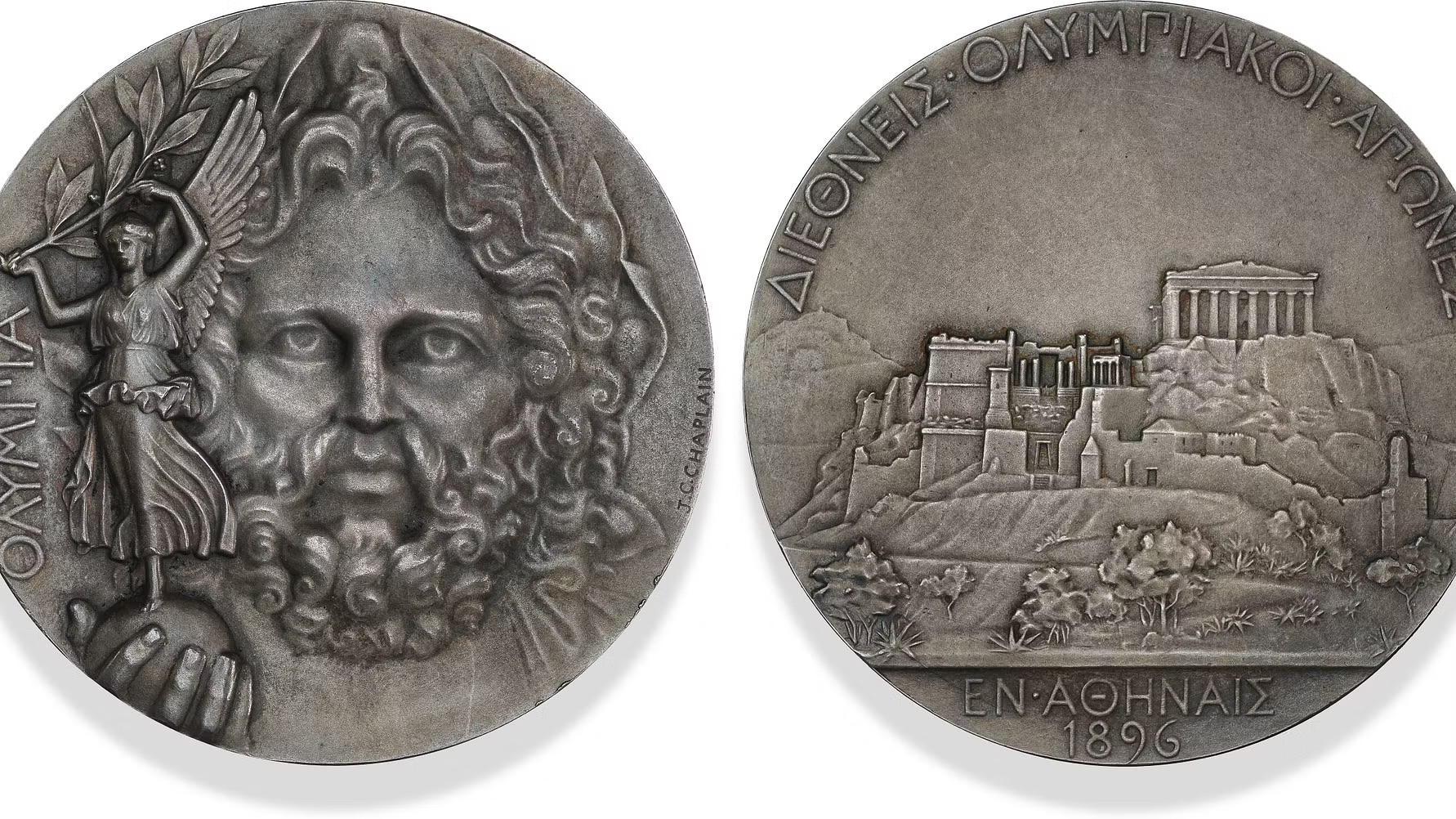
As the 2026 Winter Olympics command global attention in Milan and Cortina d’Ampezzo, a quieter but historically charged moment is unfolding a few nations to the north. Denmark’s Bruun Rasmussen is bringing to auction a first-place silver medal from the 1896 Athens Games—the first Olympics of the modern era. Objects from the inaugural Olympics surface rarely, but when they do, they carry a weight that extends far beyond sports memorabilia into cultural and institutional history.
The medal’s importance begins with what the 1896 Games represented. After the ancient Olympics were abolished in 393 C.E. by Emperor Theodosius I after more than a millennium of competition, the tradition lay dormant for more than 1,500 years. Their revival in Athens under the stewardship of Pierre de Coubertin and the then newly formed International Olympic Committee was an ambitious experiment in internationalism. The Games of the I Olympiad brought together 241 athletes from 14 nations, competing across nine sports and 43 events. Though the participants in the 1896 summer Olympics were all male, overwhelmingly European and predominantly Greek, the medal up for sale is nonetheless a surviving witness to a momentous historical moment that laid the groundwork for the Olympics as we know them today.
Created by French engraver Jules-Clément Chaplain and minted by the Monnaie de Paris, the medal’s design drew on classical imagery to anchor the modern Games in ancient precedent. Zeus appears on the obverse, crowned with laurel and holding a globe topped by Nike, while the reverse depicts the Acropolis and Parthenon, paired with a Greek inscription naming the International Olympic Games of Athens 1896.

Notably, in 1896, first-place finishers received silver medals and second-place finishers took home bronze. The familiar gold-silver-bronze hierarchy would not be introduced until 1904 and was only later applied retroactively. As a result, these first-place silver medals occupy a unique position: they are winners’ medals from before Olympic standards had hardened into tradition, making them fundamentally different from those that followed. “Such medals are exceptionally rare, and for collectors of Olympic memorabilia, this is nothing short of a crown jewel,” Christian Grundtvig, head of coins and medals at Bruun Rasmussen, said in a statement.
Auction results show strong demand for medals and other memorabilia from the earliest modern Games, with examples comparable to the medal going on the block achieving six-figure prices. In 2024, an 1896 first-place silver medal fetched nearly $112,000 at an auction dedicated to Olympic memorabilia held by RR Auction. In 2014, another 1896 medal (paired with an original postcard from the inaugural games) sold for $245,873 at Sotheby’s in London—possibly the highest price ever achieved at auction for such an artifact. Offered with a modest presale estimate of €26,000-40,000, the Bruun Rasmussen medal arrives at a moment of heightened Olympic awareness. While it’s unknown to whom this particular medal was awarded, it’s nonetheless a tangible link to the origins of an institution that has come to define global sport.
More Olympics coverage:

