

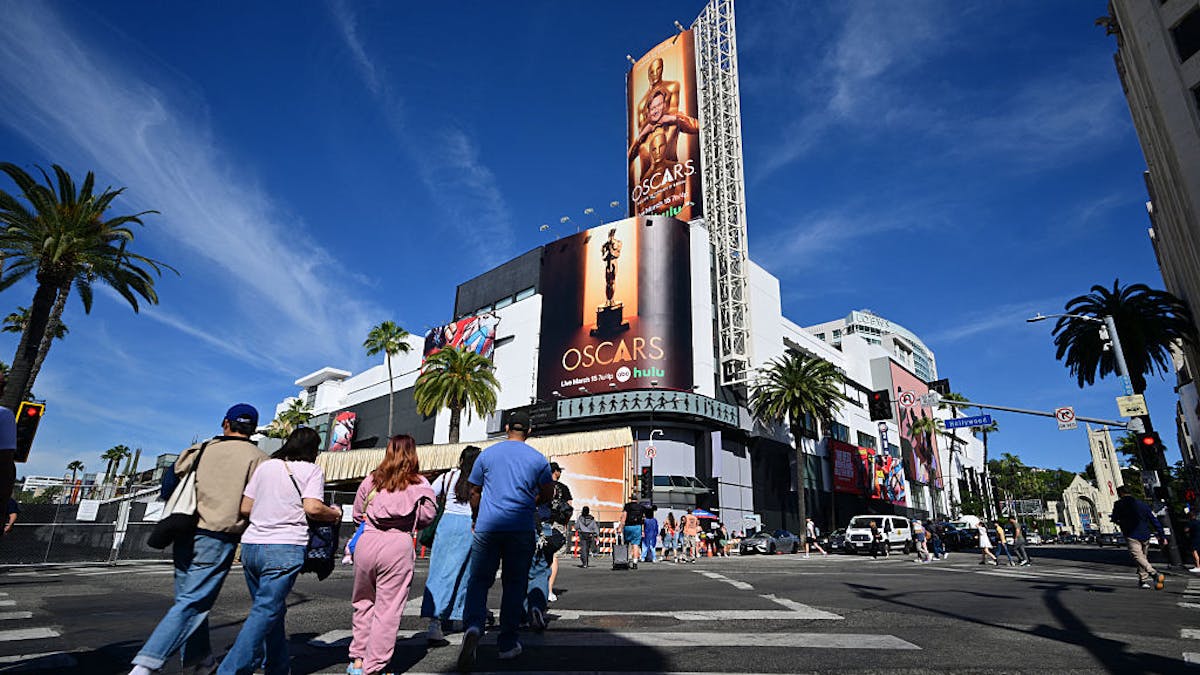
This article is part of Upstream, The Daily Wire’s new home for culture and lifestyle. Real human insight and human stories — from our featured writers to you.
***
I have a confession to make: Even as a certified conservative, I miss loving the Oscars. I miss the anticipation of those Sunday nights. I miss the domestic clatter of it—the clanging of dishes in the kitchen, the gathering of popcorn, the descent into the basement to park myself before the glow of the television. I miss the shared post-mortem with my mother, dissecting hemlines and styling choices, simply admiring the objective beauty of the spectacle.
Mostly, I miss loving what it celebrated: actors working at the top of their craft, called into a vocation with a unique sway over the human heart. Men and women tasked with reminding us of the dignity of the human experience—making us, especially as children, yearn for experiences we’d not yet had, feelings we’d had no occasion to feel. Actors reminding us that beauty exists, pointing us to its source, and ultimately helping people make meaning of their own stories within the ultimate one.
The Hollywood class still believes the Oscars matter to the public in this way. They are sadly mistaken. The country stopped tuning in years ago.
In 1998, when the ceremony was still a shared national ritual and “Titanic” swept the board, 57 million of us watched. Through the early 2000s, broadcasts often drew over 40 million viewers; even into the 2010s, over 30 million was common. By 2021, however, the ceremony had hit an all-time low of 10.4 million. Despite a modest rebound lately to roughly 19-20 million, the audience remains a ghost of its former self. Hollywood’s “national event” now resonates almost exclusively within Hollywood.
The box office tells the same story. Many of this year’s nominees barely register as movies you’d actually go see on a Saturday night. Among the 2026 Best Picture contenders, a few grossed modestly well: “F1,” “Sinners,” “One Battle After Another.” Most others were tiny in comparison: “Bugonia” has grossed around $40 million and “Sentimental Value” $22 million worldwide. Several played only at festivals or in limited art-house runs. These movies, praised in niche circles, were largely invisible to the rest of the country.
Even when the ceremony pulls 20 million viewers, it is not America in the round. The audience skews older, wealthier, and disproportionately coastal; Los Angeles, New York, and other urban markets register above the national average. Many younger Americans aren’t interested at all. This is a cluster of affluent, urban viewers watching a show that reflects their own tastes and values—a clear marker of the gulf between Middle America and the coasts. The Great Divide in black tie.
Why? Why have the Oscars become so siloed, watched mostly by an older, affluent, coastal audience while the rest of the country looks outward, upward, anywhere else? I believe it comes down to what we choose to celebrate. I’m not talking about the applause when winners wade up the stairs in heels and floor-length gowns. I mean everything else: the movies themselves, and the values embedded in them.
The divide runs deeper than taste. It’s a question of what art is for. The late philosopher Roger Scruton wrote often of beauty as the form through which the sacred manifests itself to us. He warned that art fails when it abandons beauty for provocation alone.
He was onto something. Too many Oscar favorites today have stopped prizing cinematic beauty or harmony of form. Instead, they prize “perceived importance”—trauma-laden narratives, abrasive aesthetics, and a certain grim moral instruction. The numbers tell the story of a public that feels lectured rather than lifted. According to a recent Rasmussen report, 54% of Americans believe movies have gotten worse over the past two decades, while only 27% say they’ve improved. Hollywood is delivering lectures instead of entertainment and wondering why half the country have stopped watching.
“Assumed liberalism,” a term I leaned heavily on in theater school, runs through host monologues, speeches, and acceptance remarks alike. Americans with differing worldviews—the majority of the country, it turns out—must sift through leftist jargon just to figure out who won Best Picture. As Ross Douthat puts it, the Oscars have become a “boutique affair for American liberals,” a ceremony prioritizing social commentary and niche art-house films over popular, mainstream cinema. It is also, in his words, a “venue for liberal soapboxing,” where ideology is celebrated as artistry, and the rest of the country is largely left out.
Of course, there are other culprits. Short-form media has fractured our attention; the pandemic bruised the theater-going habit; streaming platforms have made us all shut-ins. But those are the mechanics of the decline, not the heart of it. The heart of the problem is what the Oscars now define as worthy of our attention. The result is a cultural echo chamber—a narrow slice of Americans celebrating messages that resonate little beyond their own zip codes.
Some conservatives are happy about this; vindictive, even. I don’t count myself among them. The country needs these silly, glittering nights more than we like to admit—moments when we can look at the stars and seee something of ourselves in them: our dignity, our aspirations, and our common story.
***
Grace Salvatore is senior editor of media, arts and culture for Ayaan Hirsi Ali’s Restoring the West and a contributor to Independent Women’s Voice.
The views expressed in this piece are those of the author and do not necessarily represent those of The Daily Wire.

