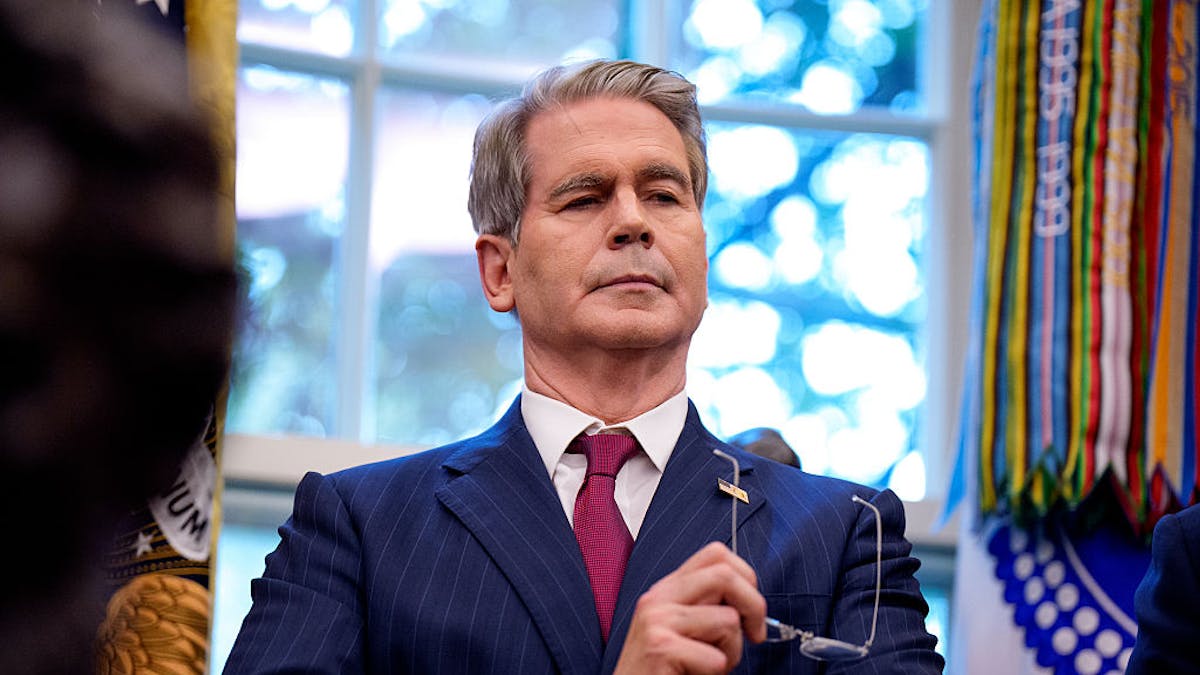
Treasury Secretary Scott Bessent slammed reports that President Trump’s meeting with China would be delayed if Beijing did not agree to secure the Strait of Hormuz.
“There’s a false narrative out there,” said Bessent. “If the meetings are delayed it wouldn’t be delayed because the President has demanded that China police the Strait of Hormuz. If the meeting for some reason is rescheduled, it would be rescheduled because of logistics. The President wants to remain in D.C. to coordinate the war effort and traveling abroad at a time like this may not be optimal.”
Bessent traveled to Paris to begin trade talks with Chinese Vice Premier He Lifeng on Sunday to set the stage for President Trump’s state visit to Beijing at the end of March. The Treasury Secretary added he had a successful meeting with Lifeng, discussing China’s purchase commitments to the United States and the new tariff regime.
Trump first announced his visit in late November after a phone call with China’s President Xi Jinping. Xi invited Trump to Beijing following their meeting in South Korea.
Bessent’s assurance that any delay to Trump’s visit would be logistical follows Beijing’s rejection of Trump’s suggestion that China deploy warships to help reopen the Strait of Hormuz, a critical passage through which more than one-fifth of the world’s oil supply travels.
When asked about the proposal, Chinese Foreign Ministry spokesperson Lin Jian said, “China’s position is clear. We once again call on all sides to immediately cease military actions, avoid further escalation, and prevent regional turbulence from having a major impact on global economic growth.”
Along with not taking Trump up on his proposal, China has condemned the United States’s role in the attacks on Iran. However, George Chen partner at the Asia Group does not expect the issue to be a central topic during April’s talks. “U.S.-China relations are already complicated enough for President Trump and Xi to handle,” he said. Adding Iran to the mix “won’t be something that both sides are keen to do.”
What will be central to the talks are tariffs. In response to the Supreme Court knocking down Trump’s sweeping tariffs under the International Emergency Economic Powers Act (IEEPA), the administration has turned to other trade authorities, including Section 122 tariffs and potential Section 301 tariffs led by U.S. Trade Representative Jamieson Greer.
Section 122 allows the president to impose tariffs of up to 10 percent for 150 days without congressional approval. Section 301 tariffs, meanwhile, require a formal investigation conducted by the U.S. Trade Representative’s office.
Before IEEPA was overturned, Trump could impose a levy as quick as posting to Truth Social. But stripped of the power of IEEPA, Bessent says 301 will not be imposed until July and he will need congressional action after 150 days for section 122.
“We assume there will be very little change in Tariff revenue,” said Bessent. “The ultimate purpose of tariffs is to reshore production. At the end of the day we want to reshore manufacturing in the US, especially strategic manufacturing.” Bessent said that goal also shaped the administration’s approach to trade talks with China. He added that the administration does not want to fully decouple from China, but does want to bring key strategic manufacturing back to the United States.