

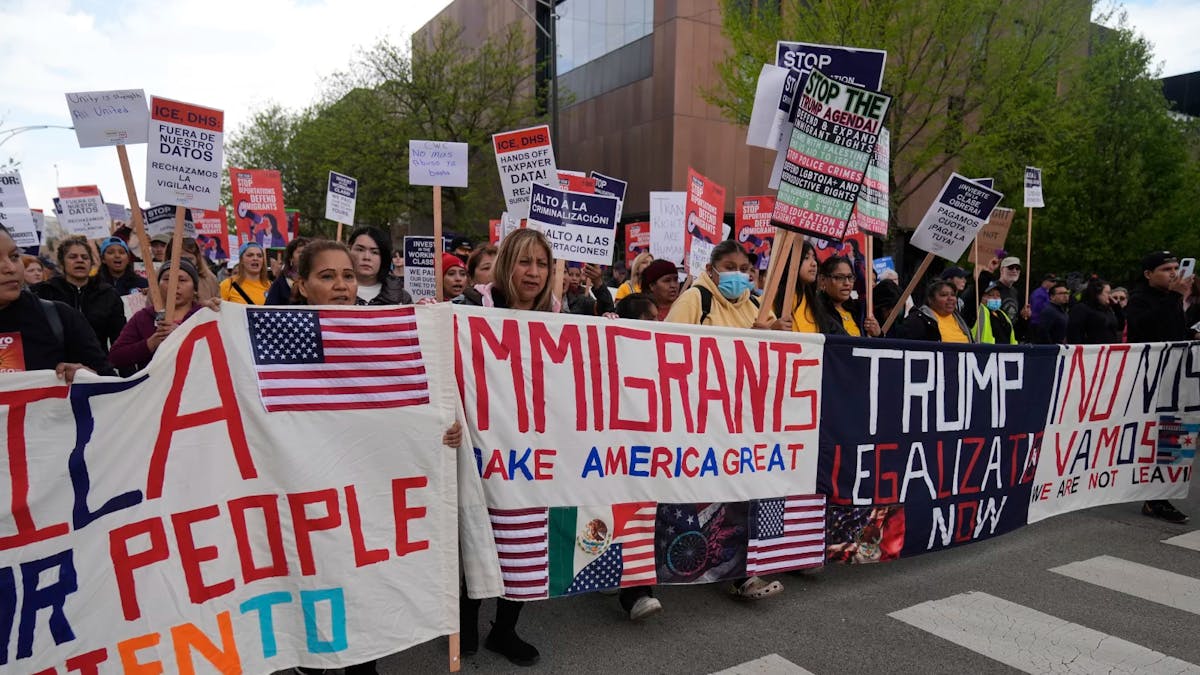
Thousands of activists, union members, and left-wing organizers are mobilizing across the country Friday for sweeping May Day demonstrations, with organizers calling for an “economic blackout” aimed at disrupting daily life.
More than 3,000 events are expected nationwide — more than double last year’s total — under the banner of “May Day Strong,” a coalition that includes labor unions, immigration groups, and political organizations such as the Democratic Socialists of America. The coordinated effort centers on a simple directive: “No School. No Work. No Shopping.”
Organizers say the goal is to flex collective economic power. “We’re really trying to actually start organizing people to see that the power that we collectively have to do economic disruption is really the power that we need in this moment,” said Neidi Dominguez, executive director of Organized Power in Numbers.
In New York City, demonstrators including Amazon workers and Teamsters marched from the public library toward corporate offices, demanding the company sever ties with federal immigration enforcement. In Washington, D.C., activists blocked intersections, carrying signs reading: “WORKERS OVER BILLIONAIRES” and “HEALTHCARE NOT WARFARE.”
Across the country, similar scenes are expected to unfold in cities like Chicago, Los Angeles, and Minneapolis, with rallies, walkouts, and block parties planned throughout the day.
The demonstrations are not limited to labor issues, as many of the same groups planning these protests are the same that organize the “No Kings” series of protests. Organizers have tied the labor movement to a broader set of political demands, including abolishing ICE, opposing U.S. military actions abroad, expanding voting access, and raising taxes on high earners.
“This includes unions, nonprofit groups, grassroots groups and faith groups,” said Pedro Trujillo of the Coalition for Humane Immigrant Rights. “We’re bringing back that energy of shutting it down.”
In Chicago, major unions, including the Chicago Teachers Union, have backed a citywide “day of civic action,” with leadership framing the protests as part of a broader ideological fight. “This is about building a more popular united front,” said union president Stacy Davis Gates. Teachers and students are playing a visible role in the demonstrations. In North Carolina, at least 15 school districts gave educators the day off to participate in rallies, while student organizers across multiple states coordinated walkouts.
Some organizers have been explicit about their long-term goal: a nationwide general strike. While such strikes have been heavily restricted under federal law since the passage of the Taft-Hartley Act, union leaders have floated plans to align contracts in an effort to enable mass work stoppages in the coming years.
Despite the fresh coat of paint, the May Day Strong demonstrations bear much of the same activist infrastructure behind earlier anti-Trump mobilizations. Groups like Indivisible and the Democratic Socialists of America — both heavily involved in the “No Kings” protests — are again helping drive turnout, messaging, and coordination. The overlap suggests these are less an organic eruption of worker-led activism and more a repackaging to project momentum rather than reflect it.
Critics argue the one-day boycott is unlikely to have meaningful economic impact, and could instead hurt smaller businesses. Economist Peter Morici dismissed the effort as largely symbolic. “If you’re talking about non-perishable activities, like going to the movies, you’ll go see the same movie on Saturday,” Morici said to Fox. “It’s not a hit on the billionaires.”
He added that shifting consumer behavior for a single day may simply redistribute spending rather than reduce it. “Somebody will go to store B instead of store A,” he said.
May Day itself has a long and contentious history. Originating in the late 19th century as a labor movement demonstration tied to the push for an eight-hour workday, the holiday later became closely associated with socialist and Marxist movements worldwide, particularly after the Russian Revolution.
In the United States, early May Day demonstrations turned violent, most notably during the 1886 Haymarket affair in Chicago, where clashes between anarchists and police left multiple people dead and sparked a national controversy that still reverberates today.
Modern organizers have embraced that legacy as they attempt to tap into large-scale labor activism in the U.S. “When the billionaires break every rule, it’s going to take more than a rally to stop them,” the May Day Strong’s website reads. Leah Greenberg of Indivisible described the effort as a test run for more aggressive tactics. “We are asking people to take a step into further exerting their power in all aspects of their lives,” she said, calling the blackout a “structure test” for future actions.
Whether Friday’s demonstrations remain peaceful or escalate into broader disruption remains to be seen. Organizers have made clear, however, that they view this year’s protests not as an endpoint, but as a stepping stone toward more sustained and coordinated economic action.

