

As the conflict with Tehran has reached a stalemate, it is up to the United States to declare victory, but first, it must define what victory means. Three outcomes qualify. First, degrading Iran’s ballistic missile arsenal to the point that it no longer poses a credible threat to U.S. bases, allies, or the Strait of Hormuz. Second, dismantling its nuclear program by ending uranium enrichment and subjecting all facilities to inspections. Third, a systemic transfer of power in Tehran that establishes a pro-West government that represents the Iranian people rather than the current theocratic order.
The third option is not only the most desirable but also the only plausible avenue, resolving the other two while reshaping the world. Eliminating Iran’s military capabilities would be costly and prolonged, and even then reversible so long as the regime remains in power. Islamic Republic leaders refuse to even negotiate missile ranges, and the new Ayatollah sees enrichment as a red line, a stance that hardens as the regime weakens. While regime change remains taboo to discuss, President Donald Trump is already bearing its costs without securing its outcome.
Every American president since 1979 has tried either to contain the Iran problem or to manage it through appeasement. Trump broke from that approach by seeking to resolve it. To do so, he must avoid a core miscalculation: the regime is structurally incapable of changing its behavior. Tehran’s missile arsenal and nuclear program are its primary points of leverage, and the premise that a durable diplomatic settlement can neutralize both ignores the historical reality that agreements tend to defer rather than remove the threat. An Islamist system built on anti-Americanism and the export of terrorism cannot abandon the very tools that sustain it.
The nuclear file remains the lingering issue. Despite long-standing differences among the regime’s pillars, they remain aligned on preserving uranium enrichment to retain a pathway to weapons-grade material and maintain leverage. Late Supreme Leader Ali Khamenei drew that lesson from Muammar Gaddafi, who gave up his nuclear program and was later overthrown. His successor, Mojtaba, is following his father’s logic. Tehran has chosen war twice rather than budge on enrichment and will do so again, while Trump cannot settle for another version of the deal he withdrew from.
On missiles, the campaign has dealt the most severe blow to Iran’s primary military asset, not only its arsenal but also its manufacturing base. More than 20,000 targets across Iran were struck jointly by the U.S. and Israel, including missile bases, stockpiles, launchers, and key personnel tied to their development. Before the April 7 ceasefire, Iran was launching significantly fewer medium-range ballistic missiles, the systems it relies on to strike more distant targets such as Israel.
Without a doubt, the regime is significantly weaker than before the war, but it remains lethal. That is due to its cheaply produced yet extensive stockpile of short-range missiles and drones that can still strike targets across the Persian Gulf, paired with hundreds of thousands of ideologically devoted personnel willing to fight to martyrdom.
Another challenge in assessing a military victory is how the U.S. and Israel present data on the regime’s missile and drone stockpiles. Both share percentage reductions to illustrate damage rather than providing baseline figures and what remains, making the true scale of degradation harder to gauge.
The war against the regime, despite the Islamic Republic being a nation-state, still reflects an asymmetric balance. The munitions used to destroy Iranian military sites are far more expensive than the targets they hit, while Tehran can disrupt the global economy with relatively cheap drones and missiles in the Strait of Hormuz. The regime’s bar is survival, while Trump is, and should be, pursuing a far more ambitious definition of victory.
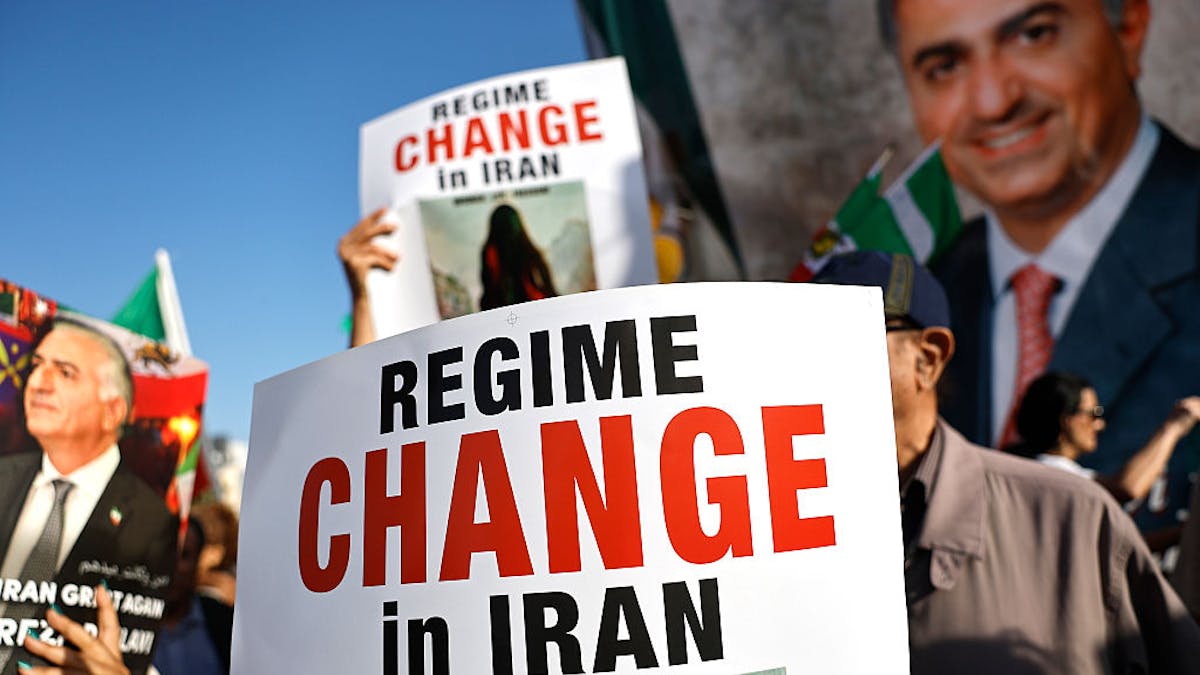
This leaves a systemic transfer of power in Tehran as the only viable path to a historic breakthrough. The key is to level the playing field between regime forces and their only true existential threat: the Iranian people. The war has already set in motion most of the components required for regime collapse, tightening economic pressure, degrading the repression apparatus, and pairing both with direct messaging so Iranians are prepared to shape what follows. Hyperlocal strikes on internal security personnel proved a turning point, forcing these fighters to fear for their lives as much as ordinary Iranians do. The abrupt ceasefire cut short these dynamics before they could produce a decisive outcome.
The window for regime change remains open, as Iranians still await the call from the president to take to the streets, a step Washington has signaled more than once. The naval blockade has already alarmed Tehran’s leadership, which faces the prospect of renewed unrest and growing difficulty paying its supporters. Washington should be prepared to press further while sustaining the economic pressure that is constraining cash flow and deepening public resentment.
Expanded support would require strikes not only on repression forces and military figures but also on the regime’s political leadership. In parallel, select dissident networks in major urban areas should be equipped to confront their oppressors. As mid- and lower-level personnel see leadership either eliminated or in hiding, while dissident cells operate across key cities, it reinforces the sense that the regime’s end is near and forces a choice between holding the line at great risk or defecting.
The conditions are in place. Iranians are overwhelmingly anti-Islamist, the region’s most pro-American and pro-Israeli population, highly educated compared to their neighbors, and anchored by a strong national identity rooted in their ancient monarchy. They mobilized in the millions in January 2026 behind Crown Prince Reza Pahlavi, the only viable transition figure.
The Iran war presents Trump with an opportunity more transformative than the collapse of the Soviet Union. A shift in power in Tehran would eliminate the world’s largest state sponsor of terrorism and a global arms proliferator that has fueled conflicts from Europe to Africa and supplied oil to China. Achieving this historic shift runs through the Iranian people.
Born and raised in Tehran, Janatan Sayeh is the Iran analyst at the Foundation for Defense of Democracies. Previously, he held various research roles at the International Republican Institute, Washington Institute for Near East Policy, and the American Enterprise Institute. Sayeh studied Hebrew and Arabic at the Hebrew University of Jerusalem and received his BA in political science from the University of California, Berkeley.

