

Weaving threads of memory and interlacing personal and collective stories, Japanese artist Chiharu Shiota is best known for her large-scale installations made of interwoven strands—often red, black or white—that transform entire spaces into immersive, poetic and deeply evocative environments. Etched in the minds of many is her majestic installation The Key in the Hand, in which two boats anchored in the Japan Pavilion at the 2015 Venice Biennale were enveloped in a dense web of red threads and more than 50,000 keys collected from people around the world—each vessel and material remnant of memory, trust and human connection, binding together global histories of grief and migration with timeless mythical tropes.
Yet it took several years for Shiota to gain worldwide recognition, a rise likely accelerated by the growing popularity of immersive art experiences and the visual reach of social media platforms like Instagram. Now internationally celebrated as one of Japan’s most iconic and sought-after artists, Shiota is presenting her first institutional exhibition in New York, on view at Japan Society through January 11, 2026. Observer spoke with the artist about the meaning behind her evocative installations, the relationship between body and memory that lies at the core of her practice and how her latest work confronts the trauma and legacy of World War II—a subject whose reverberations feel increasingly immediate amid today’s geopolitical instability.

The show’s title, “Two Home Countries,” already suggests a state of in-betweenness, a division—a fracture—of diasporic identity, much like the one Shiota has long inhabited, living and working in Berlin while maintaining strong ties to her home country. Yet, as she clarifies, this title was meant to be more positive. “I don’t have to decide which country I belong to, I can be both,” she says. “If someone would force me to choose then I would feel in diaspora and my identity separated. I believe we can have multiple home countries; this is my experience.” What she aims to express, instead, is a sense of shared humanity—something we all possess in our existential journey through the world, beyond the borders we create.
This perspective offers a compelling lens through which to approach the 80th anniversary of the end of World War II, one of the exhibition’s central themes. Although Shiota did not experience the war firsthand, she stands between two nations profoundly shaped by it, each bearing its lingering effects on the collective psyche. This historical dialogue materializes in her new site-specific installation Diary (2025), which interlaces a complex ecosystem of individual stories and destinies—of suffering, emotion and remembrance—into an intricate web of red threads and diary pages where personal and collective memory converge into a deeply moving shared history.

Over the years, Shiota has discovered many diaries at flea markets in Germany. “They fascinate me because once they were so important to someone, but after that person died, they were thrown away and ended up in flea markets,” she reflects. What makes this installation unique, however, is that it includes diaries from Japanese soldiers collected and translated by literary scholar Donald Keene. Notably, many of these diaries ended with a request in English asking that they be returned to their families if found. “The diaries are mostly written in Japanese, but sometimes there’s one sentence in English, like: ‘If you find this diary, please send it to my family.’ That really touched me and I think it touched Donald Keene, too.”
For Shiota, that English sentence revealed the soldier’s humanity. “He died as a human being, not just as a soldier. At that moment, he didn’t care about the war anymore; he just wanted to connect with his family,” she reflects, adding that the title “Two Home Countries” conveys that we don’t have to choose between them. “If we can accept two countries, two nationalities or two identities at the same time, maybe there would be less conflict.”
Floating above a tranquil indoor waterfall beside the staircase, Beyond My Body (2025) poetically captures the openness of an in-between state—between worlds, between realms. The suspended webs of red yarn suggest fluidity and release from gravity, as if inviting one to drift beyond the terrestrial limits symbolized by the pair of shoes anchored to the ground.
In the second gallery, Two Home Countries (2025) features two metal house frames tethered to a dress form by Shiota’s signature red threads, evoking her experience of living between Japan and Germany. Unlike earlier works that dwell on rupture or grief, this piece gestures toward coexistence, connection and the emotional complexity of belonging to more than one place at once—of weaving together elements of both cultures into a single, intertwined self.

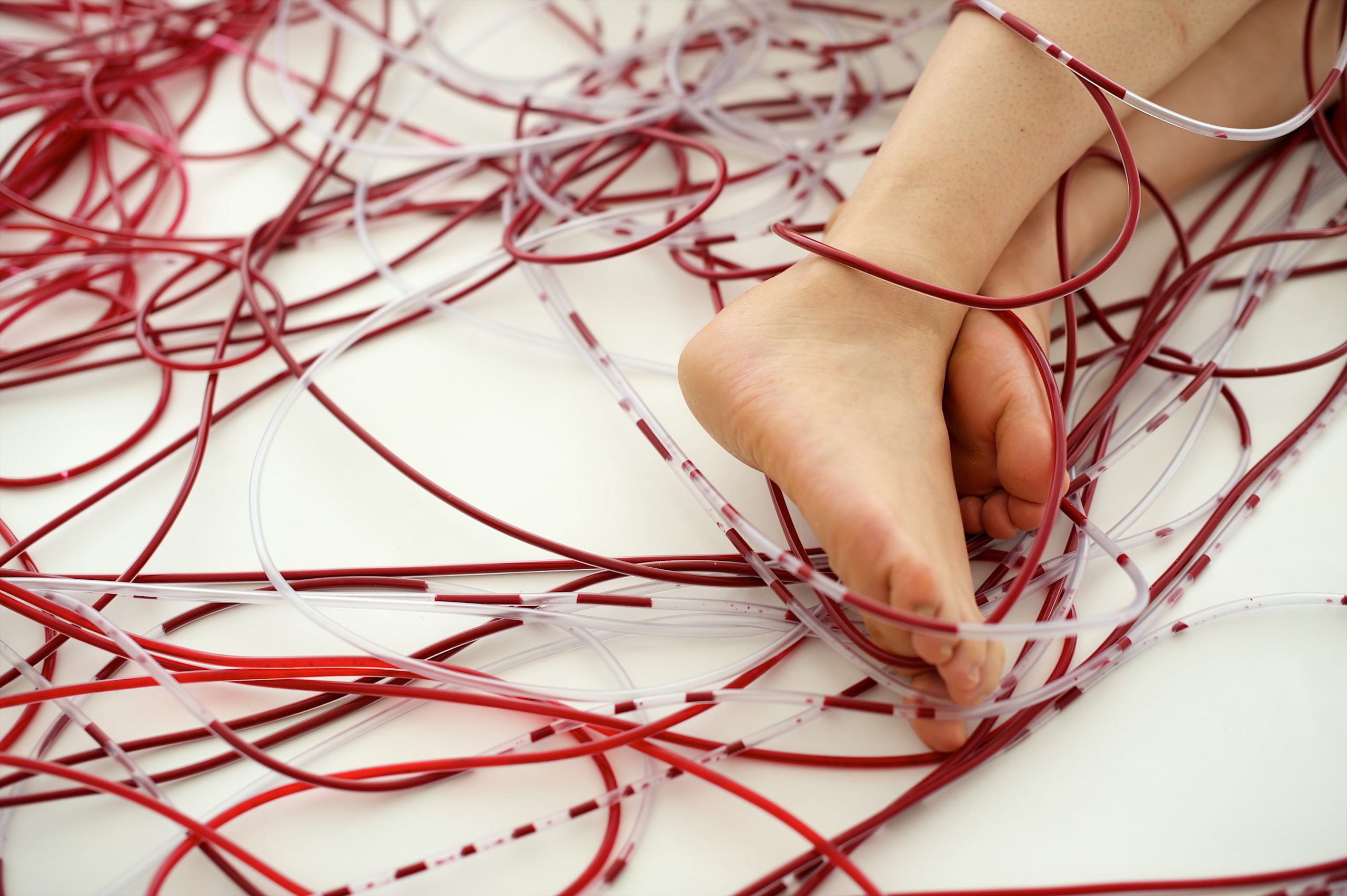
Shiota’s signature webs of red yarn weave around objects and spaces like neural and emotional networks of memory. In this sense, the threads function as both physical and metaphorical lines—binding, connecting and capturing memories within space. These installations often begin as sketches, translating inner psycho-emotional threads into drawn lines before materializing as complex spatial systems—attempts to visualize the interplay between objective reality, cognitive reflection and emotional resonance. Yet, despite mapping these webs on paper, the final outcome can never be fully controlled. The sketches, she says, exist mainly for museums or galleries seeking to understand her vision. “I use it to share the image I have in my mind, but in the end, the final work is never exactly like the sketch. If I didn’t have to make sketches, I wouldn’t,” she notes. “I need to create my work within the space. It’s like I’m drawing in the air with thread.”
Shiota admits that at first, she wanted to be a painter, but during her studies, everything she made felt derivative. It lacked meaning and she couldn’t see her identity in it. “When I started weaving with thread, it felt just like drawing, but now in three dimensions,” she says. “The accumulation of lines creates a deep color and I can express more emotion through the material.”
If the first gallery explores public and collective memory of war, the second invites visitors deeper into Shiota’s broader practice, which includes delicately painted gouaches and drawings on paper, along with sculptures and early radical performances centered on the body—testing its expressive limits, endurance and fragility to reveal it as a site of memory, whether of grief and trauma or of free, creative erotic impulse.
Much like members of the postwar Gutai group, Shiota’s work has long interrogated the body’s expressive potential beyond rigid social and traditional boundaries. Early performances such as Becoming Painting (1994), Bathroom (1999), Wall (2010) and Earth and Blood (2013) document how she used her own body as both medium and subject, often confronting ideas of authorship, vulnerability and emotional containment. These performances form the foundation of her visual language, in which psychic and emotional tension extends into space, shaping her phenomenology of being as a body bound by time and matter—fragile, transient and profoundly human.

Even in her web installations, Shiota often uses clothing, shoes, beds or suitcases as surrogates for the body—objects that bear traces of human presence yet remain empty, evoking absence and the fragility of existence. She says this is why the central theme of her work is ultimately the notion of “existence in the absence”: no one is there, yet their presence lingers. “When a human being, like my father, dies, I suddenly feel that he is present, yet he is not there. It’s a very strange feeling, but many people experience it,” she reflects. “If I don’t have memory, I can’t explain who I am. My body is just a vessel,” she adds. In this sense, objects become vessels and archives—capable of holding memory, of keeping a body alive within the space of the mind and imagination, even after it is gone.
In the final room, a series of visceral yet transparent glass sculptures resembling internal organs directly embody this idea. Enclosed in wire and thread, they suggest constriction and parasitic invasion—forces that endanger vitality while exposing fragility. These works belong to her recent series Cell (2024-2025), which also includes drawings depicting abstract cellular accumulations inspired by her recent experience with cancer. At the same time, these drawings symbolically link the microcosm of the human body to the macrocosm of nature, connecting personal experience to a universal order. “When I had cancer, I thought about my body dying and where my soul would go,” she confides. “At that time, I felt that death was not just the end, but a connection to the universe or a way to continue in another universe.”

Other recent gouaches build on this idea as profound meditations on the individual’s place within a larger web of interdependence and connection. As their title suggests, Connected to the Universe, these works already express an awareness of the body and psyche as parts of a greater whole. A few years after her illness, during the COVID-19 pandemic, Shiota reflected on how little was known about the virus or the future. In that moment of uncertainty, when humanity again confronted its own fragility, she found renewed inspiration. “I felt inspired to draw a very small human always connected by a line to the cosmos, a universe of connection,” she says. “My artwork comes from these feelings.”
For the exhibition, Shiota also designed the set for a new theatrical production commissioned by Japan Society’s Performing Arts, KINKAKUJI (The Temple of the Golden Pavilion) (2025), marking the first time American audiences will see her stage design. While her installations often resemble theatrical stages, this is not her first collaboration in scenography. The play, adapted from Yukio Mishima’s 1956 novel The Temple of the Golden Pavilion—itself inspired by the true story of a young monk who burned down Kyoto’s famed Zen temple in 1950—transforms that act into a psychological and philosophical reflection on beauty, obsession and destruction, capturing postwar Japan’s moral disorientation, the fragility of idealism and the tension between the sacred and the profane.
Developed with Leon Ingulsrud, the production resonated deeply with many of Shiota’s enduring themes, allowing her to expand her visual language into theatrical form. “The choreographer Leon Ingulsrud told me that the main character of the play lives in their own reality, separated from society, like behind a curtain. That got me thinking about the connection between these two worlds,” Shiota explains. “I imagined a line showing how he lives inside the curtain, sometimes he opens it to see another world and then goes back to his smaller world.” Premiering on September 11, the play demonstrated how Shiota’s emotive and symbolically charged universe could unfold into a broader choreography of narratives and memories on stage, carried by the power of storytelling already embedded in her intricately woven artistic world.
Although not organized as a conventional career survey, “Two Home Countries” enables viewers to experience the full scope of Shiota’s practice, which extends far beyond her most recognizable thread installations and sculptures to explore some of the most timeless and profound questions of human existence—distilling from the personal something wholly and universally human.

More in Artists

