

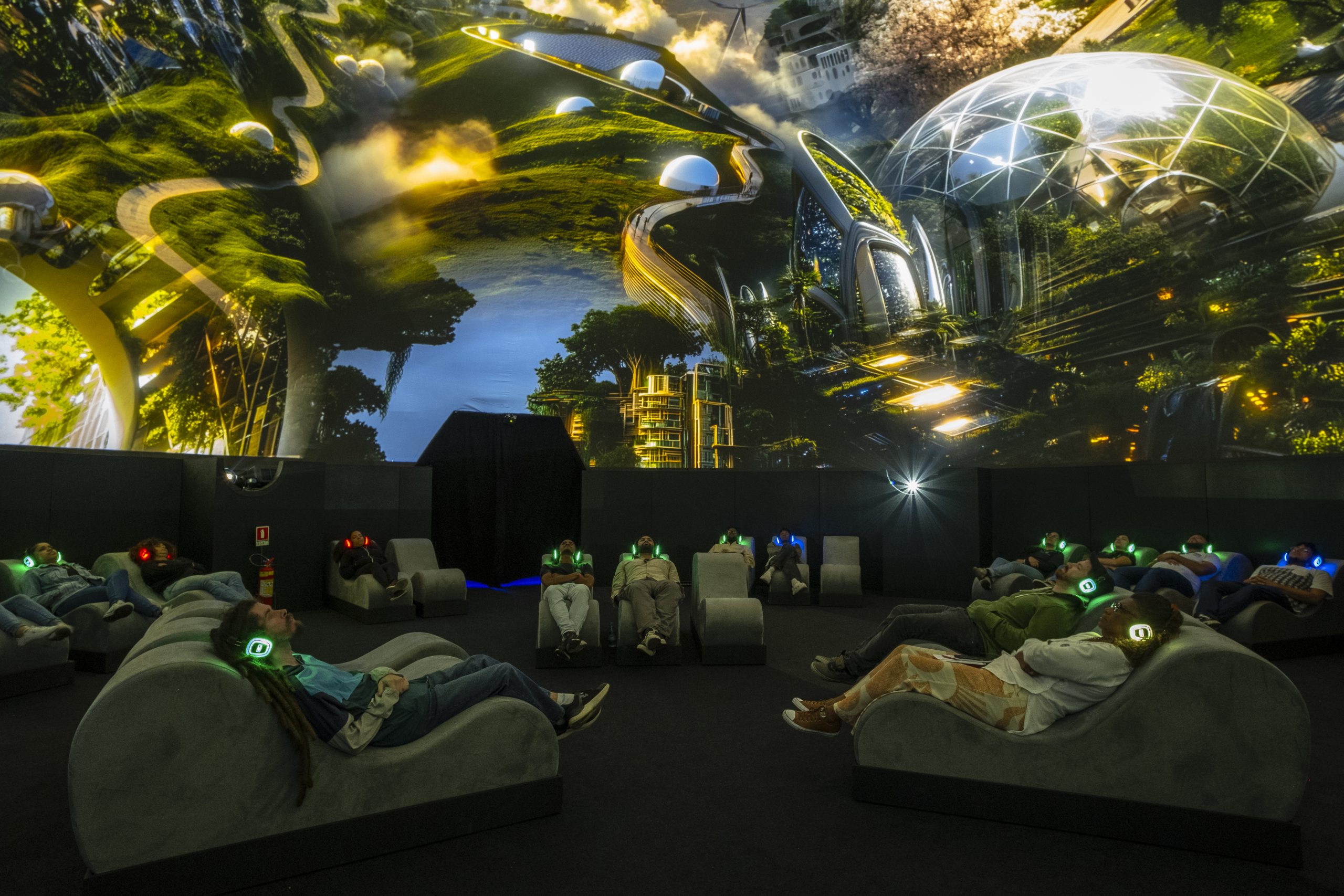
If you happen to have started your holidays early down in Rio de Janeiro, this week marks your last opportunity to check out “The Lumisphere Experience” at the Museum of Tomorrow. The Lumisphere is an innovative project developed by Carey Lovelace’s Visions 2030 studio. Within the Lumisphere’s three domes you’ll find a unique solution to the planet’s current ecological crises, as the experience takes visitors through a psychedelic light show that merges visual art and science, culminating with a survey that asks them to visualize their own green future with the help of A.I. It’s not like anything else you’ll see in the worlds of art, science or technology, and is likely coming to a venue near you in the future. To hear more about how the project came to Rio, we sat down with the Museum of Tomorrow’s Fábio Scarano.
Let’s start off by talking about how this project came to your museum, and how you see it fitting into the broader programming that you’ve been doing for 10 years.
It was a very good match, but also a bit of a surprise. This conversation started around the time we were deciding on a new curatorial line for the museum. I joined as a curator two years ago. I’ve been here for three years, but as curator for the past two. We started to think that we were beginning to make changes in the main exhibition, and we also thought that we should change the narrative of the museum. The museum is very much science-oriented. The main exhibition talks a lot about climate change and the challenges of the planet, and it tries to provoke a sense or vision of the future as it is.
As time went by, especially after the pandemic, there was a change in perception. Many visitors at first felt informed. Around 2023, feedback showed that people were leaving the main exhibition concerned about the future and anxious. We figured that we should change the narrative a little, and also how it works across the museum as a whole.
We think the word “tomorrow” is much less about the future than about hope in an active sense. Tomorrow is something inside us that moves us forward. It has to do with images we build of the future, the images that guide us. Attention is our relationship with the present, and memory is our relationship with the past. Our premise is that we are a society with a very short attention span and hardly any memory about the planet, and very little memory of our own lineage. Tomorrow is an image that results from our relationship with the past and present.
We have these three times inside us simultaneously. While speaking here, attention is happening, memory is being accessed and anticipation is already forming. I think that because we have short memory and limited attention, we become forgetful about other ways of seeing the world or interpreting life. We are addicted to modern science, which is extremely important and has brought great advances. But in times of crisis, there is no kind of knowledge—so long as it is democratic and loving—that should be abandoned.
We thought the exhibition should create a conversation between modern science, ancestral knowledge—especially from Brazil and this region—and the arts, because art communicates things science talks about in ways that can touch people emotionally and immediately, beyond numbers and graphs.
You can see this in the main exhibition. In addition to being very much a science narrative, it could feel like it could be anywhere in the world. It doesn’t have much about Brazil in it, in this area in particular. Which makes sense because for some Indigenous people from the Amazon, this is where the world began. So the holy point is about this place. When some shamans come here, they have friends from that region. Their whole life is about the places, the mountains, the legacy. These are probably people who migrated from Asia through North America, all the way south and up again. They saw it on the way down.
They thought this particular bay was the center of the world?
Yes, for some, this is where the world began. For America, Vespucci wrote a letter here called The New World, which became the nickname of the continent. That letter inspired Thomas More’s Utopia thirteen years later, which is about desire—about where you want to go. So in many ways, this is where it began and where it’s heading.
It’s very easy to discuss tomorrow here because this is a place about timelessness. It’s the beginning, but it’s also what’s about to come. In the meantime, there was this awful moment in history when around 2.5 million enslaved people from Africa arrived here. They survived immense hardship. In some African mythologies, each of us is a sun. So there’s a notion of perpetuity—again, timelessness.
We imagine creating an exhibition that guides people through history, from the cosmos toward the future, while also helping them remember what they saw and pay more attention to where they are. That way, they can see connections between different times. We’re doing that now. From the five sections of the exhibition, we changed one just yesterday. The other four will hopefully change next year. The one we changed is very much about time building through. It talks about what science says about climate change, which has to do with fossil fuels underground and deforestation.

There’s an Indigenous group in the Amazon whose mythology says that if you take minerals from underground and cut trees down, the heavens fall on our heads. That’s very similar to what science is saying now.
So what we’re trying to do is create parallels between these narratives—science and ancestral knowledge. Science says life begins in
This is about remembering and paying attention to improve our capacity to anticipate. That’s what attracted us to the Lumisphere project. It doesn’t give you a future. It stimulates you with narrative and images, helping you let go of your current relationship with time. It’s relaxing. It slows you down.
I did two experiments myself. One without sound—just images—and it had a very psychedelic effect. With sound, it was less psychedelic, but similar to meditation—guided or unguided. In both cases, it builds trust. It has to do with images, and these images are not very clear. I can recall the globe in the first room, what I was seeing there, but in the second room, I don’t really recall specific images. I recall the sensation of flying or movement, but not many images. There was sort of a diamond pattern at one point.
Some of those images are very similar to what many Indigenous people across the world draw—designs that are also similar to cave drawings from 10,000 or 20,000 years ago. Many of these patterns are thought to be part of our unconscious. The word I would use is transcendence. It helps you transcend. Every time we anticipate and build an image of the future, it’s never fully clear. It’s misty. You know the direction, but not exactly where you are going.
That brings us back to the word utopia, which is very important here. Topos in Greek means place. The “u” was always a bit of a mystery. In English, if it’s eu-topia, it’s a good place to go to. Sometimes we think of the future like our grandparents did—work hard, get a house, a car, a family. That’s a place.
But utopia can also be “no place.” And if it’s not a place, it’s a state. Something that emerges. It emerges from attention. We’ve lost attention because we’ve lost connection with our senses. We don’t touch much, don’t listen deeply, eat fast, don’t taste or smell fully. We are a very visual society. Paying attention means being immersed in the environment where we are.
The challenge for the museum is to transform it while keeping technology. We think technology helps create immersive experiences, but we also want the museum to be more organic, so people can touch, feel, smell.
It was a very organic experience—very sensory.
Yes. And Lumisphere does that well. It’s visual, but in a transparent way. We were very happy with the encounter with the team here. At one point we were discussing the American Dream—what it is. A lot of the American Dream is still utopian, a possibility of a future where there is fantastic governance. In Amerigo Vespucci’s letters, he talks about “enough.” Indigenous people loved nature because life was around them. They loved one another because they were received with celebration. There were parties every day. He called it educational friendship.
They didn’t need kings or gods. That was very subversive. Vespucci said that maybe Europeans had something to learn from them. Instead, we massacred most of them. Now, by bringing ancestral knowledge into conversation with modern science, we recover parts of the past and project new futures—what we could call ancestral futures. There are many future possibilities in remembering what different ancestries, even our grandparents, once knew.
That’s what we’ve been interested in. The Lumisphere does this with images rather than words. In the final moment, it helps you build an image of your own future. People of all ages—kids included—become curious about what’s coming.
I genuinely think liberating the imagination is very important. Especially in America, so much conversation is limited to “We can’t do such and such because we can’t afford it,” which isn’t true. But to return to the institution, this is the tenth anniversary of the museum. Earlier exhibitions were more science-oriented and, you said, depressing. Can you contrast those with the newer ones, like the Lumisphere? What were some earlier exhibitions, and what are some more recent ones that show that shift?
Many of the early exhibitions were more typical science-museum exhibitions—hands-on experiments, things you do with your hands, learning through interaction. There was an exhibition about food. There was one about a Brazilian pioneer in aviation, which was very nice. There was one about the Amazon with a lot of informational text.
In the past couple of years, we’ve done fewer pure science exhibitions and more artist exhibitions—bringing in artists who are addressing the same issues science addresses. There’s one right now on the Pantanal. Pantanal is one of Brazil’s main vegetation formations. It’s actually the second-largest wetland in the world. During the Jair Bolsonaro government, there was extreme deforestation and widespread fires. It was shocking. The exhibition upstairs features two photographers.
One photographs the beauty of the Pantanal in its preserved state. The other photographs the fires. You see the contrast. There are usually two or three images shown together. Some images are disturbing, including burned animals, so it even has an age restriction.
That’s the most visited exhibition the museum has ever had, right? Why do you think it resonated so much with people?
Yes, it’s the most visited temporary exhibition ever. Even more than Sebastião Salgado. He was a very famous Brazilian photographer who passed away recently. His exhibition here in 2022 had around 600,000 visitors. This one reached even more.
I think Brazilians have a deep connection to nature and biodiversity. I heard from many people who supported Bolsonaro that what upset them most about his government was what he did to nature. There’s not much text in the exhibition. It’s mostly images. And images communicate a lot.
Museums are about information, but they’re also about feeling—about having an experience that touches you. Some feelings don’t have words. You either feel them or you don’t. Our job is to create experiences that make people ask new questions rather than leave with answers, because most of these questions don’t have simple answers.
So if a museum is about education, feeling and informing, there’s also this question—especially in America now—about activism. To what extent should exhibitions be about showing the best or most relevant art, and to what extent should they promote a certain goal? To what degree does this institution seek to be politically activist?
I was an environmental activist. When I was younger, activism was a big part of my life, and it was about raising awareness. But sometimes activism becomes an “us against them” attitude.
Museums are places of encounter. Every time people meet, sometimes it’s very nice and sometimes there’s conflict or difference. What we try to do, through art and scientific messages, is provoke questions.
I’ll give an example. There was an exhibition we had for three or four months called “The Flesh of the Earth.” It was a painter whose work came out of the wall and looked like flesh. What she was talking about was the flesh of the planet, but also our flesh.
She also used an A.I. technique: there was a QR code, and when you pointed your phone at the painting, it came alive. There was no direct message, but you felt that you were part of the flesh of the Earth.
So it’s because of the friction—because it makes you uncomfortable.
Yes. The exhibition design made it feel like entering a cave. It was all around you. It grew around you. It could feel uncomfortable, but it was also beautiful.
We do research with the public. Some people felt discomfort, others felt something else, but overall, the feedback was very positive, even though it looked a bit like a horror-film scenario. It conveyed the idea that we are part of a network much bigger than our own species. That feeling can lead to different actions. Someone might want to fight deforestation. Someone else might want to research more. Someone else might change how they vote.
What people do with those feelings is up to them. Action has an agenda. Action is ideological. Museums, however, are about imagination. There is a collective social imagination. Today, there is also a planetary imaginary, because we’re connected through transportation and telecommunications. That imaginary is about productivity, speed, performance and money. The future becomes a measure of success defined by bank accounts.
There are local imaginaries—neighborhoods, Indigenous villages—that are different, but they’re still impacted by the planetary imaginary. What creates holes in the imaginary is imagination. We are living through a crisis of imagination. When we try to imagine a future different from the present, we often stop halfway and say, “It’s never going to happen.” If we don’t imagine, we don’t anticipate. And if we don’t have an image ahead of us, we’re not going to get there.
Museums are about imagination, not ideology. Liberalism, conservatism, socialism, totalitarianism—all operate inside the same capital-based imaginary. When one wins, not much really changes.
So it sounds like what you’re saying is that the goal of the museum, with regard to activism, is not ideological. You’re not trying to push people toward one position, but rather get them to a place where they can arrive at their own ideology.
Yes. We want to activate imagination. Even for us, working inside institutions, it’s difficult to imagine something outside the dominant imaginary.
You mentioned “The Flesh of the Earth” using A.I., and the Lumisphere also uses A.I. Given that this is an ecologically oriented institution, have you thought about whether there’s a contradiction there?
Yes. We think quite a bit about what Martin Heidegger said shortly after the Second World War, especially after the atomic bomb. There was great concern about technology. The atomic bomb showed what humans can do with technology. Heidegger wrote The Question Concerning Technology, in which he explains that all species have technologies. Bees build hives, termites build structures, beavers build dams. Plants use photosynthesis—that’s a technology. Technologies evolve to improve quality of life.
The problem is not technology itself. The problem is how we use it. If technology is used for purposes that don’t improve well-being, then that’s on us. Over the past two years—2024 and 2025—our central curatorial focus has been intelligence. I’m a botanist by training.
So you mean all kinds of intelligence—human, plant?
Yes. Intelligence means the ability to choose. Everything living makes choices. A bacterium moves because it chooses. Plants turn toward light. Plants have memory, attention and anticipation.
Today we say machines are intelligent, and nobody finds that strange. But when I used to say plants are intelligent, people thought it was ridiculous. Yet it’s absolutely true. Seeing intelligence everywhere living helps us see intelligence in every human being, regardless of class or age. Everything living becomes our brothers and sisters. This flattens ontologies—a term Bruno Latour uses. Flattening ontologies helps create real conversations between different people and different beings. We often see plants, animals, even people, as landscape rather than as beings with interiority. Machines feel different because we created them, so we’re tempted to think of them as intelligent beings.
There are two things we are not going to give up anytime soon: sustainability and digitization. Right now, they seem contradictory. But why can’t they be synergistic? Why can’t we use artificial intelligence to help life be more sustainable? For that to happen, it can’t be a monopoly of four or five corporations. These discussions move beyond good and bad, right and wrong, toward how to use technology responsibly. If that’s activism, then it’s a different kind of activism—one that requires imagination, dialogue and understanding.
More Arts interviews

