

Several New York auctions earlier this month affirmed that the enduring strength of the design market is fueled not only by the irresistible momentum of Les Lalanne—who continue to set new records each season—but also by a broader, increasingly global appetite for collectible design. According to ArtTactic, the category rose 20.4 percent to $172 million in the first half of 2025, up from $143 million during the same period last year. Despite concerns over new tariffs, early sales at recent dedicated fairs such as Design Miami Paris, Salon Art + Design and Design Miami, along with the latest auction results, confirm that collectible design is arguably the most successful category in 2025, driven by a growing and geographically diverse collector base, as well as a steady increase in institutional interest.
What stands out is that, unlike the highly choreographed fine art auctions, the results here were not engineered through guarantees, irrevocable bids or elaborate staging. Most lots sold within or above estimates without these mechanisms—and in some cases without a reserve—revealing genuinely active international demand across price tiers and periods rather than a strategically manufactured outcome.
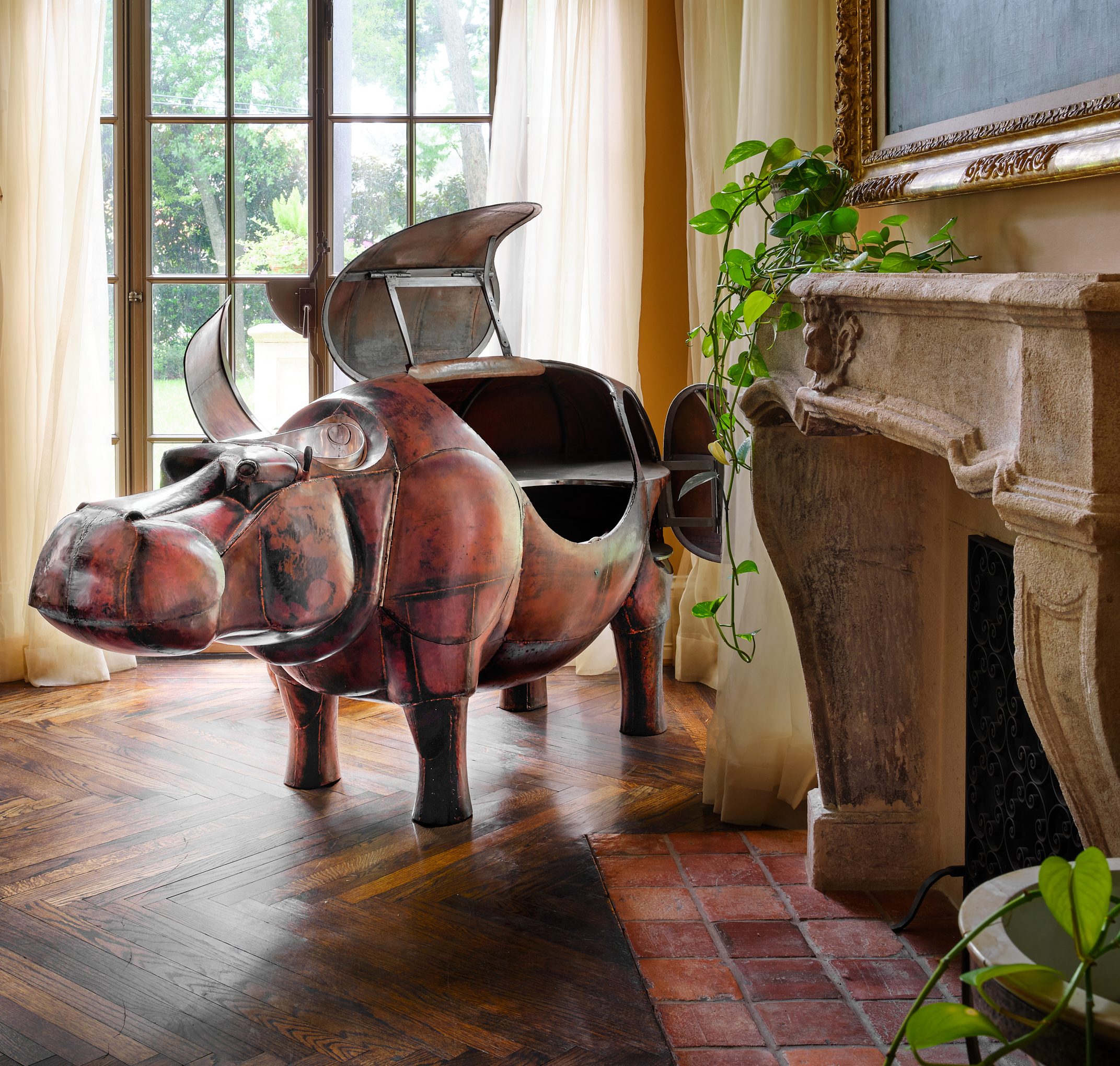
The week was headlined by François-Xavier Lalanne’s Hippopotame Bar, which achieved $31.4 million and set a new benchmark for his increasingly high-flying market. The auction totaled $50.2 million—more than double its $23 million high estimate—marking Sotheby’s highest design sale total ever. The Hippopotame Bar, commissioned as a unique piece by the Schlumberger family, inspired a 26-minute bidding battle and ultimately sold for more than three times its $7-10 million estimate, pursued by at least eight international contenders. All Lalanne works sold in a white-glove run, with animated bidding pushing their combined total to $38 million, further cementing the couple’s status as blue-chip pillars of the design-art crossover. These results follow the $18.5 million generated by the September sale of prime Lalanne material from the £73 million Pauline Karpidas collection sold by Sotheby’s in London, where several works reached 15 times their estimates.
Other top lots from the Schlumberger family included two unique pairs of Les Portes du Jardin gates by Claude Lalanne, whose floral and ornamental elegance propelled them far beyond their $350,000 high estimates, selling for $787,400 and $482,600. Claude’s Nénuphars table also exceeded expectations at $571,500, while the unique set of nine Anémone balustrade elements tripled its estimate at $431,800. These results echo the strong market response to Les Lalannes works from the Pauline Karpidas collection, which realized nearly $18.5 million in London in September, with several pieces selling for as much as fifteen times their estimates.

Concurrently, both Alberto and Diego Giacometti continued to attract strong interest from collectors who move fluidly between design and fine art. Alberto Giacometti’s two Osselet floor lamps—offered with copies of correspondence between Diego Giacometti and Anne Schlumberger—more than doubled their $200,000 high estimates, selling for $444,500 and $508,000. Diego Giacometti’s Torsade table reached $444,500, surpassing its $300,000 high estimate, while his Grecque table soared to $825,500, nearly tripling its high estimate.
The strong results extended well beyond the Schlumberger material. Most lots at Sotheby’s sold within or above expectations, including significant pieces by Art Deco master Émile-Jacques Ruhlmann. A rare Redhead dining table—one of only eight documented examples—achieved $533,400 against a $200,000-300,000 estimate. Eight De Becker side chairs and two Cannelé armchairs collectively realized $355,600, while two pairs of his lamps exceeded expectations, selling for $69,850 and $90,250. Ruhlmann’s Boudoir Collecteur armchairs and Chevet table also more than doubled their estimates at $279,400 and $88,900, but the top result was achieved by his rare pair of Gonse armchairs, which sold for $1,575,000 over a $1,000,000 high estimate. The only piece that failed to sell was the extensive Davène bookcase, likely due to logistical challenges tied to its scale and organic materials, which may face import and export restrictions.

Strong results also followed for French postwar design, including Jean Prouvé, Le Corbusier, Charlotte Perriand and Albert Cheuret—his 1925 floor lamp reached $292,100 against its $60,000-80,000 estimate. The more eccentric, animal-esque creations by American designer Judy Kensley McKie also confirmed their momentum, with one of the twelve editions of her Lion Bench selling for $406,400—four times its $100,000-150,000 estimate.
Meanwhile, the glass mastery and original vision of Tiffany Studios remain a major draw for global collectors, especially following last year’s staggering $12.4 million result for the monumental Danner Memorial Window. Sotheby’s follow-up sale of masterworks from the Schur Family Collection added another $8.2 million across 50 lots, with a 96 percent sell-through rate and 60 percent of works exceeding their high estimates, fueled by bidding from 20 countries.
The star lot was a Tiffany Studios Magnolia floor lamp, which surged to a record $4.4 million against a $2-3 million estimate—the highest price ever achieved for a Tiffany lamp—after a ten-minute battle among five bidders. Institutional demand is also reshaping this market: in 2023, the Metropolitan Museum of Art acquired the three-part, 10-foot-tall Garden Landscape, and this past May, Crystal Bridges Museum announced its purchase of the monumental stained-glass Mountain Landscape (Root Memorial Window).

Historic design led Christie’s Design Week
Demand for Tiffany Studios was also strong throughout the dedicated Tiffany sale Christie’s held the following day, on December 12, which generated a combined $3,836,035. Most of the 34 lots exceeded or even doubled their estimates—particularly some of the most iconic lamps. A Poppy table lamp on a rare “bird skeleton” base, circa 1905, soared to $254,000 against an $100,000 high estimate, while another Poppy table lamp from the same year achieved $152,400 from its $60,000-80,000 estimate. A third example, dated 1910, met its projection squarely in the middle, selling for $50,800. Leading the Christie’s sale, however, was a monumental glass masterpiece: the Birches and Irises landscape window, dated circa 1915 and sourced from the Albert Zuckerman Collection, which sold for $571,500—landing neatly between its $400,000-600,000 estimate. Also from the Zuckerman Collection, an important and rare Daffodil chandelier, circa 1900, achieved $482,600 after a $500,000 high estimate.

Meanwhile, Christie’s multimillion-dollar Design auction week began with 1925 | A Modern Vision on December 11, which celebrated the 100th anniversary of the Exposition internationale des arts décoratifs et industriels modernes in Paris in 1925. The sale generated $7,557,135 across its 39 lots, with only one lot unsold. At its forefront was a renewed appetite for the Art Deco elegance and exceptional craftsmanship of Émile-Jacques Ruhlmann, whose personal desk (1929) and armchair, circa 1930-1933, fetched a combined $1,016,000. His Grande Cannelée à Redents commode realized $482,600 from its $150,000-200,000 estimate after being showcased alongside the postwar masterpieces from the Edlis Neeson Collection during the November exhibitions. The model was originally exhibited in the Pavillon de Marsan at the Salon des Artistes Décorateurs in Paris, 1923. The strong results achieved at Sotheby’s the previous day for all Ruhlmann works likely helped fuel bidders’ enthusiasm for the French Art Deco designer. A carpet produced by his atelier around 1923 also sold for $203,200 against an $80,000-120,000 estimate.
Other highlights from the sale included two exceptional creations by Jean Dunand, the Swiss-born French lacquerer, metalworker and designer—another essential name in the Art Deco movement. Considered among the most singular pieces he ever produced, and one of only six psychés documented in the artist’s catalogue raisonné, Dunand’s Psyché à la Baigneuse dressing mirror, dated 1927, sold for $952,500 after fees from a bold $800,000-1,200,000 estimate—justified by how the piece embodies the very quintessence of Art Deco luxury, blending Orientalist influences with 1920s French fashion and, above all, a distinctly modern feminine aesthetic. Dunand received commissions from leading couturières, including Madeleine Vionnet and milliner Madame Agnès, with his own career intersecting directly with this world through pioneering cross-disciplinary collaborations.

Also consigned from the collection of prominent L.A.-based art patron and collector Eva Chow, a pair of Dunand folding game tables—realized with the exquisite laque arraché technique—soared to $203,200 from their $80,000-120,000 estimate. Dunand had originally conceived them as part of a unique interior for the San Francisco penthouse of Charles Templeton Crocker, the millionaire grandson of the founder of the Union Pacific Railroad, whose residence remains one of the most ambitious and complete residential Art Deco interiors ever created. A pair of monumental vases in lacquered wood and yellow copper oxide, inlaid with silver, also surpassed expectations, selling for $508,000 from their $250,000-350,000 estimate.
Immediately after, Christie’s hosted its successful Design sale, which generated a total of $15,913,387 across its 145 lots, driven by the now-familiar rising triad of Lalannes—along with Giacometti—and design masterpieces from the Edlis Neeson Collection, joined by several works previewed in last month’s art auctions.
Leading the sale was Claude Lalanne, whose unique chandelier Structure végétale aux papillons et oiseaux (2007) achieved $2,149,000 from its $1.8-2.2 million estimate, while her now iconic and highly sought-after Ginkgo Dining Table (2018) sold for $889,000. Similarly in demand far beyond pure design connoisseur circles, François-Xavier Lalanne’s Agneau from the Nouveaux Moutons series (2008) drew spirited international bidding, closing at $698,500—nearly three times its low estimate. Less successful was Jun Kaneko’s glazed ceramic vessel from the collection of Elaine Wynn, which failed to sell against an $80,000-120,000 estimate.

Meanwhile, several pieces from Lucie Rie’s ceramics—offered from the Collection of Robert F. and Patricia G. Ross Weis—soared well above estimate. Her footed bowls achieved $146,500 (estimate $40,000-60,000), $107,950 (estimate $30,000-50,000) and $177,800 (estimate $25,000-35,000), respectively. Equally remarkable was the $330,200 result for the Spade Form, circa 1966, by British potter Hans Coper, also from the Weis collection, driven far above its modest $70,000-100,000 estimate by animated bidding. Regarded as one of the most influential modern ceramicists of the 20th century, Lucie Rie—Austrian-born and later British—established, along with Bernard Leach, the foundations of modern British studio pottery, shaping generations of ceramic artists in the U.K. and beyond. Both potters have experienced rising values at auction in recent years, although this has been largely concentrated in the U.K. market and London sales so far. Coper’s sculptural icons—Chalices, Spades, Thistles—have surpassed £400,000 and are now approaching £700,000, driven in part by their extremely limited supply, given his modest lifetime production.

Coper’s most recent record was set at Phillips London this past March, when a rare Chalice Form sold for £693,000, surpassing his previous high of £655,200 achieved at Phillips London in November 2024. Phillips’ New York sale, Moved by Beauty: Works by Lucie Rie from an Important Asian Collection had a $2.6 million white-glove result.
Phillips bet on rising names
Last but not least, Phillips hosted its Design auction on Saturday, December 13, achieving $3,212,616 across its 79 lots, with 67 sold (an 87 percent sell-through rate) and 92 percent sold by value. The offering here leaned decisively into the postwar and contemporary end of the spectrum, as the auction house continues to ride the momentum of its rising appeal among younger collectors—Millennials and Gen Z now make up 20 percent of Phillips’ Design bidders, as Phillips’ design specialist Kimberly Sørensen recently told Observer.

The sale opened with Harry Bertoia’s Bush sculpture, which sold for $70,950—more than twice its estimate—setting an energetic tone that carried through the auction, noted Cecilia Moure, associate specialist and head of design sale. Leading the sale was Guy de Rougemont’s Nuage illuminated coffee table, made in 1974, which sold for $541,800, exceeding its $100,000-150,000 estimate. The result set a new record for the French painter associated with Nouvelle Figuration, who later became an even more successful designer known for brightly colored, modular, puzzle-like forms that dissolve boundaries between painting, object and environment, playing with abstraction, pop-inflected color and sculptural sensory engagement.
Hans Coper’s momentum continued at Phillips, with his Footed Pot with Four Indents (circa 1975) soaring to $154,800 from its $60,000-80,000 estimate. Less successful were the more virtuosic contemporary ceramic works by Ron Nagle and Kathy Butterly, many of which failed to meet their estimates under $30,000. The exception was Butterly’s Green Reach (2018), which sold just shy of its high estimate for $32,250, setting a new auction benchmark. Meanwhile, a vase by another rising British potter, Elizabeth Fritsch, more than doubled its estimate—following the record set for her work in London last month.

The auction also confirmed growing interest in female designers, particularly Judy Kensley McKie, whose $406,400 Fish bench led Phillips’ June Design sale in New York, setting a world auction record for the artist. This time, both her Duck table (1996) and Chase table (1987) fetched $245,100 from their $50,000-70,000 and $40,000-60,000 estimates, respectively—setting, one after the other, new records for a table by the American designer. Kensley McKie is considered one of the most influential figures in the studio furniture movement and is celebrated for sculptural, carved wooden and bronze furniture that transforms functional objects into mythic, animal-inflected forms.
The American architect and designer George Nakashima also remains in strong demand within the international design market, alongside Mira Nakashima, now the creative director of Nakashima Studio, who has preserved her father’s legacy of craftsmanship while successfully introducing it to a new generation. Most George Nakashima pieces in the sale exceeded expectations, led by a $61,920 free-edge cabinet with an overhanging top (estimate $50,000-70,000) and a $51,600 Trestle dining table (estimate $20,000-30,000), while Mira Nakashima’s slab bench doubled its estimate, selling for $30,960.
Italian design also demonstrated its strength, with several Gio Ponti works selling above or within estimate, including a $24,200 ottoman originally designed for his Milan residence (estimate $8,000-12,000), his refined wood corner bookcase and a rare secretaire bookcase with chair, each selling for $33,450. Meanwhile, a pair of Fungo table lamps from the Rising Sun series (1973) by Gabriella Crespi—one of the most visionary Italian designers of the postwar period—soared to $96,750 after a $25,000-35,000 estimate.

A handful of early 20th-century curiosities also performed well, such as Seizô Sugawara’s Tête de femme sculpture (circa 1928), which surpassed its $50,000-70,000 estimate to command $83,850. Sugawara introduced urushi (traditional Japanese lacquer) techniques to France at a moment when Paris was hungry for Japonisme but lacked true technical understanding, becoming the principal lacquer master for Jean Dunand.
Notably, beyond the marquee highlights, buyers could acquire iconic works like the Sushi sofa by Brazilian designers Fernando and Humberto Campana for $28,380 or a Zaha Hadid Swash chest of drawers for $15,480—more or less the price of emerging artists on the primary market. Most of the important contemporary and postwar design pieces offered at Phillips were, in fact, under $30,000, underscoring how the category remains not only an accessible entry point but also a compelling arena for sustained engagement among a younger and broader range of collectors.

