

Estimated reading time: 10 minutes
Weapon-mounted lights are tools, not toys. Use the right setup, practice the baseboard and umbrella methods, and follow one rule: Flash, Assess, Move — and your light becomes an advantage, not a liability.
Why Weapon Lights Exist — The One Job They Must Do
Weapon lights have become the norm in recent years. Rifles, shotguns, and handguns all feature some way to mount a light. Lights are like anything else in the gun world; if you do not know proper tactics to use them, you are going to find yourself in more trouble than they are worth.
Anything you attach to a gun requires you to be skilled in its use. That takes training and practice, but you also need the know-how to know what to practice. Today is all about the know-how when it comes to using weapon lights for defensive shooting.
🛒 Check Current Price for Glock 17 on GunsAmerica
The Purpose of Weapon Lights — Confirm, Not Explore
Weapon lights have a fairly simple purpose. The primary task of a weapon light is to establish the identification of a threat. We cannot shoot at movement, noise, or shadows, regardless of how certain we are that they pose a threat.
A light allows you to 100 percent confirm that the bump in the night is not a teenager sneaking back in, a cat knocking over a cup, or anything else. If the bump in the night is a threat, you can confirm that with absolute positivity, and you can ensure you can aim and hit the target.
Weapon lights can be used to locate the threat, but this is a task that is preferably performed with a handheld device when possible. This prevents you from muzzling anything that is a threat; however, in most home defense scenarios, that is not always realistic.
A secondary effect of the weapon light is the ability to disorient a threat. A 1,000-lumen and 20,000 candela light hitting you in the face is not pleasant and can cause discomfort, quickly eliminating any natural night vision your opponent may have.
A weapon light should not be used for general flashlight purposes. Do not be waving a gun around to illuminate your path for trash duty. For everyday carry, a handgun light does not replace a handheld flashlight.
Your weapon light supplements your handheld light. If you can only pick one, then pick the handheld light.
It All Starts With The Setup — Mount It Right, Place Controls Smart
Setting up your weapon-mounted light is the first step to success. With handguns, you do not have much of a choice — it attaches to a rail below the barrel.
That is the only option you get. Ensure the light is mounted so the controls are easy to access and the trigger guard does not prevent your switches from functioning properly.

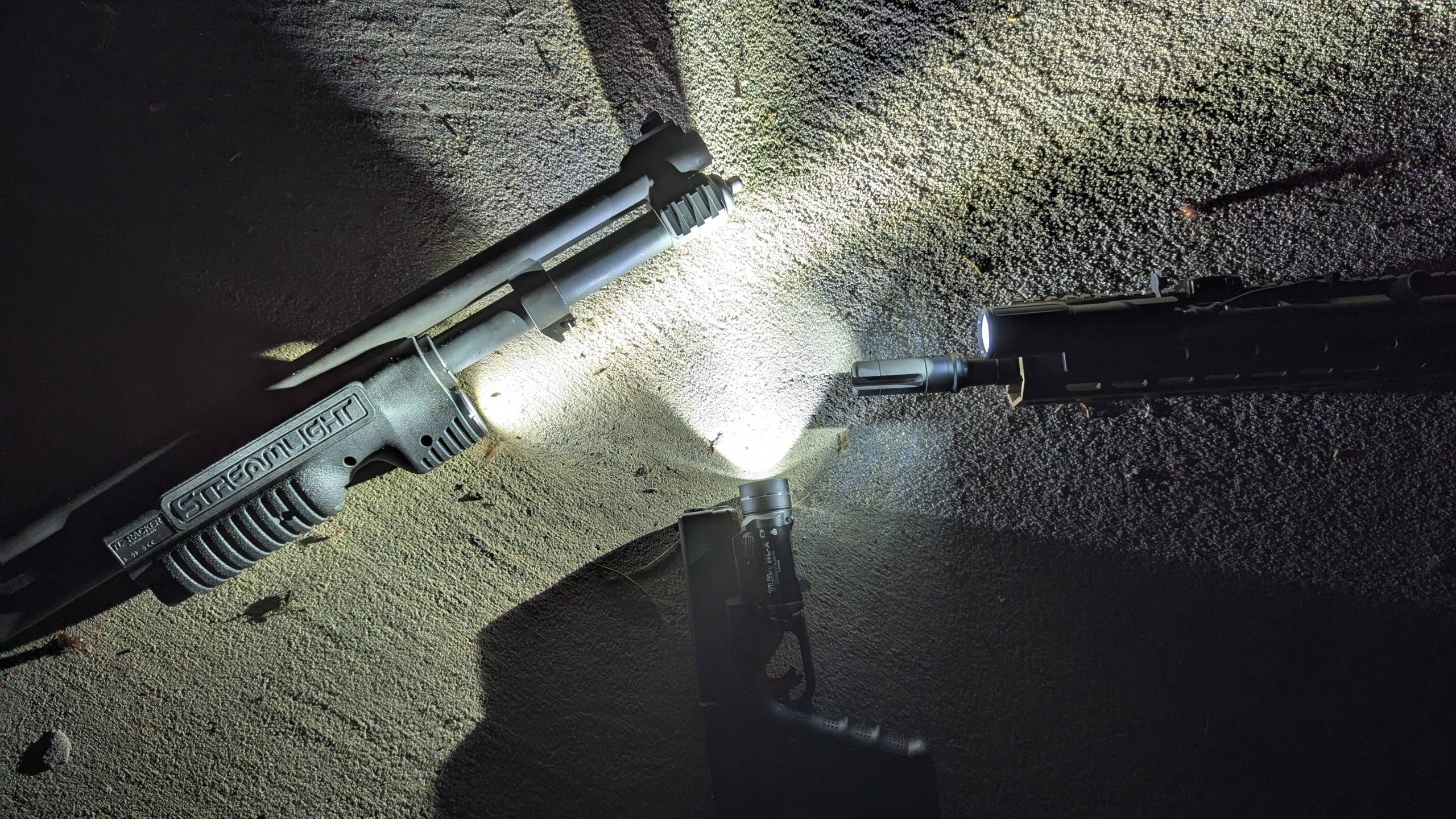
With a long gun, you have more options. In general, mount the light as far forward as possible. This minimizes barrel shadow, where the barrel blocks a large portion of the light. Depending on the length of the gun, you could run into issues accessing the light.
This leads us to pressure switches and remote switches. Remote activation allows you to trigger the light when it sits out of thumb reach. Place pressure switches so they are easy to find and press when you establish a firing grip. Controls should let you use momentary and constant modes quickly.

For shorter guns, this is not a big deal since a clicky tail cap or compact switch is still fairly easy to reach.
Basic Weapon Light Tactics — Flash, Assess, Move
Remember that weapon lights are designed to establish identification of a threat. When you hear a bump in the night, do not turn the light on and start swinging it around. If you swing the light, you become a giant beacon for any potential threats.
That brings us to a critical tactic, light discipline. We do not want the light on constantly. Most lights have a momentary mode, and that is where light discipline lies.
Flash. Assess. Move. Use that sequence every time you use a weapon light: a quick flash to gather visual data, an immediate assessment, then movement to reduce exposure.

If I am searching for a threat, I flash the light quickly in the direction I think the threat might be. When I flash the light, I assess everything the beam shows: obstacles, potential cover, ingress and egress routes, and any other visual clues.

After you assess, move. You just revealed yourself with the flash; move quickly to cover if needed and re-establish a safe firing position. If you find a threat, keep the light on and act as legally appropriate.
Muzzle Discipline and Weapon Light Tactics — Keep the Muzzle Safe
Lights sit at the end of the gun, so anything you point the light at, you are pointing the muzzle at. That does not mean there are not ways to safely use your light without pointing the gun at something you do not want to shoot. Muzzle discipline is every bit as important as light discipline.
Inside the home, you might not be directly pointing a rifle at a family member, but bullets go through walls and you could be indirectly pointing the gun at family members and neighbors.

There are two practical tactics that let you keep the muzzle oriented in a safe direction while getting light to reveal a room. Both rely on powerful, modern lights and bouncing light off surfaces instead of pointing the muzzle directly at an area you want to see.
Baseboard Method — Skip the Beam, Flood the Room
The baseboard method is like skipping buckshot across the floor. It suits the low ready. Point the WML beam low, at the baseboard or floor in front of you. The spill will bounce and broadly illuminate the room, often enough to detect threats without muzzling everything you glance at.

Umbrella Method — Diffuse Light from High Ready
The umbrella method works with the high ready. Point the light upward at a wall or ceiling so the diffused light fills the space. This is most effective in rooms with low, light-colored ceilings. Higher ceilings dilute the effect.

The umbrella method can push light around obstacles and reveal threats through shadow and silhouette instead of directly pointing the muzzle at them. It is a game of reading tells caused by shadow, and it is surprisingly effective.
Modern Optics, Modern Problems — Red Dots and Bright Beams
Most modern guns are red-dot ready, and red dots are excellent for low-light shooting. They can also conflict with powerful weapon lights. Bright beams can wash out a red dot if the dot is set too low.

To avoid washout, set your red dot brightness higher than it feels necessary in the dark. I typically use a setting or two below maximum so the dot stays visible when the light fires. Auto brightness settings rarely behave the way you want during a sudden flash from your WML — manual settings are better.

Keep your bedside gun staged with the dot brightness up and in manual mode. Cowitness iron sights and etched 1X prisms are solid backups because they do not wash out the way an electronic dot can.
READ MORE HERE: Vortex Venom Enclosed Micro Red Dot Review
Train, Train, Train — Practice Until It Is Natural
The best thing you can do is take a class. A low-light fighting class will show you what works and what does not under an experienced instructor’s watch.
If class time is not an option, effective dry-fire practice still helps. Practice the flash, assess, and move cycle. Practice the umbrella and baseboard methods. Get used to how the light feels and how it changes your sight picture.

The good news about home defense is home-field advantage. The average homeowner only has one building to learn. That makes practicing household-relevant movements and angles easier than trying to learn dozens of unfamiliar buildings.
Weapon lights and proper tactics are not complicated. They do require disciplined practice. If you have followed these steps so far in the article, you are pointing in the right direction.
Quick Gear Specs — What to Look For in a WML
| Recommended Lumens | 800 to 1,200 (momentary burst capable) |
|---|---|
| Effective Candela | ~20,000 candela for usable spill |
| Modes | Momentary and constant |
| Activation | Clicky tail or pressure/remote switch depending on platform |
| Mount | Clicky tail or pressure/remote switch, depending on platform |
Pros & Cons — Honest, Practical Takeaways
- Pros: Allows PID, can disorient threats, and supports low-light aiming when used properly.
- Cons: Points muzzle where you look, can wash out optics, and is a liability if used without training.
Related Reads from GunsAmerica Digest
Available on GunsAmerica Now

Travis Pike is a dedicated firearms writer, a Second Amendment Advocate, and a subject matter enthusiast for all things firearms. He is an amateur competitor with dreams of one day not coming in 4th place at a local defensive match. If he’s not putting text to word processor, he’s likely spending time with family, enjoying Florida’s Nature Coast, or drinking hipster beer. As the resident Florida man he has a preference for obscure guns and calibers.
Experience
- Hunter – Long time deer and hog hunter in the swamps of Florida
- Instructor – Volunteers to teach basic firearm safety classes to kids, adults, and cats
- Wannabe Competitor – Has recently dipped his toes into competitive shooting and has happily discovered an expensive hobby.
- Marine – Served five years with the infantry before transferring to the First Civ Div.

