

Known for large-scale, technology-driven installations that combine everyday objects, electronics, sound and elements of the natural world, Indonesian artist Bagus Pandega explores the parallels between the mechanics of organic life and human technology. His practice centers on experimenting with hybrid ecosystems built from speakers, sensors, lighting components, circuit boards and plants—assemblages that come to life, move, respond or produce sound when activated by viewers, setting in motion a circulation of resources and energies between organic and technological processes.
For his first institutional debut in New York, “Daya Benda,” on view at the Swiss Institute through January 4, 2026, Pandega presents three ambitious installations that examine the interdependence inherent in the use of natural resources, transforming the space into a complex living laboratory where these hybrid collaborative systems between human and organic unfold before visitors’ eyes.
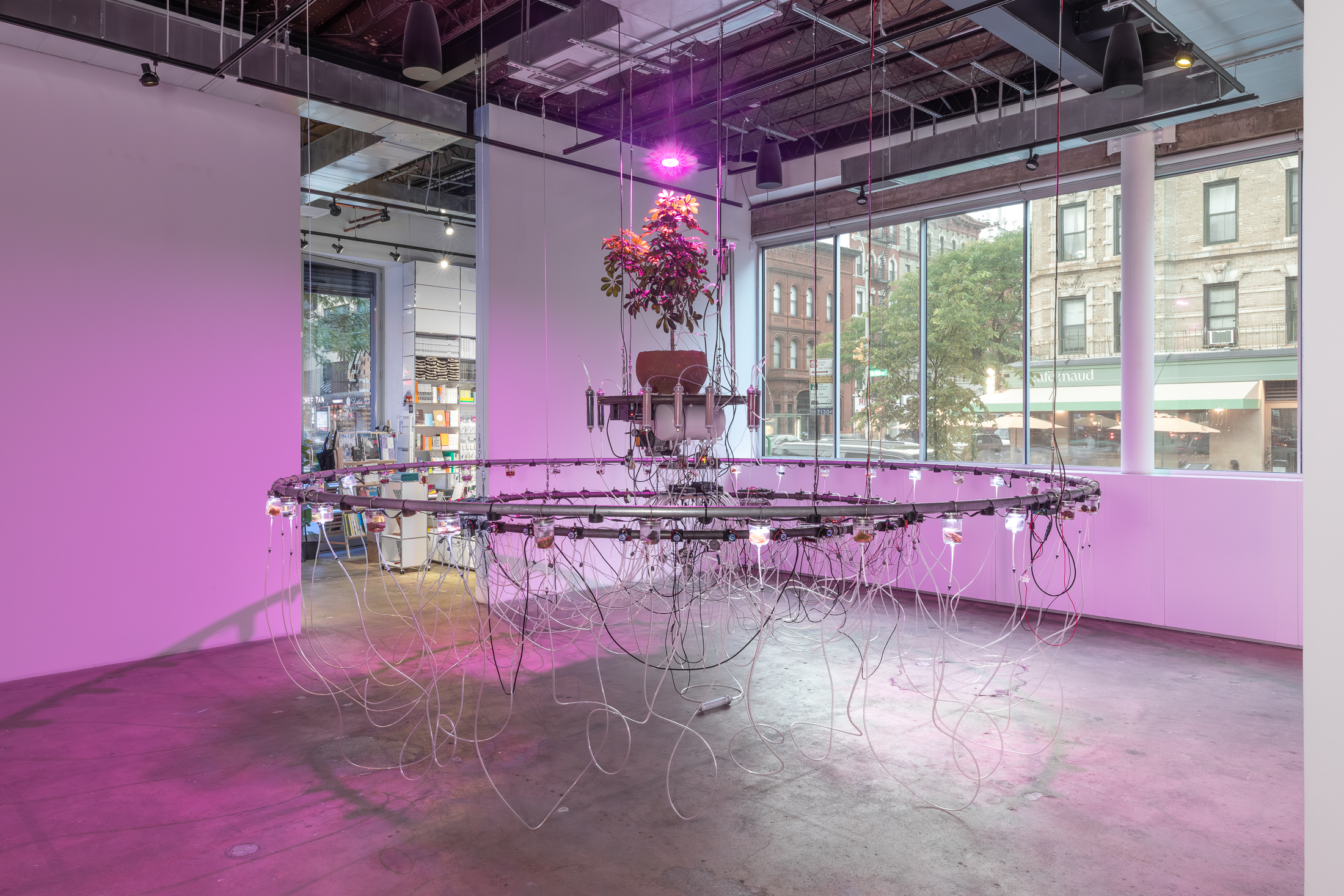
The heart of the show, encountered immediately upon entry, is Hyperpnea Green (2024), a large suspended mechanical sculpture composed of concentric rings lined with clear vessels containing Indonesian minerals, common American houseplants, lights and a music box. All components are wired into a single system connected to an oxygen machine and a biofeedback mechanism that responds to the metabolic signals of both plants and people. As viewers exhale carbon dioxide, the installation releases oxygen into the space. Borrowing its title from the medical term describing rapid or deep breathing to meet increased oxygen demand, the work becomes a live experience of the unequal distribution and extraction of one of the planet’s most precious elements: oxygen. Through this circle, Pandega reveals our dependency on the natural world—one we simultaneously deplete through unstable consumption—while illuminating the interdependence between organic and artificial systems. By embedding viewers within these feedback loops of electricity, breath and movement, Pandega foregrounds relations shaped by cycles of life, extraction and reciprocity.

He began developing his own oxygen-concentrator machine during the COVID pandemic, initially as a civilian tool for personal survival. “In Indonesia, my family and I had to wait in extremely long lines just to get oxygen, and I didn’t want to take that risk. So I began researching and building several oxygen machines myself,” he recalls. The model now integrated into Hyperpnea Green is the most efficient one he created at that time, approaching medical-grade functionality.
Pandega’s background is in sculpture—he graduated from Institut Teknologi Bandung with a BA in fine art. After school, however, he moved away from traditional sculptural practice and began building mechanical and electronic pieces, initially as a means of earning a living, then as a way to reimagine contemporary sculpture as something capable of addressing the issues of our time, especially the growing tension between anthropogenic interventions and natural processes. “I moved very slowly at first, working with simple mechanisms, and I kept developing from there. It’s been about fifteen years of continuous experimentation and growth,” he acknowledges. What initially aligned with the legacy of kinetic art soon took on a different urgency as his machines became vehicles to address resource inequity, the disruption of ecological balance and the consequences of human technological dominance over nature.
These themes are particularly resonant for Pandega and his generation in Indonesia, who have witnessed the country’s accelerated modernization often at the cost of its natural resources and biodiversity—marked by uncontrolled deforestation and aggressive extraction fueled by global markets.
“After COVID, I realized I could take these machines further. I couldn’t stop thinking about how the ecological situation in Indonesia has changed—especially the constant deforestation,” he reflects. “Even before COVID, it was terrible, but we had somehow gotten used to it. Every year, you see forests burning everywhere. During COVID, there was a pause, and you could see the Earth recovering a little from mining and other pressures. It made clear what our interventions were causing.”
This is why, in Hyperpnea Green, he created a direct relationship between artificial and natural oxygen producers. “At the top of the piece, there’s a real plant, and at the bottom, the artificial oxygen machine. The plant controls the activity of the artificial system,” he explains, noting how it subtly stages a subverted circle of interdependence between humans and nature.

From this first installation onward, it’s evident that Pandega approaches his practice as a laboratory—turning art into open research that tests phenomena, recreates them and proposes hybrid alternatives through works conceived as hypotheses rather than fixed statements.
Although the idea and development are entirely his, the original blueprint for the concentrator machine came from scientists and the medical field. Pandega adapted and modified it, using the imaginative power of art to reconfigure and challenge existing scientific systems and official knowledge.
This is why he describes his do-it-yourself methodology as a “hacker approach,” working with familiar technologies and redirecting them to activate mechanical or chemical reactions that generate sound or movement, while implying a collaborative agency between human presence and the natural entities involved. “I feel more like a hacker—a mechanical hacker. I don’t invent things; I modify them and push them further,” he notes, pointing out that many instruments in the exhibition are synthesizers whose functions he has transformed from sonic to mechanical.
In the adjacent small room, another installation features an acrylic tank filled with electrolyte solution—an aquarium that appears empty but is alive with transformation. Inside, a tree branch undergoes continuous nickel plating. Throughout the exhibition, the branch slowly accumulates metal, its form shifting over time. A live feed of the work is projected onto a nickel-containing LED screen on the SI rooftop, visible from the terrace and the street below. Enlarged and flipped upside down, the rising hydrogen bubbles appear to fall like rain or tears.
Titled Anim Wraksa (2025)—from Kawi, or Old Javanese, meaning “the spirit of the tree”—this work condenses dense symbolism and advanced technological processes into a single alchemical system. Due to today’s global demand for nickel in batteries for computers, phones and electric vehicles, Indonesia—the world’s largest exporter—faces immense ecological damage from nickel extraction, including deforestation,

“Nickel plating is everywhere—in spoons, earrings, anything with that silvery finish—but the public rarely sees the actual process,” Pandega says. “I wanted to magnify that process and connect it with the ecological and mining issues in Indonesia.” Here, the logic of extraction reverses: instead of removing nickel, the metal accumulates on the plant. “By the end of the exhibition, the sculpture changes shape because the plating keeps building. It’s time-based work, but not human time—another kind of process, collaborating with natural rhythms.” In this sense, the work encourages viewers to attune to nature’s “deep time,” a durational logic radically different from linear, human-centered temporality.
Considering these works, even if Pandega never states it outright, viewers inevitably recall how Indonesia has been constructing vast new cities—often ecological catastrophes masked as national progress. Between 2001 and 2024, the country lost 32 million hectares of forest, roughly 20 percent of its 2000 forest cover. The new capital Nusantara—rising in the rainforests of East Kalimantan—is the starkest example: framed as a smart “forest city,” it is effectively an artificial urban project carved into one of the world’s most biodiverse regions. Deforestation in the capital zone reached 18,000 hectares between 2018 and 2021, with activists warning that nearly half the remaining forest is now threatened by construction, mining pressure and infrastructure development.
While Pandega’s work is not literal in its address of these topics, he pushes his practice toward political engagement. “I don’t always show it directly, but the ideas are there,” he says. “I’m constantly criticizing government policies on nature—mining, land use, everything.”

Parallel to this critique, many of Pandega’s works draw on alternative paradigms beyond the Western extractive model, recovering more ritualistic and relational modes of being in connection with nature. In several installations, technology meets ritual and spirituality through the use of traditional instruments and their sounds—ancestral technologies that embody more harmonious ecological relations.
One example is A Diasporic Mythology (2021), a kinetic and sound installation commissioned for the 10th Asia Pacific Triennial. Developed from his research into historical narratives and the circulation of instruments, it combines Indonesian and Japanese string instruments (Taishogoto, Mandaliong, Balinese Penting, Kecapi Sijobang, Lombok Penting) with tea plants and MIDI-sprout sensors that translate plant biodata into sound. The result is a hybrid chorus articulating the interconnectedness between human and plant life, as well as the cultural and historical exchanges between Japan and Indonesia.
For Pandega, these works engage what could be called “ancestral technologies”—tapping into older forms and tools to imagine alternatives to contemporary anthropocentric systems. “My practice isn’t always about cutting-edge devices. I often work with mechanical, basic systems and mix them with technology and programming. I don’t want to show ultra-advanced devices just for the sake of it,” he explains. This search for analog mechanisms, prototypical circuits and evident processes reveals the labor, vulnerability and ingenuity of his DIY methodology, reinforcing art as a system of relations rather than a fixed object, offering open-ended hypotheses rather than answers.

This is also evident in Putar Petir Racing Team (2025), the new commission on the second floor—a work that functions as both sculpture and a fully operational electric motorcycle, entirely built from scratch. Painted in gleaming purples, pinks and golds, it draws on the jamet aesthetic—a Javanese-metal street style tied to drag racing. A nearby video documents a drag race that Pandega organized in Bandung, where his electric motorcycle competed against gasoline-powered models. The installation includes a custom racing jersey and helmet from a fictitious team, displayed against a wall painted in the familiar green of modest Indonesian homes.
Here again, Pandega presents a staged hypothesis—an experimental phase in an ongoing inquiry. “I like showing strange possibilities, objects that seem both made and not made,” he notes. Ultimately, Pandega’s work is research-driven, embracing an open-ended practice of questioning and testing scenarios that is more akin to scientific inquiry. “I try to keep it open-ended—an abstraction of something that exists in the world, presented as a hypothesis of an alternative. It’s about how nature and technology can coexist, how they can work together to build something better rather than destroy each other.”
His practice is a long-term project, one whose results may not emerge for years. Yet working at this intersection of human mechanics and organic mechanisms remains one of the most vital positions from which to acknowledge—and attempt, through the imaginative, disruptive power of art—to rethink the ecological and humanitarian crises produced by our existing systems of knowledge, science, politics and technology.
More in Artists


