

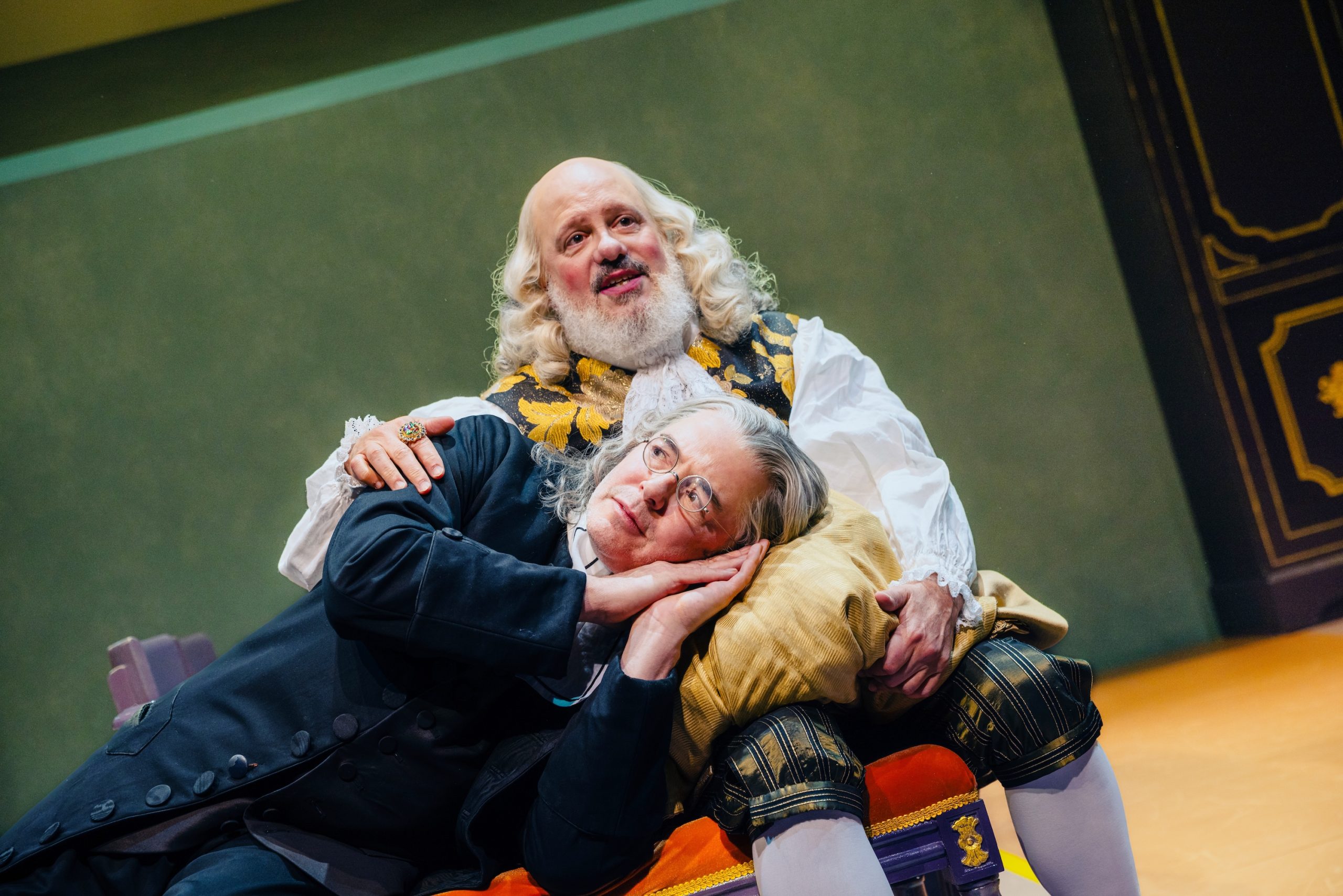
One is tempted to execute a stunt review of the new Tartuffe in heroic couplets, as the late, great Richard Wilbur translated Molière’s comedies for six decades, beginning with The Misanthrope in 1955. For example, I could open with:
This shoddy Tartuffe with its lazy rhymes
Is a cracked church bell that gratingly chimes.
But I won’t subject you to my doggerel; I had to choke down so much already at New York Theatre Workshop. Lucas Hnath’s version of the 1669 French classic adopts a defiantly dopey attitude to the original Alexandrine verse, spitting out countless false rhymes (special/medal), pointless recycling (bastard/disaster—twice!) and triplets that seem to relish their own insipidity (“to touch your ass is no more crass than worshipping at holy mass”). Wilbur opted for a sleek line of iambic pentameter, and his bouncy euphony, highly playable and delightful on the ear, remains the gold standard. Hnath’s effort, by contrast, is a collegiate prank, a hectic hash of profanity, stoner chuckles and feints at moral philosophy. He seems unconcerned if his rhyming falls flat or his characters sound like idiots. The outraged matriarch Mme Pernelle (Bianca del Rio, haute camp) lambastes her relatives for being louche and uncouth:
I am stunned you think it’s okay that the cleaning woman has so much say, be that as it may,
go ahead and let the maid just have her way, I can no longer stay and watch you all fall into
moral decay.
I’m not cosplaying rhyme police; this is cheap stuff. Once you hear Hnath’s weakness for flat or tinny notes, you can’t un-hear it, and it will bug you for two hours sans intermission. For some reason, he formats his script in prose, as if to bury the juvenile wordplay.
What a misguided affair from such an accomplished team. Director Sarah Benson has collaborated intensely with living or modern playwrights (her productions of An Octoroon, Fairview, and Blasted were unforgettable) but sinks under the weight of a hyper-stylized design and resolutely unfunny text. Hnath has been justly celebrated for form-bending in weird, metatheatrical dazzlers such as Dana H. and A Public Reading of an Unproduced Screenplay About the Death of Walt Disney (which Benson staged at Soho Rep). It’s unclear what the goal was here. Drunk Theatre does French Baroque? Hip-hop Molière without actual rapping?

Tartuffe is a clockwork farce about the hypocrisy of moralizers and the credulity of followers. Wealthy patriarch Orgon (David Cross) has fallen under the spell of Tartuffe (Matthew Broderick), a nondenominational preacher who espouses a vaguely Catholic credo of sexual abstinence and mortification of the flesh. Naturally, this doesn’t prevent Tartuffe from gorging on Orgon’s larder or lusting after his attractive wife, Elmire (Amber Gray, glamour and grace). Orgon’s son, Damis (Ryan J. Haddad, petulant delight) sees through the hypocrite—as does mouthy maid Dorine (Lisa Kron) and mousy daughter Mariane (Emily Davis). Perpetually posing with a frozen smile and singsong delivery, Ikechukwu Ufomadu pops in now and then as Mariane’s nincompoop suitor Valère. There’s a tasting menu of acting styles clashing onstage, but Ufomadu really seemed to be in his own play. I kinda wish I’d been at that one.
To be sure, it’s a murderer’s row of gifted actors, and David Cross (Arrested Development) cannot not get laughs playing a confident dolt. Davis simpers and grimaces deliciously as Orgon tries to arrange a marriage between her and Tartuffe, and Haddad throws very amusing tantrums. Kron seems baffled by the world around her, but manages dry one-liners. As Elmire’s brother and a voice of reason, Francis Jue may not have the flashiest role, but he finds a pleasing balance of witty restraint and outrage. About Matthew Broderick, I don’t know what to say. After seeing umpteenth performances from him on Broadway and Off-Broadway, I’m still shocked by his limited range and strangulated physical vocabulary. His Tartuffe talks (and walks) like Kermit the Frog in a frock coat. His understated squeaks render some lines droll, but on the whole, Broderick recedes into the muted green walls (mock-Louis XIV furnishings by set collective dots).

Benson and her designers deserve credit for not setting Tartuffe in a modern-day megachurch or MAGA country. Her actors are arranged in a hermetically sealed, cartoon version of 17th-century France, with sumptuous costuming by Enver Chakartash so colorful and candied it’s like a crate of macarons on legs. Sound design by Peter Mills Weiss mixes boxing-match bells and industrial droning, and interstitial dances by Raja Feather Kelly gesture (superfluously) toward the characters’ lives of leisure, like mimed ballroom dancing and tennis. Heather Christian contributes a dirge at the end that seems to point out everyone is guilty of moral certitude, which kills the already decomposing satirical vibe.
Look, finding comic gold in Molière is famously hard. The antique Gallic humor is refined and mannered, the Wilbur translations, as mentioned, are hard to beat, and the structured nature of the farce needs a super-deft, well-directed group of clowns to keep it popping. This past summer, Red Bull Theater’s The Imaginary Invalid actually worked. Adapter Jeffrey Hatcher opted for a prose translation that went straight for the funny bone. It was all there: visual gags, silly accents, runaway mugging, jokes about Les Misérables. Punch lines that punched. At New York Theatre Workshop, it’s style without substance—which Molière mocked in the first place.
Tartuffe | 2 hrs. No intermission. | New York Theatre Workshop | 79 East 4th Street | 212-460-5475 | Click Here For Tickets

More in performing arts


