

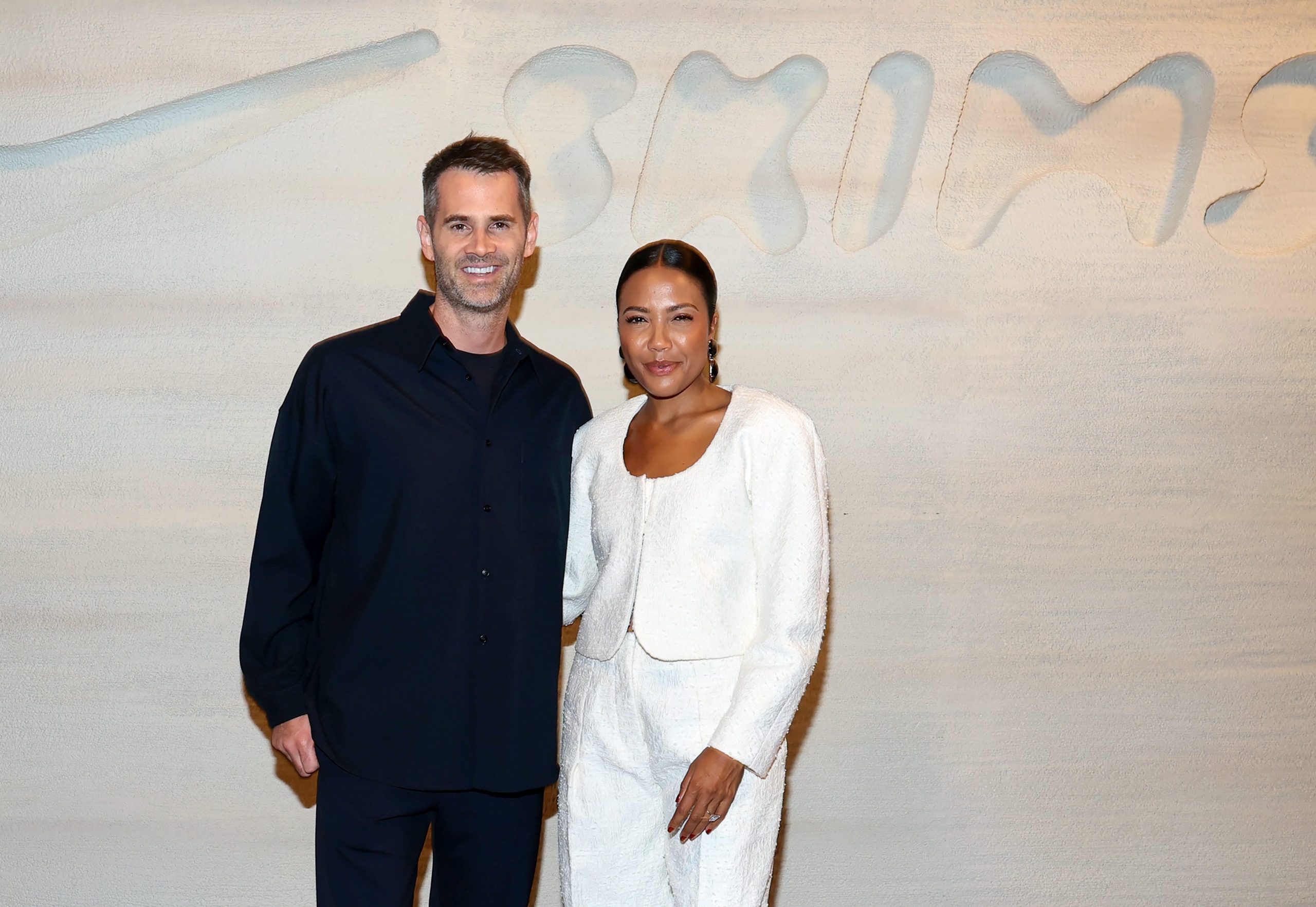
With a freshly minted $5 billion valuation, Kim Kardashian’s shapewear company Skims has become a case study in modern celebrity-backed retail done right. While Kardashian is indisputably the face of the brand, her co-founders, Emma Grede and Jens Grede, are the architects and operational engine behind its success. The husband-and-wife team also oversees a growing portfolio of brands within and beyond the Kardashian-Jenner universe.
“If the KarJenners offer the rocket, the Gredes bring the fuel,” Christine Russo, principal at Retail Creative and Consulting Agency and U.S. Correspondent for Retail Technology Innovation Hub, told Observer. “Whether it’s celebrity-founded or not, they understand the fragility of attention and are able to kick a flywheel and support it with functionality.”
Emma Grede, 43, began her career in London, while Jens Grede, reportedly 47 (his exact birthday isn’t public) grew up in Sweden. The two met through their work in fashion. Emma worked as a fashion show and events producer before launching a talent and events management company in 2008. Jens went on to co-found the denim label Frame in 2012, the same year the couple married. He has also partnered on multiple ventures with his childhood friend Erik Torstensson, including fashion marketing firm Saturday Group.
In 2015, Emma met Kris Jenner and pitched the idea for a denim brand built around Khloe Kardashian. The result was Good American, which launched in 2016 and became one of the most successful celebrity-backed apparel brands to date. Today, Jens serves as chairman of Frame and CEO of Skims, while Emma is Skims’ chief product officer. The couple has four children.
Rewriting the celebrity playbook
Together, the Gredes have co-founded and hold ownership stakes in Skims with Kim Kardashian, Good American with Khloe Kardashian and Safely with Kris Jenner. Emma also co-founded Off Season in partnership with fashion designer Kristin Juszczyk, the NFL and Fanatics, while Jens continues to build Frame as a standalone fashion brand.
Emma has emerged as a visible business figure in her own right, appearing on Shark Tank as the show’s first mixed-race woman investor and on the U.K.’s Dragon’s Den. In 2022, the Gredes, alongside Kim Kardashian, received the Council of Fashion Designers of America’s inaugural Innovation Award.
Their celebrity-driven ventures haven’t been without missteps. Skims faced early backlash over its original name, Kimono (a type of traditional Japanese robe), prompting a swift rebrand after criticism over cultural appropriation.
“This is illustrative of the very responsive approach that they’ve taken in staying on top of consumer trends, listening to feedback and using it to iterate and improve what the brands offer,” Sky Canaves, principal analyst of retail and ecommerce at eMarketer, told Observer.
Sustainability remains a weak point for Skims, Canaves noted, which has scored poorly on materials and sourcing and has yet to meaningfully address those concerns. That scrutiny could intensify as the brand expands into Europe, where environmental regulations are stricter. Still, Canaves added, “I can’t think of a comparable force in the fashion industry today across multiple brands that is not a major conglomerate.”
“Emma and Jens Grede have built brands with backbone,” Albert Varkki, retail strategist and co-founder of luxury leather brand Von Baer, told Observer. “Each label in their portfolio has a crisp product thesis—Skims focuses on fit and solution wear, Good American focuses on inclusive denim—and they keep building with that discipline. That clarity and strategy are why their repeat-purchase rate is unusually strong for celebrity brands.”
According to Varkki, the Gredes have rewritten the celebrity-brand playbook. “Instead of putting all the weight on hype drops, they built operational consistency—stable SKU architecture, replenishable hero products and real fit testing. That stability is what gave celebrity branding legitimacy again.”
Fashion brands are rarely family businesses. The industry tends to elevate singular creative figures—Ralph Lauren, Vera Wang, Calvin Klein—but the Gredes are quietly reshaping that model from behind the scenes. Their partnership, both personal and professional, remains central to their success.
“It has been a gift and a blessing that we had a working relationship together for just under a year before we actually started dating,” Emma Grede said during a conversation with her husband on her podcast Aspire.
“I grew up in a home where work and life were always intertwined, and it wasn’t something that my parents were trying to separate. They got a tremendous amount of joy and value out of it, just like I believe I’m getting a tremendous amount of joy and value out of working with you,” Jens Grede said. “We’re lucky now that we don’t have to argue so much about who’s taking out the trash. But for most people, the division of roles and responsibilities in a home, in any relationship, it sure looks like work to me. So I don’t make that much distinction.”


