

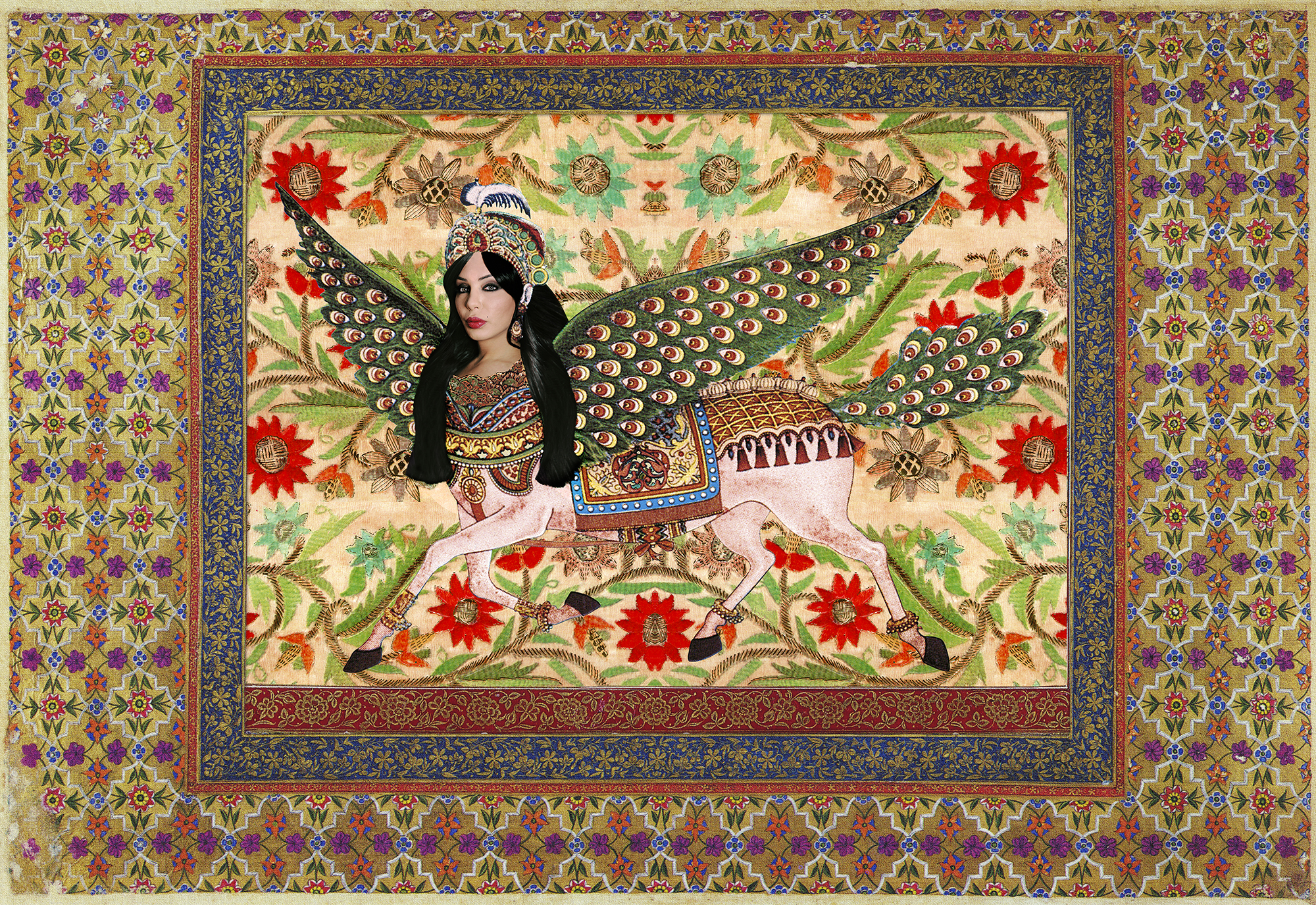
One cold Oslo morning in mid-November, the kind where each hour of daylight is a gift and the air chills any optimistic thought of lingering outside, the opening of “Deviant Ornaments” at the National Museum of Norway marked a significant shift. Installed in one of the most prominent institutions in the Nordic countries, the exhibition explores queer experiences in the Islamic world, a topic often considered too delicate and politically charged for museum spaces.
“It started with the Queer Culture Year in 2022,” the National Museum’s director, Ingrid Røynesdal, tells Observer. “We asked ourselves the question, what should we do? What can we do to really amplify or embrace a new and broader understanding of gender and sexuality?”
That question led the institution to bring in co-curator Noor Bhangu, whose doctoral research on queer identities in Islamic contexts inspired the show. “Her project was so vital and so clear,” Røynesdal recalls. “We were super inspired by her approach, which fits very much together with the whole umbrella of the museum programming.”
Røynesdal doesn’t sidestep these concerns when dealing with the nuances of multiculturalism and queer identity. “We need to go into those topics with respect and responsibility,” she says. “It’s not the obvious exhibition.”
Not obvious, no, but important to start these kinds of conversations. In a country where the asylum acceptance rate remains relatively high, many second-generation youth navigate two parallel sets of expectations: the social liberalism of their adoptive Norway and the more traditional and religious values carried across borders by their families of origin. “As a museum, we need to be relevant to an increasingly diverse society,” Røynesdal acknowledges.
While pussyfooting around Islam and not tackling the problematic aspects head-on, “Deviant Ornaments” still carries the good type of tension of a show that could almost certainly not happen in most of the places whose cultures are referenced. In it, the rereading of queer expressions in ancient artifacts or its expression in contemporary works happens within a progressive Scandinavian interpretive framework that permits seeing the difference between religious dogma and Islamic lived culture while assuming safety in doing so. In that, the exhibition is illustrating how institutions globally are trying to adapt, sometimes haltingly, to a society whose values are shifting in real time.
New interpretative strategies at the National Museum of Norway
Reflecting contemporary concerns comes more easily to more recently opened museums, possibly in places that didn’t have a longstanding institutional art tradition, like the Louvre in Abu Dhabi or the National Gallery of Singapore. Europe has, of course, a different set of issues. Rather than starting from scratch to go right into ultra-contemporary thinking, European museums today are faced with a need to revamp their collections, as well as making sure their temporary shows (which often draw pieces from the collections) are up to speed with contemporary discourse.
Think about the National Gallery in Rome, which long ago abandoned chronology in favour of curation, or the MUCEM in Marseille, the latter of which is building its temporary exhibitions out of the relics of what used to be colonialism-based racist institutions.
Keeping up with the changing tides of culture is definitely a struggle and it implies that we need to seriously think about what to shed light on and what we are happy to tuck away in a museum storage’s darkest corner.
The National Museum of Norway, taking advantage of its upgraded reconfiguration within the new blocky building on the waterfront in 2022 that allowed the merging of four major institutions focused on art, craft, design and architecture, has been deeply reconsidering what has long been missing from its art history narratives. The current collection comprises some 400,000 objects. “It’s a huge mandate,” observes the director. “What matters now is using that breadth to open up new interpretations, to present those objects within different frames, opening up the potential to a new understanding.”
The main collection of the museum follows the standard chronological narrative but slightly shifts perception of different epochs—for example, foregrounding women’s social worlds rather than tucking them into domestic categories. Orientalist works come with panels prompting viewers to interrogate the context in which they were created, rather than take them at face value. The permanent collection itself no longer feels immovable. “We change the permanent collection every Monday to reflect new themes,” Røynesdal explains. The work continues beyond the gallery displays and extends to a mediation program, which is meant to build bridges with different audiences, even those who might not be familiar with a museum environment.

MUNCH: a contemporary context for a timeless artist
In the waterfront of the Tøyen area of Oslo, rising to a height of 57.4 metres above the shore, the slanted gray MUNCH museum is impossible to miss. It’s in this ultra-contemporary building that the legacy of Edvard Munch is being read as an ongoing reflection, rather than a closed heritage. Walking through, it’s easy to see how Munch’s artistic preoccupations, emotional and existential turmoil and the vulnerability of the body resonate strongly with contemporary concerns about identity and mental health.
The museum emphasizes this by organizing Munch’s collection thematically, from nudes to love and loneliness. These and other universal themes allow us to see how, for example, in his approach to the naked body, the artist has been egalitarian between men and women, and how the human emotion therein traces a direct line to contemporary works of, say, Bacon or Marlene Dumas.
The capital letters of the museum name and banner on the façade make it obvious that the artist has been turned into a brand. However, it’s through the tools of capitalism, the museum is able to remain appealing and connect the legacy to the present. In their 2025 program, we saw this in action in shows like “Lifeblood,” which linked Munch’s work to changing medical histories and attitudes about illness and bodily vulnerability. There, his preoccupations were reread as part of broader social and historical transformations within Norway.
Now and then the museum hosts shows that don’t reference Munch directly but echo his themes in a contemporary form. An example is the current MUNCH Triennale, titled Almost Unreal and focusing on virtual realities. Unfolding across different floors, the show explores a global and technologically mediated present through the work of some 20 contemporary artists from various countries. Their works include a lot of narratives from the Global South, as well as diaspora narrations, from Indonesian artist Natasha Tontley, who explores fictional accounts of the history and myths surrounding “manufactured fear” and the afterlife, to Marseille-based Sara Sadik’s Y2K-inspired video featuring teenagers from the derelict Seine-Saint-Denis neighborhood in Paris, negotiating ideals of society.

Internationality and the Astrup Fearnley Museum
The Astrup Fearnley Museum of Modern Art in Tjuvholmen is part of the new cultural quarter developed in the framework of Oslo’s “Fjord City” project. Hosting one of the richest and most diversified private collections of contemporary art in Scandinavia, the museum is in yet another incredible building, this time designed by Renzo Piano with a boat-meets-Norwegian-wooden-house feel.
The interior of the institution, characterized by sharp corners and rooms that ramify in an unexpected way, forces the curation of the collection and the temporary exhibition to imagine inventive solutions. Works are presented in a non-linear way while through the glass,
Its founder, Hans Rasmus Astrup, collected works boldly, often against prevailing market tastes. “When the owner of a private museum passes away, you can go two routes. You can either keep the collection as it was, presenting it more like a museum of the collector, or you go the route of the Whitney or Louisiana, where the initiative is private takes on the role of a public institution,” the museum’s director, Solveig Øvstebø, tells Observer. “When we think about our museum’s DNA, we see that ours is artistically driven.”
When Øvstebø was chosen as the director of the museum, coming back to Norway after years at the Renaissance Society in Chicago, she saw an opportunity to diversify what was already a serious collection. “There were important pillars within the collection, but it needed to be broadened and to include more voices,” she says. Besides acquiring new works that filled gaps in the collection, she curated rotating exhibits, small in size but very thoughtful: “While it’s good to look at what’s missing in the collection, in terms of identity and global diversity, it’s important not to lose sight of another element: artistic diversity.”
She conceives these rotating exhibitions as small conversations between pieces. “Right now, for example, we have a conversation between works by Nicole Eisenman and Michal Lopresti that in different ways portray isolated figures, a particularly contemporary experience, one might say, but the possibility of connection is also suggested. On the opposite wall, you have Nan Goldin, which adds to all these different ways of coming into the persona and psyche of being human.”
Some of these conversations are deliberately uneasy and meant to disorient the viewer. Like when Odd Nerdrum, a Norwegian painter who openly rejects contemporary art, is shown in the same room as Jeff Koons’ flashy and ultra-pop golden ceramic Michael Jackson with its little monkey. Ultimately, Øvstebø believes in curating as an adaptive process rather than a thesis to prove. “It’s very dangerous to make manifestos,” she concludes. “A collection is organic, like we humans are.”
More in Museums


