Performance art is always a negotiation between procedure and provocation. It is an art aimed at infiltrating a neural pathway, at constricting the muscles behind one’s neck, at confiscating the right to familiarity and narrative. It emerges, by these very virtues and not in spite of them, as an art of entertainment. Whether empowered by traditional intentions or iconoclastic ones, performance art functions by implicating the audience rather than just addressing it. If the audience measures the value of entertainment, performance art is entertainment that appraises the audience’s values. In other words, to be entertained by performance art is to be at the mercy of it. Performance art, therefore, has a distinct urgency within Los Angeles, a city that is in a perpetual state of rehearsal. By way of Roy and Edna Disney CalArts Theater (REDCAT), Los Angeles performance art has become all the more experiential, edifying and electrifying.
Cornered in a part of Downtown Los Angeles swamped in contemporary art museums and performance centers, REDCAT has become a nucleus for a range of experimental work in the city. REDCAT draws a much more eclectic crowd than its neighbors—an assortment of artistic vanguardists and wayfarers, MFA candidates, hangers-on and prospective or participating performers. Every Thursday in November (except Thanksgiving), REDCAT presented a program consisting of three stage works for the 22nd annual New Original Works Festival. The NOW Festival is composed of performers and collectives based in the greater Los Angeles area, with nearly all the pieces being interdisciplinary in one way or another, blending shades of dance, theater, opera, poetry, film and satire.
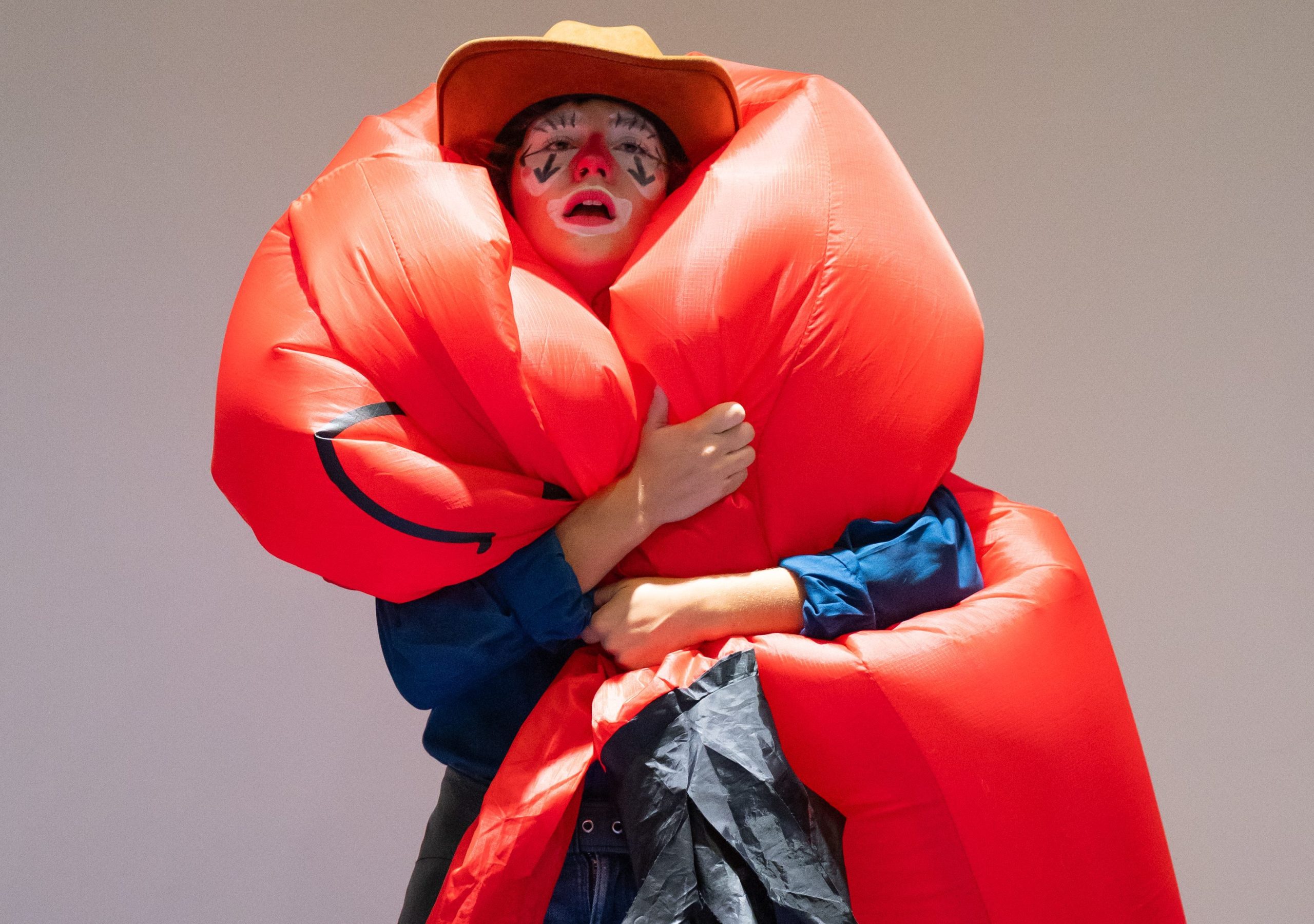
The most compelling entry of the first weekend was BEG, a cacophonous cabaret loosely consisting of rodeo clowns, techno raving, bluegrass ditties played on a tinny banjo, shaving cream sommeliers, and an overwhelming quality of sadomasochistic Americana, all topped off by Elvis the King. Long Beach-based artist Jacob Wolff directed the experimental opera as both a limerick and a lament to the rodeo clown, exploiting the fine tension between embarrassment and entertainment. On stage, Wolff’s performers gyrate and convulse, singing and shouting, doing everything within their power to distract and disorient. It’s a slippery work, one of those that both defies and defiles expectations of Western art and culture. In one instance, an automated voice reads out a definition of “good” art as defined by classical standards: balance, symmetry, certainty, centrality and beauty. As the definition intones, it is juxtaposed by the incongruous bedlam crescendoing on the stage: a rodeo clown fondles an inflatable air dancer, men in bubble wrap masks sprint across the stage, majorettes flock themselves in the fabric of their flags and a guitar player descends from the aisle, strumming off-tune and singing with a grotesque, guttural viscosity.

When performer Jessica Hemingway is asked what “bad” art is by the disembodied voice that seems to oversee its proper designation, she answers, “dancing, singing, Christian vegetables.” The piece is capricious, absurd and deliciously uncool, soaked in the charming, cultish idiosyncrasies of the Western rodeo circuit without wading too far into currents of discord or dogma.
Where BEG lunges through gestures of bellicose dissonance and athleticism, Thresholds comes to a separate peace. The opening act of the festival’s second weekend, Thresholds married readings from Divya Victor’s KITH and CURB with a composition by Carolyn Chen, the melodic accompaniment of the American Modern Opera Company and the lyrical dancework of Visalini (Vini) Sundaram. Victor’s verse poetry bears the weight of South Asian experience across themes of arrival, assimilation, marginality, mythology and liminality. Victor opens “J is for Jarasandha” with the tale of the mythical birth and undoing of warrior king Jarasandha, who was born in two halves, juxtaposing it to an anecdote about an old Punjabi woman’s inexplicable separation from her son at the Toronto airport. Vocalist Mayuri Vasan backs Victor’s words with strains of Carnatic music, braided into Chen’s piano and Xenia Deviatkina-Loh’s violin section. Sundaram’s movement fuses contemporary dance with classical Indian dances, such as Bharatanatyam, in the same vein as Victor, who maps out the Mahabharata epic onto the lives of contemporary South Asians through “J is for Jarasandha.”
There are moments of clever and copacetic symphony within Thresholds, where each element of the performance orbits one another in ranging succession, but there is no single moment of consonance among the performers, no netted convergence, no singular rhythm that converts them all. Mid-performance, a quarter change occurs, and Victor reads poems from CURB, which plainly and unceremoniously narrate accounts of contemporary hate crimes against South Asians. The titles are simple: “Gas Station 2” or “Curb 4,” referring to the locations where the violence occurred.

Tying these themes up was the performance’s coda, “Paper Boats,” a poem outlining instructions for folding the human body into a paper boat. The performers drop their instruments, slot themselves against the stage and attempt to turn themselves into paper boats, to “Fold the arms towards the chest along the axis of your spine” as Victor instructs, to “hold your / breath as your thumb presses down on any skin / bubbling at the corners” as she recommends. The act of folding oneself into a paper boat makes a perfect metaphor for the impossible demands of assimilation, demands Victor makes explicit in the poem’s opening injunctions: “Go to a place with no
Another second weekend gem was Mommy, a high-octane, psychosexual farce that meditates on motherhood, heteronormativity, mental health and the prison of domesticity with a cartoonish effervescence. Written by Orin Calcagne and directed by Jensun Titus, Mommy is a slapstick comedy horror that thrives on its own supply of physicality, absurdity and versatile anti-sentimentality. That the play opens on the excruciating klaxon call of a bibbed and bonneted Baby, played by Reshma Meister, is a testament to this. There is no romance in having a family as far as Mommy is concerned. Daddy and the eponymous Mommy, played to perfection by the dazzling Jake Delaney and Ren Ye, are the paragons of heteronormative bliss, as constantly reassured to Baby by Mommy herself. Yet when Daddy announces that he will be moving his homosexual lover and 22-year-old intern Lucien, played by Meadow Holczer, fault lines in Mommy’s marriage and her psyche begin to show. Antics ensue.
All of the performers in the play possess a certain thrill and verve that courses through their dialogue and their physical expressions. From Baby, who spends most of his time in the play delivering philosophical soliloquies from the birdcage his mother locked him in, to his older brothers played by Santi MacLean and Calcagne—the latter of whom beetles across the stage on his arms alone because he broke his legs throwing himself from a window. Yet it is Ye’s performance as Mommy that truly stands out in this work. She flaps her mouth in aimless ventriloquism as Tessa Calire Hersch reads most of her lines from a corner upstage, pitches her body to and fro—assisted by black-clad stagehands—with the agency of a marionette.

The live foley of Caro Shannah Levy, Ian Bratschie and Nathan Wolfe, with music composition by Rubin Hohlbein, brackets the narrative. Their work imposes sonic consequences on the family in the form of theremin tones and kazoo noises. The moral of Mommy—if it can be called that—is ultimately delivered at the end of the play by the least neurotic member of the family, Baby. We were all once a part of our mothers. It is not a novel conclusion, though certainly an empathetic one; however, it is also undercut by the play’s outlandish and comical nature. Nevertheless, Mommy shines with a true acuity for comedic timing and a piercing interpretation of the Middle American fever dream.
In the third and final weekend of NOW, jeremy de’jon guyton tested the endurance and plasticity of memory with notes on building a foundation, 1963. It’s a marvelous and meticulous work, uniting video, audio, sound, set design and a physically fluid guyton into a robust, mixed-media autofiction. None of these elements feels put upon or meretricious, but instead functions as part of an organic form.
Excerpts of guyton’s family history in Los Angeles emerge amidst a backdrop of radio fuzz, broadcast announcers, R&B songs and recorded interviews with his family members. The set is simple, partitioned off at the corner of the stage by billowing white sheets. Several CRT television units and radios were scattered across the set, and a projection screen descended from the flies, flicking home video that illuminated scenes of muted dining room conversations and backyard parties. His dance, which oscillates between contemporary, lyrical, and self-effacing styles, was effective in balancing the tension between confession and legacy. The artist moves as though he were possessed by memory and inhibition. With tensed limbs and strained motions, he works around the set with a sinuous gait. At one interval, guyton pushes a wheeled television unit ahead of him as he skates and slips behind it. The artist is someone deeply immersed in his own ancestry, evidenced by his founding and stewardship of a.l.t. ^home, a creative residency and cultural archive established within his South Los Angeles home. In notes on building a foundation, 1963, he channels this legacy through his movement. At the work’s climax, guyton reads a monologue that is a mélange of anecdotes, family records and musings, with no single narrative taking priority over another. Altogether, the piece renders memory itself—fragmentary, recursive and resistant to order.

Lu Coy closed the festival with the ethereal Becoming the Moon, an opera based on the transfeminine rebirth of Tecciztecatl, the Mexica moon god. Coy adapts The Florentine Codex’s account of Tecciztecatl, who, hesitating to be reborn as the sun, allowed the humble Nanahuatzin to leap into the fire ahead of him and be reborn instead. Ashamed by his inaction, Tecciztecatl resolved to follow Nanahuatzin into the flames, and thus two suns were born. Yet the gods, deciding to punish Tecciztecatl for his cowardice, dimmed his light, transforming him into a feminine moon.
Coy regales the myth through dance and song, dominating the stage with sculptural formations and luminescent design elements that are simple yet impactful. In one instance, Coy pours
There were some pieces in this year’s NOW Festival that underwhelmed. There was I Am an American (via Los Angeles) from Diana Wyenn and Ammunition Theatre Company, a Schoolhouse Rock-style production that attempts to dissect the American political apparatus without delivering a conclusion of consequence. Then there was Maylee Todd’s MOUTH, which pairs scatological stand-up comedy with a medley of fairly inoffensive and earnest pop music. Though both struck me as particularly aimless, most of the works in the festival were anything but. The offerings of NOW were rigorous, marked by expeditions into risk and vulnerability, a willingness to shatter narrative expectations and a fecundity of original thought.