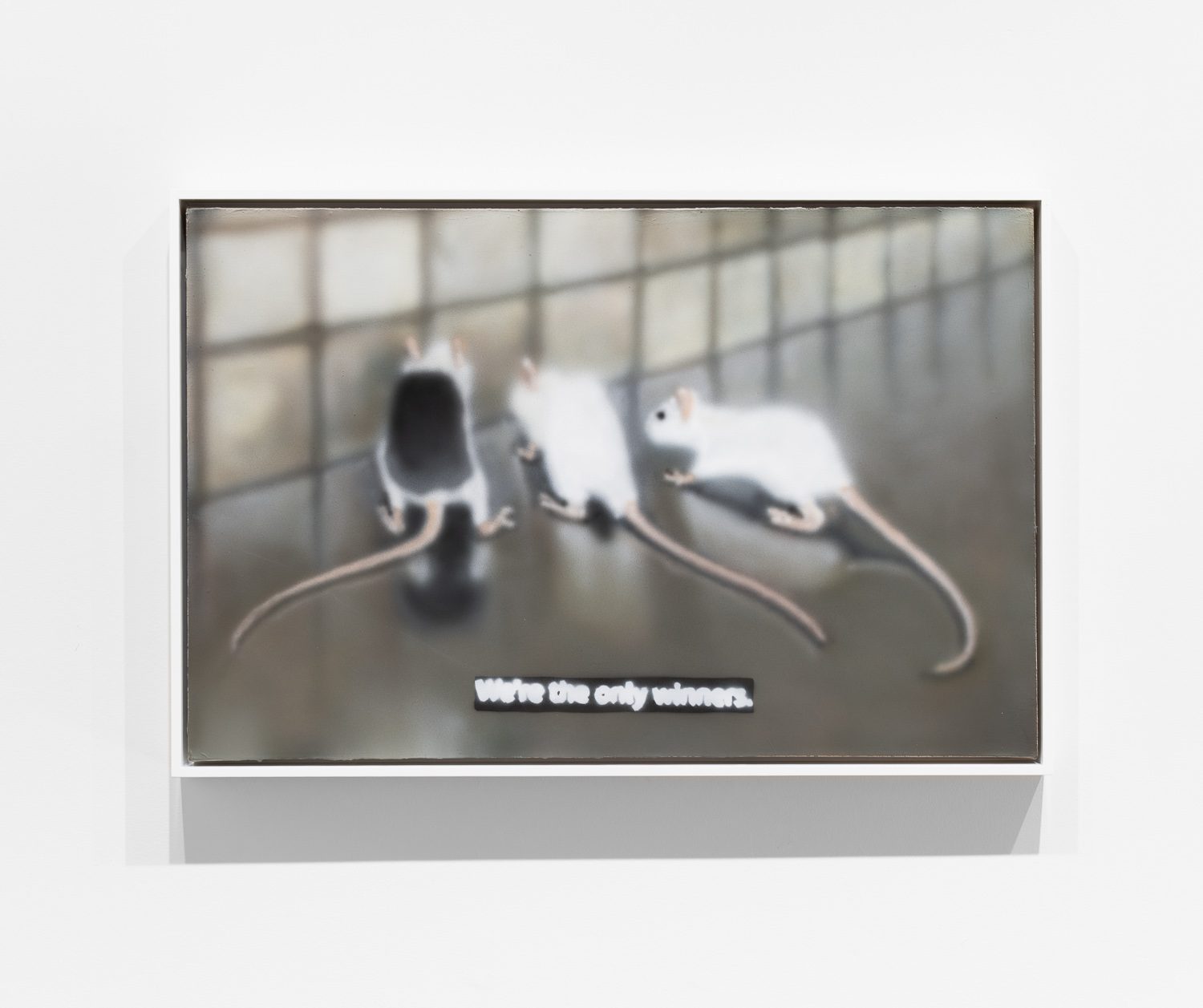
These days, Morgan Buck doesn’t make paintings that look like paintings. With their airbrushed surfaces and grainy, digitized haze, his canvases look like screenshot shitposts pulled from the weirder corners of the internet—and I mean that in the best way possible. Buck doesn’t do lazy nods to digital culture, and his work is meticulously crafted. His recent solo show, “Instantly & Effortlessly,” at ILY2 in New York—the artist’s second with the gallery—demonstrated just how far he’s willing to go in his engagement with the visual detritus of our algorithm-fed lives, marrying the deliberate labor of painting with junk images in something that shines a light on the promises and the pitfalls of both.
Here’s where I should probably cop to personally loving the weirder corners of the internet, where Buck’s process begins. He scavenges screenshots, video captions, A.I. outputs and stock imagery, manipulates them digitally and uses them as raw material for paintings that are at once funny and deeply uncanny—think deep-fried memes, but more refined. Buck riffs on themes of attention, automation and absurdity while grounding each piece in the technical rigor of photorealistic airbrushing.
It’s shitposting with a twist: conceptually agile, technically sophisticated and, like the best absurdist memes, sneakily moving. There’s humor and a sense of depravity, along with a real tension between image and object, intention and accident, meaning and nonsense. Some of Buck’s paintings draw you in with their oddness and keep you there with an undercurrent of melancholy. Others are just plain fun to look at.
Buck can be as irreverent as his paintings suggest, but while he talks about his practice with a casual bravado, there’s an undercurrent of disciplined artistic self-awareness that comes through when he talks about his work. He is, you might say, serious about not being too serious. His paintings are smart without being didactic, technically impressive without being self-important and prompt questions about how we engage with both art and the internet. His work is the most fully realized—and amusing—blurring of high and low culture I’ve seen in a long time, and I caught up with Buck as “Instantly & Effortlessly” was closing to talk about artificial intelligence in the arts, the allure of the airbrush and painting with a sense of humor.
The title of your exhibition “Instantly & Effortlessly,” which closed at ILY2 late last year, felt like a critique of digital-age gratification. How did you choose it, and what was it meant to signal?
I thought it was a funny and attention-grabbing title that related to the streamlining of art production with A.I. Ultimately, I’m an artist very interested in process and ideas of labor in art. I have an MFA in craft, so it’s part of my background to be interested in these topics. Part of my goal with my process is efficiency, so having A.I. in the mix is a dream come true. Using A.I. as an artist is pretty much like banging creative heroin: it gets you to the best results without trying. Just instant and effortless. No pain, just gain.
You use an airbrush technique that intentionally suppresses brushstrokes and painterly “texture” and also obscures subjects. What motivates that choice, and how does the technique support the conceptual underpinnings of your work?
Honestly, there’s not really much of a “concept” behind it. It’s more of a scam to make people take digital art seriously without them necessarily knowing it’s digital. People seem to want effort from artists for some reason. They don’t want to just see that someone walked up to a machine and pushed the art button. I also think painting translates the digital image into something that reads more human in a more visceral way. Originally, when I started airbrush painting, it was mostly about trying to make the painting look like a digital print.
A few years before the airbrush came into my practice, I was a painter who painted with heavy brushstrokes and a palette knife and all of that jazz. That painterly materiality gets to the point where it’s just a default filter that says, “I’m a painted painting painted by a painter” in every piece of art one makes. It’s a very boring effect when you think about it, and it’s also not effortless either. If anything, it’s trying way too hard.
For this reason, I became tired of painting, and for a year and a half, I didn’t paint. I just thought painting was for poseurs. This is when I started focusing on digital images that I made with my cell phone panorama. I’d pull up Google Images with a bunch of weird thumbnails and do a screenshot with the panorama distorting the images into a surreal, blurry glitch collage. They had cool compositions and really looked like paintings, but weren’t. I’d print the images and exhibit them like photography. Pretty instant and effortless.

However, the problem with that work was that people needed an explanation for what they were looking at, which is ultimately what made it a fail for me. In 2017, I did an artist residency in Leipzig, Germany, and didn’t really have much access to a printer, so I began to paint the digital images. I had a relapse. I became a total conformist poseur again. It felt great. All of a sudden, no explanation was necessary. It’s a painting. People get that. I came back home to Portland and wanted to blur the line between the digital prints and the painting materials even more. That’s where the airbrush really clicked. Airbrush, with the atomization, can create photographic effects much more efficiently than the paintbrush. It’s a flat surface like a sheet of paper. I’ve been painting with the airbrush exclusively since 2018, and it’s been my default for so long that I don’t even think about it as a novelty like most people do. I just think it’s the only relevant way to paint, period.
Your paintings often stitch together images sourced from digital overload, from social media debris to A.I. fragments; how do you decide which images deserve to be slowed down and transformed into the physical space of painting?
I think it’s important to mention that it’s not all digital overload, social media and A.I. The captions are always from my rigorous art practice of sitting on the couch watching TV and movies and taking screenshots of captions that I like, usually while drinking beer. I also use some of my own photos from my real life, so it’s more about a full range of visual experience and not quite as solely tech-focused as your question suggests. To answer your question, though, I often decide using tech.
I’ll post the digital images on my Instagram stories, and usually I will already know which ones I want to focus on, but if one I’m on the fence about gets a ton of likes, specifically from followers I know have good taste and know me personally, I will usually focus on those. Mostly, I’ll know because it will already look like a good painting, and the caption frames the image in a way that adds to its narrative in a funny or interesting way.
You’ve spoken about humor, depravity and immediacy in quick-scroll culture; where does your own sense of humor come into play when you’re assembling and recomposing these scenes?
My sense of humor often comes in when I’m choosing which caption to use. Sometimes the picture is the joke, and the caption is the punchline. The best part is the fat is an example of that. I had DALL·E Mini generate a flesh-tone Jell-O, and that weird waxy cube is what it came up with, and then I had that caption that I mentioned in my collection of captions from Iron Chef Japan. Sometimes it’s an idea that happens on site. The painting I mean he’s a genius as far as I’m concerned was like that. I was in Kauai looking at that twin waterfall everyone likes and instantly imagined an Alec Monopoly mural on the wall of the cliff there. I follow him on Instagram, so his luxurious high-roller genius is drilled into my mind daily. I took photos knowing I was going to make that painting. I don’t have a set order of how it happens. It’s all nebulous. The A.I., photography, digital appropriation, etc., it’s essentially just like how a normal artist would draw. It’s just my version of draftsmanship.
Your work engages with the idea of dopamine, reward systems and the psychology of attention; do you think painting can counter or rewire the attention habits shaped by digital culture?
A hundred percent I know it can. My paintings are way more powerful than Mark Zuckerberg. Every time I pick up my airbrush, he starts sweating uncontrollably. He trembles in fear that his reign will all be over soon. Only my paintings can do that. He knows it.
Seriously, though, I embrace social media and all of the dopamine reward systems. I’ve gained so many opportunities and friends from social media. Where would I be without it? The algorithms and filter bubbles are a problem, though. However, if I were to speculate, I’d bet power and money will continue to win at the expense of ethical concerns even long after my paintings hit gallery walls. I doubt any damage to the attention economy directly linked to my art will be reported.
I also want to say that with A.I., it’s easy to get tired of the common, easily prompted A.I. art and deepfakes that we see on our Instagram and TikTok reels. That aspect is super annoying to me. However, people forget we have a once-in-a-species opportunity to reinvent our idea of human creativity. A.I. is a tool that is not human that collaborates with you. It’s hard to understate the significance of that. It will only become more unlimited. You can decide how much or how little, which A.I. model for this part of the image or that part of the image, etc. The artists who don’t want to touch it because they think it’s clip art are really just missing out, in my opinion. Do you really think you’re going to make more interesting art with a piece of charcoal? There are so many unconventional ways of using A.I. I just want to encourage other artists to begin the journey and open their minds more.
How do you hope people will engage with the work that was in “Instantly & Effortlessly” moving forward? Do you want them to laugh, cringe, reflect, feel nostalgia or question their own consumption of images and attention?
I want people to enjoy the work, think it’s funny, interesting and well executed, but really I’m not an artist who is focused on clear communication goals. Each piece is just data from my process that I’m presenting to the audience. There’s a stream of consciousness there that people can certainly draw meanings from: critiques of capitalism, technology, pretentiousness, cringe and so on. What it means all together is simple. Buy all of my paintings right now. That’s it. Easy.
More in Artists