

Christie’s upcoming auctions of the holdings of philanthropist and patron of the arts Irene Roosevelt Aitken tell the story of a deeply refined eye. Spanning some 800 lots, the collection includes Fragonard drawings, Romney portraits, Savonnerie carpets, Louis XV giltwood chairs, Meissen porcelain and antique European firearms—each piece a testament to Aitken’s taste for European connoisseurship at its most opulent. With three live auctions slated for February 11-13, plus two online sales, the dissolution of her collection will reveal whether the haute billionaire appetite for such ornate fare still holds sway in the era of Mahdavi minimalism.
“Her collection is extraordinary in terms of connoisseurship; the consistency of superlative quality across so many categories remains unsurpassed,” Christie’s deputy chairman Will Strafford told Observer, pointing out the impeccable provenance of lots once owned by tastemakers like Winston Guest, Consuelo Vanderbilt Balsan and Thelma Chrysler Foy.
The sales offer a glimpse into a bygone era. Art and design collectors extraordinaire, Irene (who died at age 94 last April) and her third husband, Russell Barnett Aitken, were the crème de la crème of New York society. The family resided in a luxe Rosario Candela building on Fifth Avenue for close to 100 years. Russell, an artist and true Renaissance man, was her third husband, and much of the collection was actually acquired by his late first wife, the sculptor Annie Laurie Crawford, who favored French holdings (and whose daughter was the tragic Sunny von Bülow).
Irene, however, added highly important British 18th-century pieces and more. The paintings and the pastels, in particular, are sublime. Irene’s George Romney portraits? Divine. “You don’t see much of this quality outside top-tier museums,” London art advisor Harriet Drummond, who spent nearly four decades at Christie’s and advised Irene, told Observer.

While at Christie’s, Drummond handled the sale of the Hugh Douglas Hamilton 1790 Portrait of a Gentleman (estimate: $100,000-150,000) to Irene. “The Europeans and Americans will step forward for the paintings, and some are hedge fund guys. While many of Irene’s purchases reached record prices, Christie’s estimates are highly reasonable.” A Hamilton pastel last scored $535,739 at a Christie’s sale in London in 2000.
Still, with prices reaching $1 million+ for a Savonnerie carpet, c. 1640, is demand dwindling for Irene’s rarefied antiques? Collectors who favored such fare—Jayne Wrightsman, Jane Engelhard and Chicagoan Catherine Hamilton, who founded the American Friends of Versailles—are no longer with us. And deep-pocketed figures like Bezos, Beyoncé and others, including Arab and Emirati buyers, hardly seem like Gilded Age fanciers.
So, is opulence still in? “I wish I knew, as it’s a bygone era,” collector Susan Gutfreund told Observer. She, along with her late husband, John, who served as CEO of Salomon Brothers, dwelt in a 12,000-square-foot apartment in New York and a home in Paris. Recently, she trimmed back her collection of rarities, though she still sups on 18th-century Sèvres porcelain, just as Louis XIV and Marie Antoinette did.
But Paris dealer Guillaume Léage, who heads Galerie Léage, which specializes in 18th-century furniture and objets, told Observer that “the taste for French 18th Century remains alive,” adding that he will be buying at Christie’s sale for clients that include the Louvre, the Met, the Getty and others.
The sale is, arguably, taking place during turbulent times. Yes, the stock market has reached startling heights, but Saks Global filed for bankruptcy. Amazon is laying off a stunning 16,000 workers. Even Alexander McQueen is slashing staff. Strafford, however, is unfazed. He points out that a scant three years ago, the Rothschild sale staged at the auction house’s Rockefeller headquarters achieved a staggering $62.6 million against a trifling $20-33 million estimate. Plus, “an increasing number of non-Europeans are now taking on grand French chateaux and massive English country houses and fitting them out with period furnishings. Young fashion designers are buying French and British 18th-century furniture for its lasting craftsmanship.”

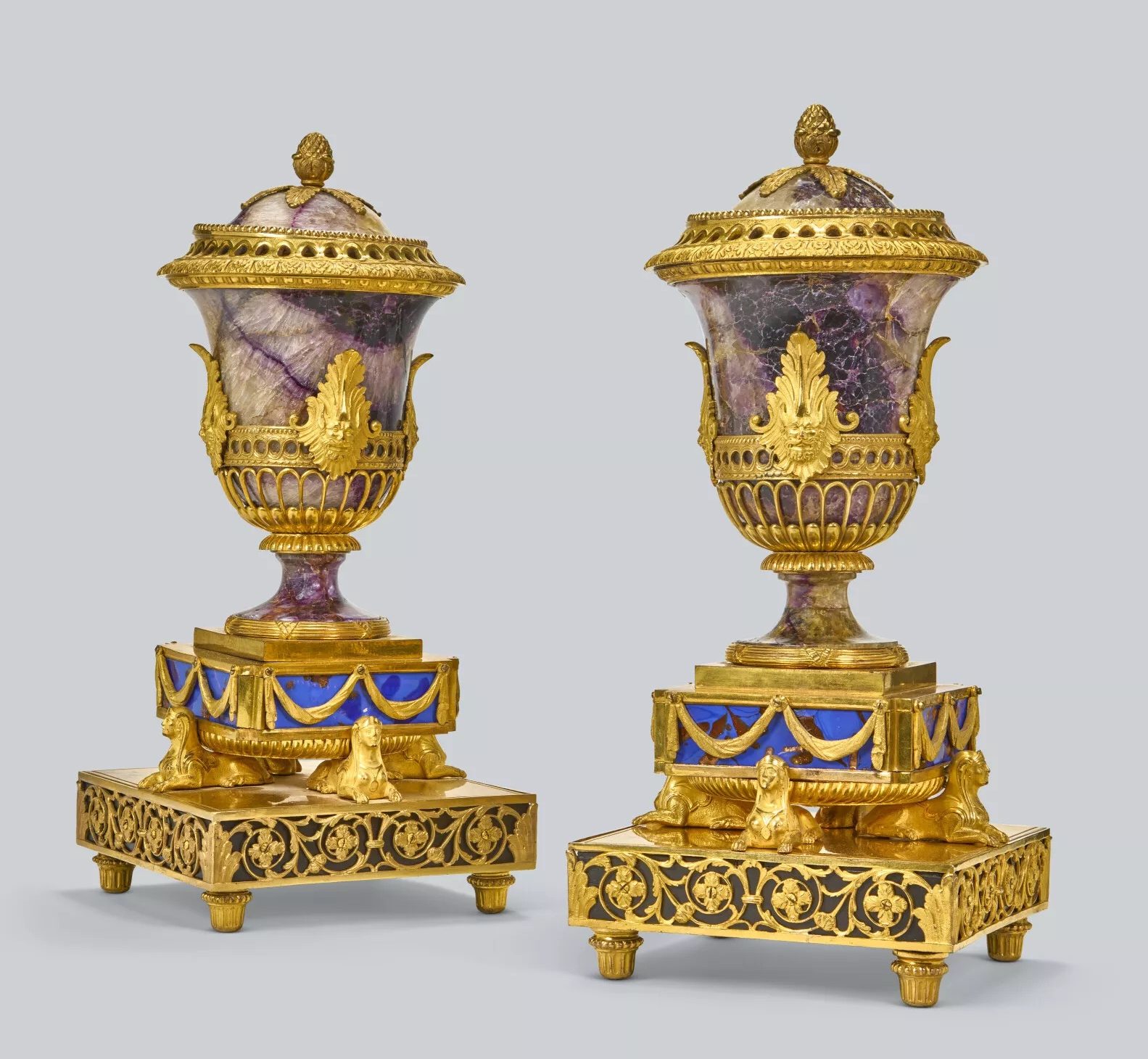
Rarities in the sale include the oeuvre of the 18th-century polymath Matthew Boulton, the co-developer of the steam engine and a preeminent purveyor of luxury goods whose patrons included Catherine the Great. Irene’s cache of Boulton examples is among the rarest and most important in the world, noted Strafford. Case in point: a pair of George III ormolu-mounted blue john candle vases is expected to achieve $80,000-120,000.
Russell’s firearms should inspire keen interest. There is a pair of gold-embellished pistols given by Napoleon to his son, the King of Rome. And the luxury holdings of a bygone era will doubtlessly find favor. A Tiffany 18-karat gold dressing room set, complete with brushes, perfume bottles, scissors and more, is expected to fetch $100,000-150,000. And who can resist a set of Cartier gold matchbox holders, each adorned with a charming enameled red ladybug?
But will the under-40 set be buying? London dealer Jonny Yarker, who with Lowell Libson, exhibited at the Winter Show and sold Irene all of her pastels but one, told Observer that the “reality is Frick didn’t start collecting in his 40s. It’s not the end of an era. People are always buying the best, and she left a stellar legacy.”
Ever the thoughtful New York arts philanthropist, Irene stipulated before she passed that the auction’s proceeds would benefit the Metropolitan Museum of Art, the Frick Collection, and the Morgan Library and Museum.
More in Auctions

