

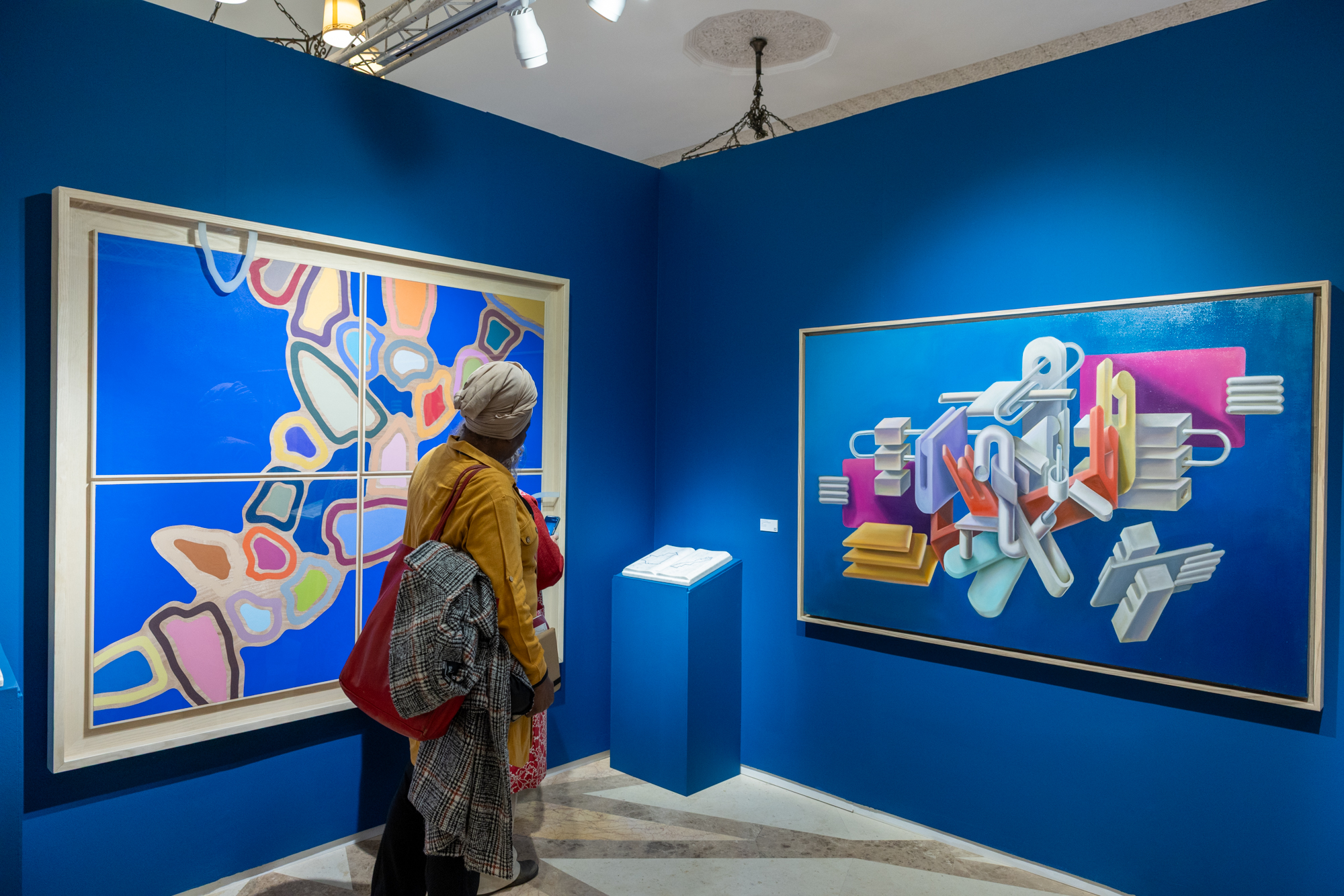
The first week of February was an especially busy moment for the art world this year, and one of the questions I found myself answering most often in recent weeks, repeated across vernissages, dinners, previews, emails and DMs, was: “Are you going to Qatar?” To which, “No, I’m going to Marrakech,” was rarely the answer people expected.
I wasn’t the only one, of course, but in a week that saw major art events in Mexico City and New Delhi, many collectors responded to the magnetizing attraction of Art Basel’s inaugural Doha edition. Collectors, galleries, institutions and even celebrities converged en masse on Qatar’s capital, drawn by the promise of a new center of gravity.
Against this backdrop, hopping onto a plane to Marrakech prompted an unavoidable question: why come here now, when so much of the art world is elsewhere? The question becomes more pointed upon arrival. The 2026 edition of the 1-54 Contemporary African Art Fair is smaller than in previous years. The number of galleries has been reduced, the fair occupies a tighter footprint and the broader media conversation has largely shifted further east.
The city itself, however, tells a different story. From the first steps out of Marrakech Menara Airport, it is clear that what’s happening here is entirely different from what’s unfolding in Doha. This year, the boutique fair operated in dialogue with exhibitions spread across the city, keeping visitors constantly engaged—if not by the energy of Marrakech itself, then by a program that extends far beyond the walls of La Mamounia, the state-of-the-art hotel where the fair takes place.

One of the defining features of this year’s fair is the scale of its citywide activation. “We can’t now distinguish the fair from the program in the city,” 1-54’s founding director, Touria El Glaoui, told Observer. “It’s a mixture of commercial and not-for-profit, or profit and institution.”
More than 25 exhibitions and events aligned with the fair, involving institutions such as MACAAL and the Yves Saint Laurent Museum, as well as independent spaces, artist studios and private foundations—not bad for a city which the rest of the year is definitely sleepier on the contemporary art front.
In Africa, a distinct identity shaped by context
Founded in London in 2013, 1-54 emerged from a clear premise: to create a platform dedicated to contemporary art from Africa and its diaspora. The fair expanded to New York in 2015 and launched its Marrakech edition in 2019. Each location developed its own identity, shaped by its specific audience and context. Marrakech quickly became the most embedded of the three, drawing on the city’s existing networks of artists’ studios, collectorship, its pace and its ambition as a city to become a pole for the narratives of wider Africa. “We have a focus that is quite specialized,” El Glaoui explained. “If you come to 1-54 it is because you have on your roster contemporary artists from Africa and the African diaspora, and for that market it’s not as competitive an arena.”
This year’s 22 participating galleries included a group of local spaces from Casablanca and Rabat, French galleries with established connections to African artists and galleries operating across the African continent. One that is a staple of the Moroccan art scene is Loft Gallery, founded in Casablanca and directed by Yasmine Berrada, which has been participating in 1-54 Marrakech since 2018. “1-54 Marrakech takes place in our market,” Berrada told Observer. “We know all the clients there, and also we are really identified and established in the Moroccan art market.” For Loft, the fair has become a fixed point in the calendar. “This moment of 1-54 in February is very important for us. It’s one of the strongest moments for the gallery.”

In Marrakech, Loft’s engagement extended across multiple sites, in addition to the group presentation at their booth at La Mamounia. They organized an “art takeover” of the city with an exhibition in their space, in Riad al-Mellah and in the Musée de la Parure. It’s a busy time for Loft, as theirs is the only Moroccan gallery presenting at Art Basel Qatar. “We are aiming at being more and more present in the Middle East art market,” Berrada said, adding that while at Art Basel Qatar they showed pieces from €18,000 to €80,000, whereas in Marrakech, works started at €4,000. At 1-54, Loft curated a collective presentation called “Crossings,” which brought together works by Mehdi-Georges Lahlou, Nassim Azarzar, Moroccan artist Mustapha Azeroual, M’hammed Kilito and Samy Snoussi around the idea of memory and identity.
“The Marrakech audiences are definitely more familiar with my work than the audience from Doha,” said Azeroual, whose iridescent artworks playing with light were in Loft’s booths in both Marrakech and Doha. “But at the same time I believe in the universality of art, and I think my work resonated with audiences in both locations.”
NIL gallery, out of Paris, presented at 1-54, with an all-photography booth, and at ZONAMACO, where it presented paintings. “In Marrakech we wanted to have a two-woman artist presentation, through a curated photographic dialogue between Sara Benabdallah and Hasnae El Ouarga,” gallery assistant Malou Boussake told Observer, adding that Moroccan collectors tend to support Moroccan artists. “The two artists show two different sides of contemporary Moroccan photography: one more narrative and embodied, the other more meditative and process-driven cyanotypes.” The price range for unique works and limited editions was from €3,800 to €9,800.

A South-South network
With their different targets, focus on different artistic geographies and completely different contexts, El Glaoui doesn’t see Art Basel Qatar as a competitor. “What I actually find interesting as a signal is that all of these three fairs, including ZONAMACO in Mexico, are happening all in the Global South.” Could that signal the beginning of a shift in art market geographies? Time will tell, but 1-54 is certainly committed to continuing to promote South-South connections, and this was evident in the presence of Tokyo gallery Space UN, which works exclusively with African artists.
Founded only two years ago, Space UN was conceived in response to a gap. “There is no platform or network for African artists in Japan, especially for contemporary artists,” Naoki Nakatani, director of Space UN, told Observer. “We are trying to be the advocate for creators from Africa coming into Japan, expanding their narratives outside of the continent without going through Europe.”
Some of the works at the booth are the result of a residency program in which African artists engaged with Japanese-style ceramics, tapestry with a Japanese hand-weaving technique and paper. “I think there are similarities between Africa and Japan in terms of material, but also philosophically,” added Nakatani. “We share a certain appreciation and some similar traditions.” The price range spanned from works on paper beginning at around €1,000 to paintings ranging from £5,000 to £18,000. Ceramic pieces were priced between £3,500 and £6,000, while a large tapestry produced using Japanese weaving techniques reached £60,000.
Walking through 1-54’s booths, it’s easy to be lured in by Amina Benbouchta’s delicate paintings of still lifes, with neons that perfectly dialogue with the colors of the canvas. These were presented by Parisian gallery Galerie 208, alongside other works, including those of Ivorian Casablanca-based artist Yvanovitch Mbaya, who shows works on paper and canvas representing sensual male figures made with coffee as a primary medium.
Galerie 208 has developed a program centered on artists from Africa and the African diaspora, maintaining close ties with Morocco and West Africa. Gallery director Nathan Chichportich framed the gallery’s participation in clear terms: “It’s a chosen, geographical focus. We stand by it. It’s Africa that we are putting forward.”
An international fair with a local focus
MCC Gallery, based in Marrakech, presented works including Malika Sqalli’s photography exploring identity and the body, while Salma Cheddadi showed paintings that examine masculinity through vulnerability and introspection in bright red colors. The former were priced between €3,000 and €15,000. “We are committed to accessibility alongside experimentation,” Jeanne Mansour, a curator at MCC Gallery, told Observer.
What all the gallerists we spoke to agreed on was that the competitive advantage of Marrakech lies in the energy of the city itself, which is rough and enchanting at the same time. “There is something very magical happening because of the vibe, the weather and the fact that people are happy to be here,” Berrada said.
1-54’s modest size coupled with the citywide activations meant it was easy to connect with artists, gallerists, collectors and industry people during the week—there were studio visits, cocktails on gallery terraces and loads of opportunities to mingle in Gueliz, the artsy neighborhood. “I think in Marrakech there is more proximity between the public and the galleries and also the public and the artists,” added Berrada.

“In terms of destination, I think we’re winning,” added El Glaoui. “I don’t think I have to worry about Marrakech being less popular because something else is happening.” Indeed, her concerns lie elsewhere. “There’s a certain climate in the world right now where maybe people might not be as encouraged to travel or maybe a bit worried about buying art. I don’t think this is the other art fair’s competition. It’s more about the economic and social environment.”
El Glaoui points to a growing sense of anticipation among local audiences. “The Moroccans now are waiting for this week. Before, they would come maybe one day. Now they all come for the weekend.” A testament to this is the opening day of 1-54, where there was barely any room to move across the booths.
But of course, for the very committed art lover, you can do it all. “I have met a lot of collectors in Doha that came for the first two VIP days and then flew to Marrakech for the opening of 1-54,” Berrada said. “These days people are ready to fly and to travel. And some of them, yes, did make the effort to do both.”

More in Art Fairs, Biennials and Triennials


