

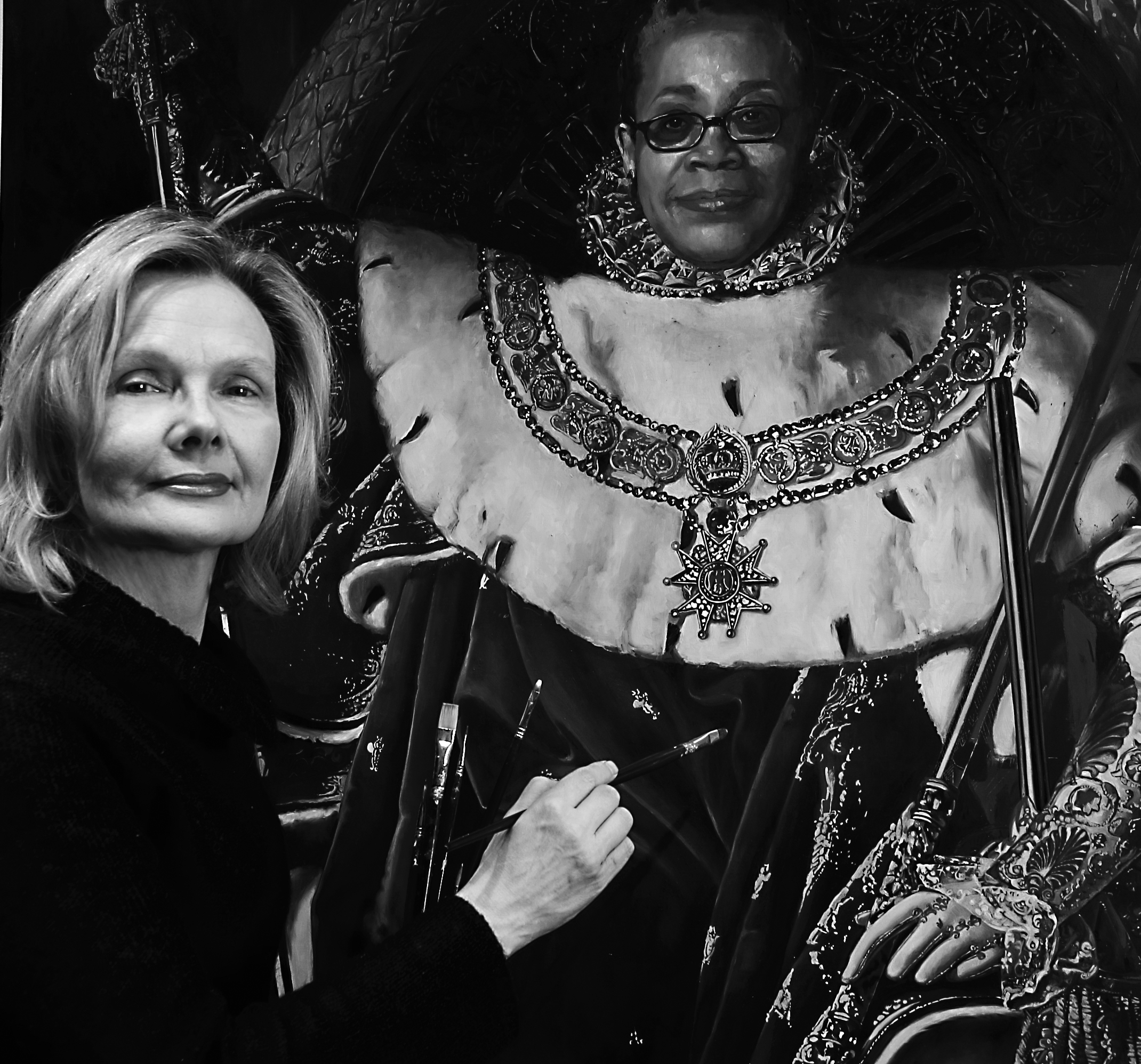
Painter Kathleen Gilje’s life has unfolded like a Felliniesque film, where dreams and destiny are inseparable. Born in 1945 and raised in Bay Ridge, Brooklyn, Gilje grew up in an immigrant family. She was always drawing and painting, but it never occurred to her that painting could be a career. After graduating from City College of New York, her parents gave her a round-trip ticket to Europe. She stayed for more than five years, and Italy changed everything.
Gilje traveled between Rome and Naples, where she worked as a conservator of paintings. It was there that she fell in love with Old Masters and began to see them almost as “living, breathing things.” She learned how layers expand and contract, how paintings crack, pop and age—almost like a lifespan. This was where she learned, as she later put it, the meat and potatoes of restoration. It was also where she began to explore making her own work. Eventually, she returned to America, rented a loft in SoHo and began painting full time.
Gilje is known for revisiting historical paintings, making contemporary interventions. As the art historian Linda Nochlin wrote in Art in America, she is “as much a conceptual artist as she is a dyed-in-the-wool painter.”

Gilje is also my mother. Her studio was my childhood landscape. Growing up inside an artist’s life long enough, you learn that art is not a job. Art is soul. It’s persistence. It’s an obsession. It’s learning how to stay within something for it to reveal itself. Her work questions the accepted versions of truth and exposes what has been buried or erased. Power and vulnerability coexist in her work. So do beauty and disruption. And so does love. She gave me the framework and the gumption to question the societal stories we inherit and to trust my voice—whether I was writing “The J-Spot” column or speaking out publicly during #MeToo.
Gilje’s work has been shown in museums internationally, with solo exhibitions at the Bruce Museum, the List Center at MIT, the Williams College Museum of Art and the National Museum of Women in the Arts, among others. She currently has an exhibition at the Morris Museum, “Iconic: Kathleen Gilje Repaints Art History,” which brings together three decades of her work and is on through April 2026.
Our conversations took place over lunch in the loft where she paints and I write. It’s where we’ve always talked about art, literature, politics and whatever we’re thinking through at the moment.
Have you always loved art even in childhood?
I think I was born with a paintbrush in my hand. That was how I played. All I did was draw. I grew up in an immigrant family and had a fairly conventional upbringing, although my mother was a little unconventional in that she was an avid reader. I can’t remember a time when she wasn’t reading. When she took breaks, she wrote poetry, all while raising three children. As a child, when I wanted a book, she didn’t hand me a children’s book. She handed me Omar Khayyam or Balzac, and I couldn’t make heads or tails of any of it. At a certain point, she began painting. I remember seeing my mother painting in the kitchen.
Did you ever think you could have a career as a painter?
I went to college and majored in art and literature, but I thought I would have to do something else. I remember taking art history classes and watching slides being projected while the professor talked. The paintings felt distant. What I learned about art came later when I lived in Italy. I had always dreamed of going to Europe. I wanted to get out of the small world I grew up in and see a bigger world. After I graduated, I traveled through Europe and landed in Rome. I would go to the park, Villa Borghese, and draw the trees, or I would walk around at night and look at the buildings and think, “This is the most amazing place.” It was very different from Brooklyn. Everything was old. You could see where people, for hundreds and hundreds of years, had worn the steps down with their feet. There was such a presence of history—of life, of past and present.
By the fall, I needed a winter coat and I was running out of money. I had to get a job. When I was in college, I worked part-time restoring high-end furniture. Occasionally, paintings would come in, which I’d restore too, but I knew nothing. I faked it. In Rome, a friend told me there was a famous conservator, Antonio De Mata, on Via del Babuino. So I walked there and knocked on these old, gigantic doors. When the professor came out, I said I was looking for a job as a restorer. He was very short, Neapolitan. He asked what experience I had. I looked him straight in the eye and, in my broken, miserable Italian, said, “I was the conservator for the Metropolitan Museum of New York.”
Had you planned on padding your résumé like that?
No, it just came out in the moment. He knew that was ridiculous, but Americans were popular back then, so he said, “Okay. We’ll try.” I started as an apprentice. I did little things at first, like sweeping the floors, and gradually began working on paintings. I was taught how to reline paintings and how to inpaint damaged areas. I learned the whole makeup: the canvas, the preparation, the paint. I became aware of time periods—how cracks from the 1500s were different from the 1700s, how paint dries and behaves. And by having a great mentor, I learned quality. And then De Mata was invited to become the chief restorer at Capodimonte in Naples, a museum on top of a mountain. He brought his team, and there I restored Caravaggios, Titians, Tintorettos and Riberas.
Did you make your own art as well?
Yes, I started working in plastics and doing painting and sculpture as well.

Why did you decide to leave Italy and come back to New York?
I had an exhibition in Milan. When they found out I was a woman, they said, “We don’t show women because they get married, have kids, it’s usually the end of their career and we don’t want to invest.” I was extremely disappointed. I thought to myself I’d have a better chance in America. I think I felt, too, it was time to go back.
How did you find your footing in New York?
I didn’t know many people. An old friend told me artists were moving into SoHo, into these large empty spaces that had once been factories. So I found a loft and fixed it up to make it livable. I wasn’t sure how I’d support myself, but fortunately, because of my background, I was introduced to a very important conservator, Marco Grassi. I worked on great Old Master paintings, which allowed me to pay my basic expenses and make my own work.
What was your work like at that point?
The work was figurative, but very simplified, with strong primary colors. I was interested in breaking the surface. The idea was to integrate the figure or the object with the background, so that they melted into each other. The figure and the ground would bounce back and forth.
When did art conservation and being a fine artist converge?
It began when I stopped working for Marco Grassi and went into business for myself. One of my clients, Stanley Moss, had a major collection and I restored paintings for him. At one point, I was restoring a small El Greco, The Fable. I was alone with that painting in my studio from morning to night, seven days a week, for weeks and weeks. I knew every inch of that painting perfectly. I could see the brushstroke—how he pulled it, the direction, the weight he put on the brush. I could see how one area was done loosely and indifferently and another area was pure magic. A turn. A twist. I could almost feel his wrist twisting. The closer I got to the painting, the more I sensed his presence. It wasn’t hostile. It was warm, like, you’re saving my painting or you’re doing it right. I felt like his hand touched my left shoulder, as if there was a bond between artists and time. Ever since that moment, I’ve felt that artists—all artists—are like pearls on a string. We’re all on the same string. We’re all interconnected.
And then you copied the painting.
After that, I ran out and bought a stretcher and canvas. It was the same size as the original. I copied the painting not to sell, but to learn. That’s something artists have always done—they look to other artists to learn. When Stanley Moss came to the studio, I was proud and showed it to him. He said, “I didn’t give you permission to do that. I could sue you.” I said, “Oh, come on, Stanley.” And he said, “Well, if I don’t sue you, can I buy it?” I told him I’d have to make a change. In the original, a monkey, a rogue and a boy were lighting a candle, so I added an electric light bulb. It had to do with time and where we are now.

Was that the beginning of this body of work?
One of the first works in the series was after El Greco, Portrait of Cardinal Niño de Guevara, Grand Inquisitor, Restored, 1993. The Cardinal was a leading figure in the Spanish Inquisition, which persecuted and executed countless people. In the painting, he sits on his throne, his hands gripping the arms of the chair. I saw the tension in his hands. There was a feeling of death and anxiety. Behind him, I painted Andy Warhol’s Orange Disaster series of electric chairs. That’s how I made my choices. I began to see that everything represents something. I started bringing different artists and ideas together. Although I have always loved the act of painting, in the end, it’s the conceptual part that gives me the most joy.
When your background as a conservator and your love of painting came together, did it feel like something opened up and clicked?
I think I was really connecting with myself. When I came back from Italy, I felt like a bit of a misfit in the New York art world. But when I started doing these paintings, it was something that came very naturally to me. I was finally in touch with my own unique experience. At that point, I stopped trying to fit in and started saying, to thine own self be true. The only thing I had to offer was myself—for better or for worse.
I wanted to ask you about motherhood. Did being a mother influence your work, or did you try to keep it separate? As a kid, I always wanted you to paint me.
I did paint you.

Yes. But as a kid, I wanted the focus you put on your work to be on me. Of course, that changed over time and you did end up painting me in my twenties.
I think that being a mother and having you and your brother made me a much fuller person, a richer person. Being a mother is complicated. In many ways, you get so much from your child, more than you give. A lot of my feelings about life and emotion came out of motherhood. And sometimes I’m not able to explain those feelings with words, but I can use—
Your paintbrush.
Yes.
One of my favorite early paintings of yours is Portrait of an Old Man with a Child, Restored, after Domenico Ghirlandaio. His name sounds like “girl and daio,” and the child has curly blonde hair so I thought it was a little girl like me, looking at her grandfather. And through the window, you replaced the landscape with Magritte’s The Castle of the Pyrenees, a castle on a floating rock above the sea, which is when I fell in love with his work.
I love that you thought it was “girl and daio.” The child looks up at the old man with such loving eyes, and the original painting was damaged, which, to me, is part of its beauty. Sometimes in my work, I recreate the consequences of age. The damage becomes part of the painting. The old man and the boy represent love and the floating rock, eternity.
I want to talk to you about Susanna and the Elders, Restored, 1998, your installation based on the painting by Artemisia Gentileschi, because it had such an impact on me growing up. I didn’t fully understand it at the time, but I knew it was powerful. What originally drew you to Artemisia’s work?
I first encountered Artemisia Gentileschi’s work when I was living in Italy. I remember seeing her painting Judith Slaying Holofernes. She had painted bright red blood everywhere. I remember thinking, “Oh my God, I’ve never seen anything like that.” Artemisia was the daughter of Orazio Gentileschi, a well-known Baroque painter. He had several children, but Artemisia inherited that strange art gene. It doesn’t distinguish between male or female.
Her rendition of the biblical story Susanna and the Elders is about sexual abuse. Two elders spy on Susanna while she is bathing. They demand sexual favors and when she refuses, they threaten to ruin her reputation. Artemisia painted this subject from a woman’s point of view. Susanna is pressed against a stone wall while the men loom over her from above. It’s oppressive. If you look at how male artists painted Susanna—someone like Tintoretto, for instance—she often appears to be flaunting herself, almost as if the men are the victims.
It’s eerie, because later Artemisia’s own life would almost mirror Susanna’s.
Yes, not long after she painted Susanna and the Elders, Artemisia was raped by her tutor, Agostino Tassi. What followed was a long, humiliating trial. Tassi called witnesses to claim that Artemisia was a “badly behaved” woman. She technically won the case, but it took its toll. Eventually, she rebuilt her life and became the first woman admitted to the Artists’ Guild in Florence.
So when I painted Susanna and the Elders, Restored, I drew on my background, using methodologies in conservation such as X-rays. I created a painting in lead white under the original, showing Artemisia screaming and wielding a knife. In the trial testimony, she describes throwing a knife at Tassi after the assault. The X-ray of that image is displayed on a lightbox beside the painting.
Linda Nochlin wrote that your work functions best in what she called “textual complicity, not scholarly literalism,” where meaning emerges through the viewer’s participation. How conscious are you of the viewer?
I’m very aware. I often write texts to accompany the work, but not everyone sits around reading art history books—and that’s fine. What matters to me is that the viewer brings themselves to the painting: their experiences, their emotions, their history. They see the work through who they are.
Nearly 20 years after you painted Susanna and the Elders, Restored, I never would have imagined that I’d speak up in the #MeToo movement. Looking back, it feels as if Artemisia helped shape my courage, as though her spirit lived in the loft through your work—a lineage of women in a world that has so often treated us as objects rather than heroines. I wanted to ask you about your 2006 series Curators, Critics, and Connoisseurs. How did that come about?
I was interested in painting collectors and figures in the art world the way Andy Warhol once did. I liked the idea of collaboration, of inviting them to imagine themselves in a painting within art history. I used to run into the art historian Robert Rosenblum at the NYU pool. He was one of the leading scholars on Ingres. I asked him if he would ever consider sitting for a portrait, and he agreed.
In his essay on the series, he later wrote that when you suggested he be painted as Ingres’s Marquis de Pastoret, it was “almost enough to make me believe in reincarnation,” since people had long told him he resembled the Marquis.
Yes, Robert was very funny. When he saw the finished portrait in my studio, my art dealer at the time, Francis Naumann, turned to him and said, “Now you’re immortalized.” And Robert said, “I just wish I had that outfit.”

Another portrait that I find particularly striking is of Lowery Sims, the art historian and curator for modern and contemporary art.
Lowery wanted to be painted as Napoleon with a gun. I painted her after Ingres’s portrait of Napoleon, but with the addition of a rifle. The pose is similar to Eldridge Cleaver’s famous photograph Huey P. Newton in a Wicker Peacock Chair. In a review of the show, Sims told The Wall Street Journal, “Put these icons together, and it represents my interest in art history and being spawned in the age of the Black Panthers.”
Linda Nochlin, who wrote Why Have There Been No Great Women Artists?, was someone you deeply admired and when you asked her how she wanted to be painted within art history, what did she choose?
I assumed Linda would choose Courbet, since she’d written so extensively about him. But instead, she chose A Bar at the Folies-Bergère. She wanted to be the barmaid. In Manet’s painting, the barmaid appears somewhat distant, almost weary. Linda was anything but that. Her presence was commanding. This portrait is included in the Morris Museum exhibition.
You then went on to paint the philosopher and art critic Arthur Danto as Socrates, Robert Storr along with his wife Rosamund Morley after Degas and the former New York Times art critic Michael Kimmelman as The Thinker after Eakins. Kimmelman later told The Wall Street Journal, “It’s a funny thing seeing a painting of yourself when you’re supposed to be judging paintings.” In your current exhibition at the Morris Museum, you include Woman with a Parrot, Restored, after Courbet. The painting shows a reclining nude woman, her arm lifted as a parrot lands on her hand. Next to it is an X-ray.
This piece is very much about the male gaze, which Courbet seemed to have struggled with. Instead of remaining outside the painting as the observer, the X-ray reveals a male nude beneath the surface, painted in lead white, hidden under the parrot’s perch. The male figure becomes part of the painting, but you can only really see him in the X-ray.
Does that mean the male nude becomes objectified himself?
I think it has more to do with the conflict around the gaze. There’s also a sense of humor to it. It’s almost as if he couldn’t help himself, so he jumped into the painting—like going down the rabbit hole.
You’re also showing a new body of work inspired by Zurbarán’s female saints. What drew you to them?
Zurbarán painted almost 60 female saints. The saints were a way for the church to reach people. I like to think of them as the Kardashians of their time because they were so famous. People knew of them and related to them. Many of the saints were punished and betrayed, often portrayed in horrific torture scenes. What’s striking is that Zurbarán painted these women with great dignity, standing larger than life, with elaborate dresses and vivid colors.
How did you approach making what you call Las Santas de Zurbarán, The Cult of Unruly Women?
I painted four saints and used four models. I bought different brocades and constructed their elaborate skirts. All four saints wear wife beater tank tops because saints usually have terrible stories of abuse and I wanted a contemporary thread that united them.
For instance, Agatha of Sicily is the patron saint of sexual abuse. In Zurbarán’s painting, she holds her severed breasts on a plate. In my painting, she holds two Saint Agatha cakes in the shape of a woman’s breasts. There’s actually a Saint Agatha Day and in Sicilian bakeries you can buy these cakes with a little cherry on top. Behind her are ominous and threatening donkeys after a painting by Goya. Your father, sculptor Robert Lobe, made the wooden frames, which I designed and painted, adding brief texts that tell each saint’s story.

One of my favorite saints in the series is Margaret of Antioch. To me, she exemplifies how creativity can never be erased, even in the face of darkness.
Margaret is the patron saint of childbirth and creativity. According to legend, she was swallowed by the Devil disguised as a dragon, but the Devil couldn’t contain her power. She burst through his stomach and emerged unharmed.
Speaking of creativity, I love the story behind Leonardo da Vinci’s Ginevra de’ Benci. What drew you to her?
It’s an absolutely gorgeous portrait. Ginevra was a poet. She’s very young here and we don’t have much of her writing, but we do have one line that survives. “I ask your forgiveness, and I am a mountain tiger.” Here she is—this docile, beautiful young woman—and even back then in 1490, through her poetry, she’s telling you who she is. So I painted a tiger tattoo bursting through her chest. And it makes me think that throughout history, women have always had mountain tigers within.
Yes, women have always had interior lives. They have goals and dreams of their own.
And maybe they can’t always fulfill them.
But they have spirit. I wanted to ask you about the creative process itself. Often when I’m writing, things can feel messy for quite a while. You’ve always told me to stay with it, that whatever I first saw or felt is still there to be found. Can you elaborate?
It can be very painful, especially if you’re really stumped or going through a transition. But creativity—the process of creativity—is the most exciting thing. Getting it in the end, almost like once it’s over, it’s over, right? I think the thing is, love what you’re doing and be persistent. Because if you love what you’re doing, you enjoy doing it and then it’s easy to be persistent.
More Arts Interviews


