

Fifty years after her death, Lee Miller is having a moment. Last year, Lee, a biopic of Miller starring Kate Winslet, was released in cinemas, with several biographies reissued to accompany the film. Indeed, Miller’s is a life worth telling. She was a model for some of the leading Surrealist photographers in Paris in the twenties, before picking up a camera and discovering she could take better pictures herself. She traveled the Middle East: Palestine, Egypt, Lebanon. She photographed the Blitz and other key moments of the Second World War for Vogue. She was among the first photographers to discover the atrocities of the Holocaust. She famously posed in Hitler’s bathtub, a framed portrait of the recently deceased Führer propped behind her head, her muddy boots, still caked with the dirt of Dachau, tossed on the floor. This photographic act of defiance and daring was emblematic of Miller’s temerity. If any one person could sum up the 20th century and its innovations, its absurdities, its beauty and its horror, it may well be Lee Miller.
Those in London shouldn’t miss the chance to see Miller’s photographs at Tate Britain. Closing soon, “Lee Miller” is the biggest exhibition dedicated solely to Miller ever mounted in the U.K. and takes a broadly chronological approach to its subject. Before we are introduced to Miller’s own photographic corpus, we see her as framed by some of the leading photographers of the time, including Cecil Beaton, Arnold Genthe and Edward Steichen. Those familiar with Miller’s war photography will find her posing for sanitary products slightly incongruous. But Miller was a leading beauty among the American expats in prewar Paris, a time of unbridled creativity and sexuality. It was the place to be, and Lee Miller never wanted to miss out. But Miller was too independent to be defined by other people. She would soon pick up a camera herself.

Miller’s first forays into photography were collaborative. Her relationship with the Surrealist Man Ray is legendary. The pair created iconic images together—some eccentric, some erotic—in what is perhaps photography’s most celebrated collaboration. Many of the images have a distinct blown-out look, the result of a process called solarization, whereby a negative is exposed to light while still developing. Though the procedure dates back to the nineteenth century, Man Ray is commonly associated with innovating and perfecting the technique, but there is reason to believe that it was actually Miller who first realized solarization’s aesthetic potential.
With the exception of a few forays into Kodachrome, “Lee Miller” is an entirely monochromatic exhibition. (While the curators understandably wanted to create as comprehensive a show as possible, it would have been good to keep the exhibition entirely in black and white for visual consistency.) Some of the show’s most powerful images are from Miller’s travels around the Middle East, following her marriage to Egyptian businessman Aziz Eloui Bey. Thank God Miller had not yet discovered color. Ironic as it may seem, these images of blue skies and sandy deserts would not have worked in color; they are not so much travel photographs as extensions of Miller’s surrealist style. Portrait of Space, taken in Egypt in 1937, is a prime example, its alluring composition defying conventions of reportage. Whether photographing architecture or people, Miller’s compositions in this period were more expressive than documentary.

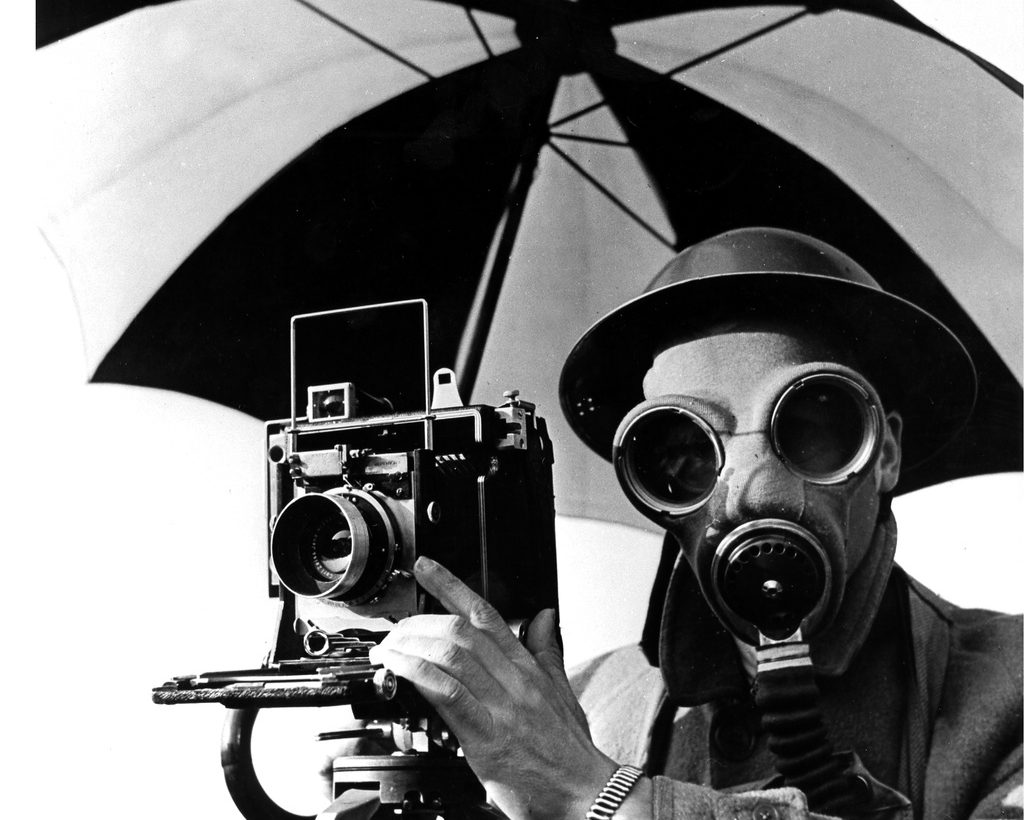
It was not until the Second World War that Miller’s journalistic eye was honed. In 1939, she moved to England. The glamour of les Années folles was replaced with the austerity of wartime London. She shot fashion portraits for Vogue, using the bombed-out city as her backdrop and the new apparel of the Blitz—gas masks, air raid helmets—as her accessories. But Miller knew the real story was on the continent, not London. If one word can describe Miller at this stage, it is restless. She did not want to miss out on the action.
There were not many female war correspondents, but that was of no importance to Miller. What mattered to her was getting close to the story, irrespective of the danger. She photographed as many aspects of the war as she could: combat, injured soldiers and civilians living alongside the violence. Miller wanted to be everywhere at once; her journalistic impulse led her to the darkest stories.
Miller, along with American photographer David E. Scherman, was one of the first journalists to see the Holocaust shortly after liberation. She saw the bodies with her own eyes; she photographed survivors and perpetrators. Mostly, however, she photographed the dead. I missed the press opening of “Lee Miller,” and so went along to the exhibition a few days later once the show was open to the public. Even in the afternoon on a weekday, the exhibition was busy, with lots of people competing to look at each photograph. But the mood of the Holocaust room was somber and silent. We all slowly walked from one image to the next, taking in the horrors captured on film. It is striking to remember that Miller’s Buchenwald photographs were published in Vogue rather than a newspaper. (None of her photographs of Dachau were published in her lifetime.)
Leaving this room, it felt somewhat absurd to think about anything else. Just as there can be no poetry after Auschwitz, there can be no celebrity portraits after Miller’s images of Dachau and Buchenwald. Of course, Miller’s career did not end in 1945, and the curators understandably had to round off the show chronologically. But it is hard to look at another neatly framed portrait of Picasso moments after seeing skeletal bodies piled atop one another. Even as events unfolded, Miller knew that people would not believe such a crime against humanity had occurred. She sent a cable to her London editor: “I IMPLORE YOU TO BELIEVE THAT THIS IS TRUE”—a plea for truth that is sadly pertinent in 2025.
After the war, Miller continued to shoot for Vogue, but the horrors she had witnessed in Europe had a lasting impact on her. She slowed down her work and in her last decades was more devoted to cooking than photographing. It is amazing to think that after a restless few decades of activity, Miller spent the rest of her life living an obscure existence in rural England. Many of her best photographs were unceremoniously stored in her attic, the negatives undiscovered until after her death in 1977. Such a stark contrast to her earlier life seems like a contradiction, but maybe it is not; bright stars, after all, burn fast. “Lee Miller” chronicles a life that for decades never stopped except to take a frame on a Rolleiflex. After years of urging her editors to print her pictures in the hope that the public would pay attention, she reached a point where she no longer cared whether her images were seen. Thankfully, “Lee Miller” is not letting us forget.

“Lee Miller” is at Tate Britain until February 15, 2026.
More exhibition reviews


