

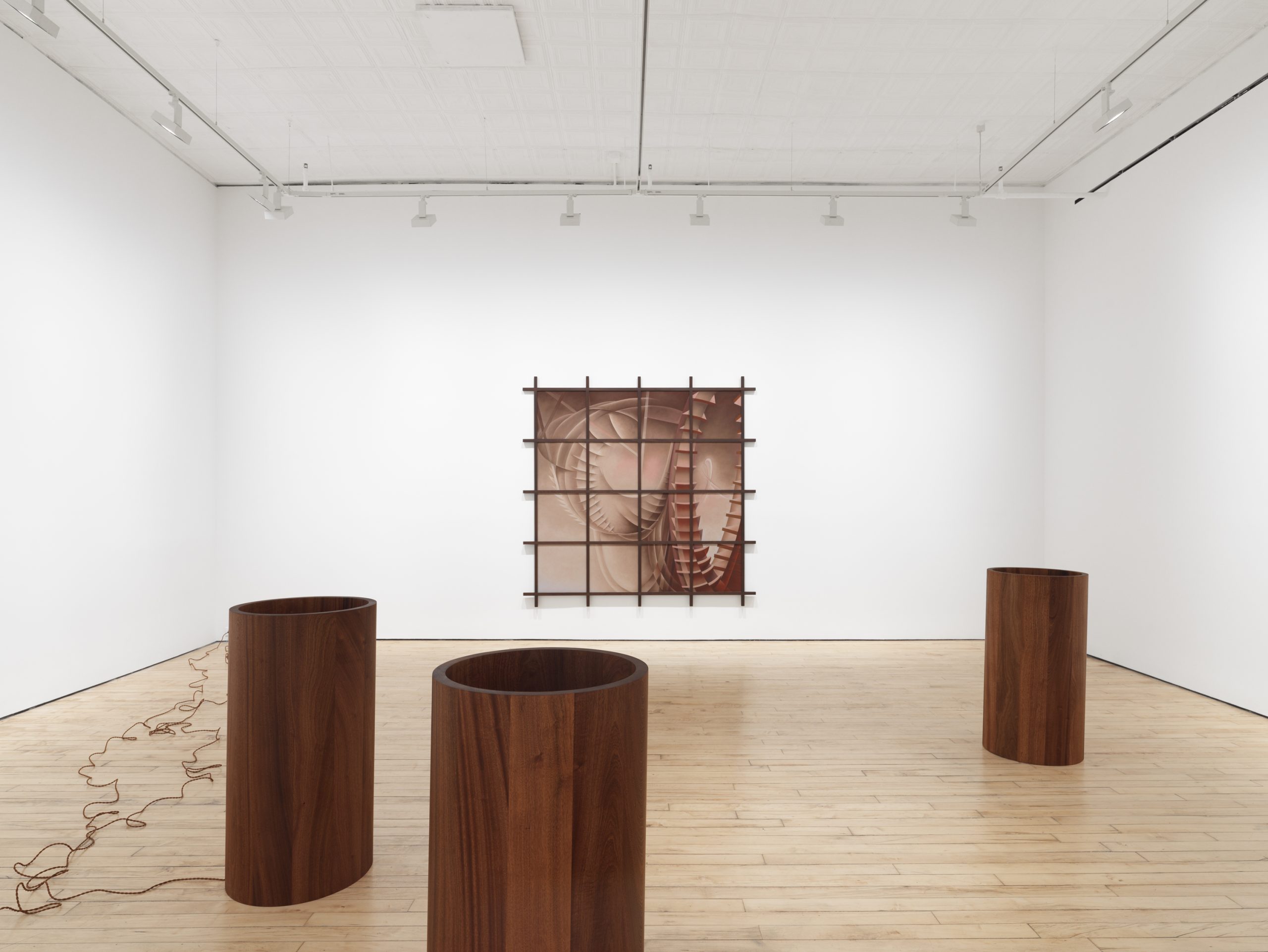
What is striking about Charlotte Edey’s work, particularly upon first encounter, is its ability to navigate—in masterfully crafted, physically tactile structures of wood and textile—the dialectical tension between inner and outer worlds, staging a fundamental inquiry into the interaction between body, psyche and environment. Already established in the U.K. and Europe, where she has exhibited widely in both commercial and private spaces, she recently made her East Coast debut at James Cohan with a new body of multimedia works in an exhibition titled “Corner/Fold.” The show brings together intricate abstract patterns, the sensory pleasure of needlework and the intense physical labor, precision, and endurance required by woodworking.
She both exposes and explores architectures of the interior, understood as simultaneously bodily and domestic. The interplay between inside and outside, the body turned inward, opens onto an investigation of the viscerality of soul and senses, of selfhood negotiated between embodiment and awareness, and of the politics of space. “In my work, I’m interested in ideas of self-care as they are reflected in interior space,” Edey tells Observer. “My real interest is in where the personal meets the structural—how our experience, or our reality, is given form through the tactile matter of environment and lived experience.”

At the center of Edey’s multimedia practice is, essentially, a question of the fundamental interaction between body, psyche and environment. “The foreground might shift, but the fundamental structure remains the same,” she notes. “They all shape and inform one another. What’s interesting is that any one of the three can become the directive force at a given moment.”
As made clear by the labyrinthine structures of the compositions, Edey has focused in this show on the archetypal and timeless form of the labyrinth, conceived as a framework for meditating on selfhood and the architectures of the self. “In the proverbial sense, the labyrinth functions as both a narrative and a spatial structure. It is shaped as much by memory, movement and desire as it is by path and wall,” she reflects, pointing out that the earliest labyrinths were allegedly created by dancers, meaning that choreography, bodily movement and footsteps gave them form. “For me, that makes the labyrinth an ideal materialized condition for thinking about how space implicates the body, or suggests movement through it.” Yet that movement is often instinctive and irrational, revealing unfiltered dynamics between the body and its spatial orientation within given structures and circuits—not unlike those we navigate neurologically. “It feels like the truest representation of what it actually means to navigate the world.”
“As I was making the work, I had a set of concerns in the studio—tensions I wanted to hold and explore—between surface and depth, proximity and separation, puzzle and solution, control and surrender, tightness and looseness,” Edey adds. “These tensions operate experientially, but the labyrinth is generous as a conceptual framework through which to explore them materially.”
Interestingly, despite the architectural logic in her approach to visualization and art making, Edey has no formal training in architecture—only a personal interest, particularly in the theory and thinking behind living space, from houses to urban structures. She studied drawing at the Royal Drawing School, a traditional institution in London focused exclusively on observational practice. Drawing, she notes, is the medium that most directly implies an intuitive connection between hand and mind. “It’s not a conceptual course, and there’s no written component, so everything is about the language of the hand.”

She explains that each work begins as sketches in pencil and pastel that include the frames. From there, she scales up to soft pastel compositions on sanded paper, which become the finished drawings on view in the exhibition. Even in textiles, the process always begins with drawing. “The tapestry works start as soft pastel drawings that are translated onto a digital Jacquard loom, then hand embroidered and hand beaded. That process feels very much like drawing on a prepared ground—building depth, creating density, choosing points to emphasize,” she explains, noting how it resembles stippling or hatching on a colored surface. For this reason, she acknowledges, all the pieces in the show still feel distinctly like drawn works.
Edey also collects objects, spending time at flea markets, secondhand shops and on eBay, accumulating frames, dollhouses, spindles and theater props that serve as material inspiration. These items tend to “marinate” in the studio for long periods before working their way into the pieces—sometimes compositionally as references, sometimes quite literally embedded within the frames themselves. Across framed works and wooden structures, many motifs are rooted in textiles, mirrors and knots. The spindles are antique stick-and-ball forms that resemble spools of thread. Theater props function as pins, quite literally piercing the frames. One of the larger grid works is titled Gauze, a reference to medical netting. “I like that bleed—that cross-surface harmony. That’s where it feels exciting to me.”
Even more compelling is how all these media—from drawing to needlework and woodworking—extend the same interplay and transfer between mind and matter, material and thought. “It’s very direct—there’s no real intermediation,” she admits.
Textile media—embroidery, beading and needlework—are already laden with signifiers tied to the body, gender, identity and repair and healing. “The way you repair a piece of fabric mirrors the way we think about repairing the body; it’s an embodied practice,” Edey says, describing how, in her studio, there is constant mirroring between material and thought, action and reflection. Much of her work unfolds within this interplay, and what emerges is a practice that begins with observing existing structures—of reality itself—and expands outward into societal, psychological, emotional and ecological dimensions, continuously navigating the exchange between inner and outer worlds.

Anchoring the exhibition are Edey’s two largest works to date, Gauze and Fold above fold (both 2026). Each reaching nearly eight feet in height and width, these immersive pieces become illusory architectures that draw viewers into shifting mazes of choreographed movement. Unsurprisingly, Edey prefers to describe her work—particularly at this life-size scale—as portals: self-contained worlds that open new possibilities for perceiving, conceiving and imagining space and our relationship to it. “I liked the idea that each work could function as a portal—an invitation to enter a space and, in some way, unravel it,” she reflects.
The choice of materials, techniques and visual language—artisanal, non-automated and intellectually intricate yet densely poetic—also acts as a resistance to speed. Edey’s work demands attention to detail on both tactile and conceptual levels, unfolding slowly through sustained contemplation, like a code that gradually reveals itself. Many of the works adopt mandala-like structures, activating something archetypal within the collective subconscious. “Ideally, the reward is in the time it takes to decode them. If you’re willing to follow the threads and sit with the work, then maybe something opens up experientially,” she says. “I like the idea of a portal that slows you down, that makes you pause and think twice. That already feels like enough to ask, especially now.”
As a whole, Edey’s work examines the relationship between micro and macro systems, tracing how structural patterns repeat across different layers of reality. From microcosm to macrocosm, natural forms have long inspired human attempts to contain the universe’s entropic nature. But here, the artist seeks not control but comprehension and a glimpse of the enduring frameworks that regulate and circulate both internal and external experience. Her practice speaks to the desire to contain reality, to build structures that briefly resist entropy. When this comes up, Edey points to her sustained engagement with literature on symbolic architecture. “I’m particularly drawn to Aldo Rossi, who was deeply interested in architecture as a vessel for collective memory. That idea really resonates with me.” On a micro scale, she adds, houses themselves can function as archives, embodying memory and trauma.

Equally compelling are three floor-based stained glass sculptures reminiscent of wishing wells, along with mesmerizing kaleidoscopes that spark the imagination. Viewers can peer into their softly illuminated interiors, childlike portals that open onto other dimensions through an unexpected shift in perspective.
The idea of the maze is central here as well, suspending disbelief and transforming these works into diorama-like worlds contained within a structure. The series draws inspiration from A Little Fable, Franz Kafka’s 1920s absurdist tale of a cat and mouse trapped in a shrinking space. As Edey notes, the act of bending and compressing oneself to channel vision downward plays into her interest in shifting orientation and disorientation. Within these wells, knots, loops and orbs reappear in mesmeric stained glass, illuminated from below.
“It’s about creating something you can enter: self-contained worlds that still relate to our own,” Edey acknowledges. At its core, she says, it is about the sensation of crossing a threshold into another space, accessing a different state of mind and returning to reality changed by it. “That’s the experience I crave. If that feeling can be passed on through the work, that feels like the magic of it.”
Ultimately, Edey’s practice stands as both a response to and a refusal of the growing disconnection from the material and physical world. It offers a slow, tactile and meditative mode of reentry—one that is more sensorially and emotionally reattuned, in which meaning is rediscovered through embodied experience.

More in Artists


