

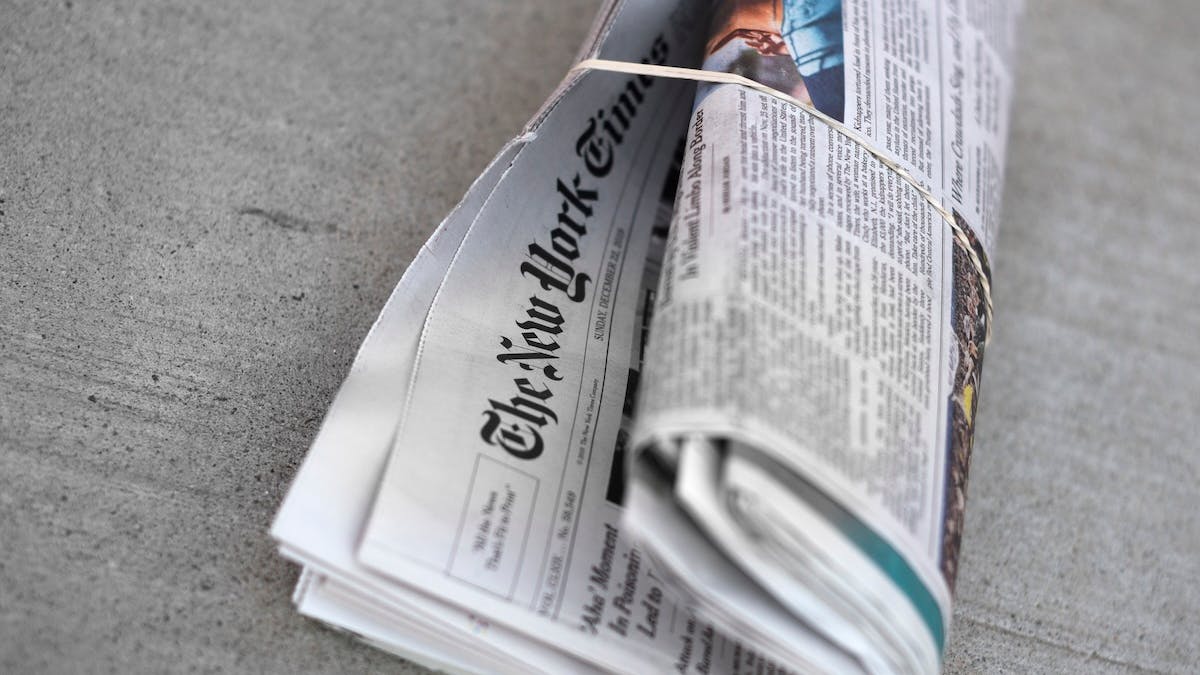
The New York Times confirmed that they’ve cut ties with a freelance writer who stands accused of using AI to generate his book review. Alex Preston said he’s “hugely embarrassed” by the whole debacle.
The legacy paper was alerted by a reader who noticed that Alex Preston’s review of “Watching Over Her” by Jean-Baptiste Andrea was suspiciously similar to the review of the same title that Christobel Kent wrote for The Guardian last August.
When confronted by the Times, Preston admitted to using AI for assistance in writing his review and said he did not realize it had lifted copycat lines from anywhere else.
The New York Times sent a note to The Guardian, saying, “[Preston’s] reliance on AI and his use of unattributed work by another writer are a clear violation of the Times’s standards.”
“I made a serious mistake in using an AI tool on a draft review I had written, and I failed to identify and remove overlapping language from another review that the AI dropped in,” Preston said in his statement to the Guardian, as the outlet noted. “I am hugely embarrassed by what happened and truly sorry. I took responsibility immediately and apologized to the New York Times, and I also want to apologize to Christobel Kent and to the Guardian.”
The phrase “lazy Machiavellian Stefano” from The Guardian version became “lazy, Machiavellian Stefano” in the New York Times version.
The Guardian described the book as “most significantly a song of love to a country of contradictions, battered, war-torn, divided, misguided and miraculous: an Italy where life is costume and the performance of art, and where circuses spring up on wasteland.”
This is very similar to the Times version, which said the characters “populate what is ultimately a love song to a country of contradictions: battered, divided, misguided, and miraculous. This is an Italy where life is performance, where circuses rise on wasteland.”
The outlet noted that Preston has written for The Observer, The Financial Times, The Guardian, and The Economist. He’s also written six books, including the recent release, “A Stranger in Corfu.”
This isn’t the first time a legacy newspaper outlet got caught publishing AI-generated content, as The Daily Wire previously reported. The Chicago Sun-Times was called out last year for advertising an AI-generated summer reading list, including a number of titles that didn’t actually exist.
Only five of the fifteen suggested titles were real books. The writer, who was not a full-time staff member, apologized for his “huge mistake” and said he “betrayed that trust.”
The paper also issued a response to subscribers, noting that the person responsible for the error had been terminated and promising the mistake would not happen again.
“We are in a moment of great transformation in journalism and technology, and at the same time our industry continues to be besieged by business challenges. This should be a learning moment for all journalism organizations: Our work is valued — and valuable — because of the humanity behind it,” the statement said.
“At Chicago Public Media, we are proud of our credible, independent journalism, created for and by people. And part of the journalistic process is a commitment to acknowledging mistakes. It is unacceptable that this content was inaccurate, and it is equally unacceptable that we did not make it clear to readers that the section was produced outside the Sun-Times newsroom.”

