

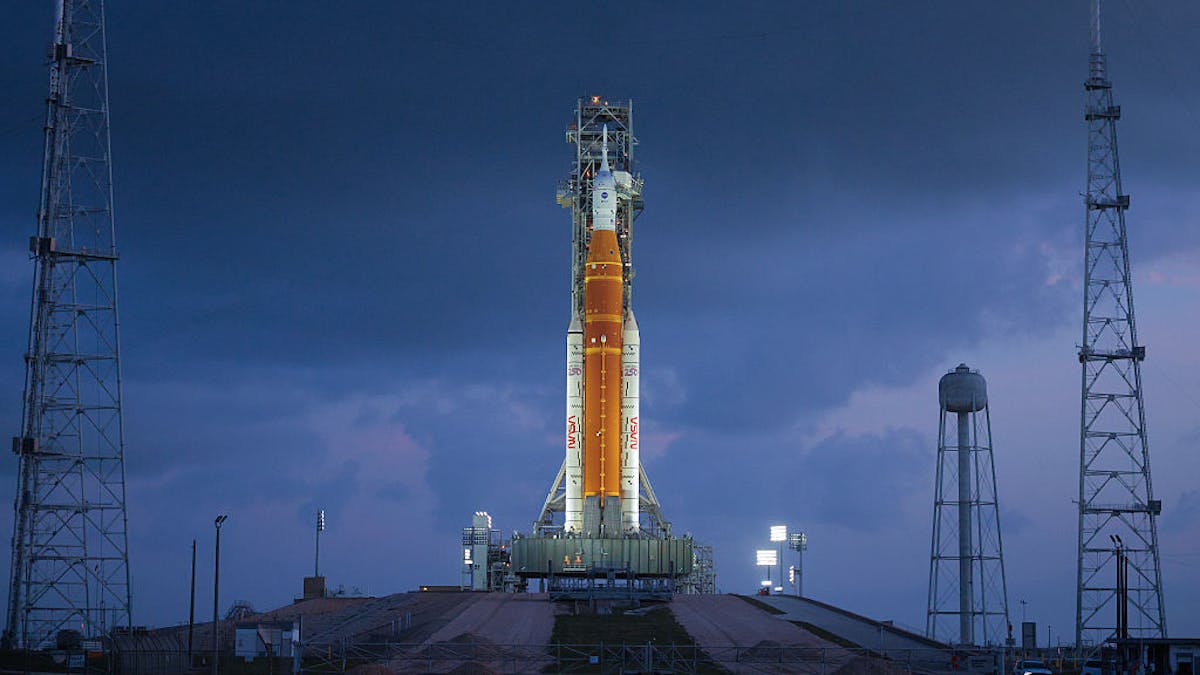
There are billion-dollar rockets, decades of engineering, and the full weight of American ambition behind Artemis II — and then there’s the toilet.
Within hours of launch, astronauts aboard NASA’s Orion spacecraft ran into an issue with the capsule’s “Universal Waste Management System,” a compact, next-generation space toilet that reportedly cost more than $23 million to develop. Mission specialist Christina Koch flagged that a fan had jammed in the urine collection system, rendering half the toilet’s functionality unusable.
Engineers on the ground scrambled to troubleshoot while the crew fell back on contingency measures, including collapsible backup urinals not far removed from older, less glamorous eras of space travel.
“The toilet fan is reported to be jammed,” NASA spokesperson Gary Jordan said during live mission commentary, as engineers scrambled to diagnose the issue from the ground. Officials later clarified that while the system’s urine function was temporarily offline, “the fecal collection of the toilet … can still be used,” forcing astronauts to rely on backup measures for part of their waste management.
The issue was ultimately resolved after a series of guided fixes from Mission Control. “Happy to report that toilet is go for use,” astronauts were told, with the added recommendation to let the system “get to operating speed before donating fluid,” a phrase that, in another context, might sound absurd, but in orbit is just another procedural necessity.
Even so, the early malfunction undercuts what NASA has touted as a major quality-of-life upgrade. The Orion toilet includes a private compartment, airflow-based waste removal, and ergonomic restraints, a far cry from the Apollo-era system that relied on bags and adhesive, once memorably described in mission transcripts as “a turd through the air.”
The early toilet trouble was just one of several hiccups during the crew’s first day in space, a reminder that even the most advanced missions are not immune to everyday frustrations.
Shortly after reaching orbit, the astronauts experienced a brief communications outage with Mission Control, leaving ground teams unable to receive data from the spacecraft. “There were no issues with the vehicle itself,” NASA Administrator Jared Isaacman said, adding that communications were quickly restored and the issue remains under investigation.
The crew also ran into a more relatable problem while setting up onboard systems: email issues.
“I also see that I have two Microsoft Outlooks, and neither one of those are working,” commander Reid Wiseman radioed to Mission Control, prompting ground teams to step in with remote tech support to resolve the glitch.
Despite the rocky start, from toilet malfunctions to comms dropouts and email bugs, the crew quickly moved past the issues and hit a major milestone. After getting some rest, the astronauts successfully completed a critical translunar injection burn, firing Orion’s main engine for nearly six minutes to send the spacecraft out of Earth’s orbit and toward the moon.
Mission Control confirmed the burn placed the crew “on trajectory to fly around the moon for the first time in 50 years,” marking a major step forward for NASA’s Artemis program.
As NASA pushes toward longer missions and a sustained lunar presence, waste management is not a luxury but a requirement. Systems must be reliable, sanitary, and sustainable, especially as future missions aim to recycle water and minimize contamination.
Still, the early issues highlights that the systems furthest from mind can rear their ugly heads, and in a mission meant to symbolize technological precision and forward momentum, even the smallest system can become briefly, the most talked-about part of the spacecraft.

