

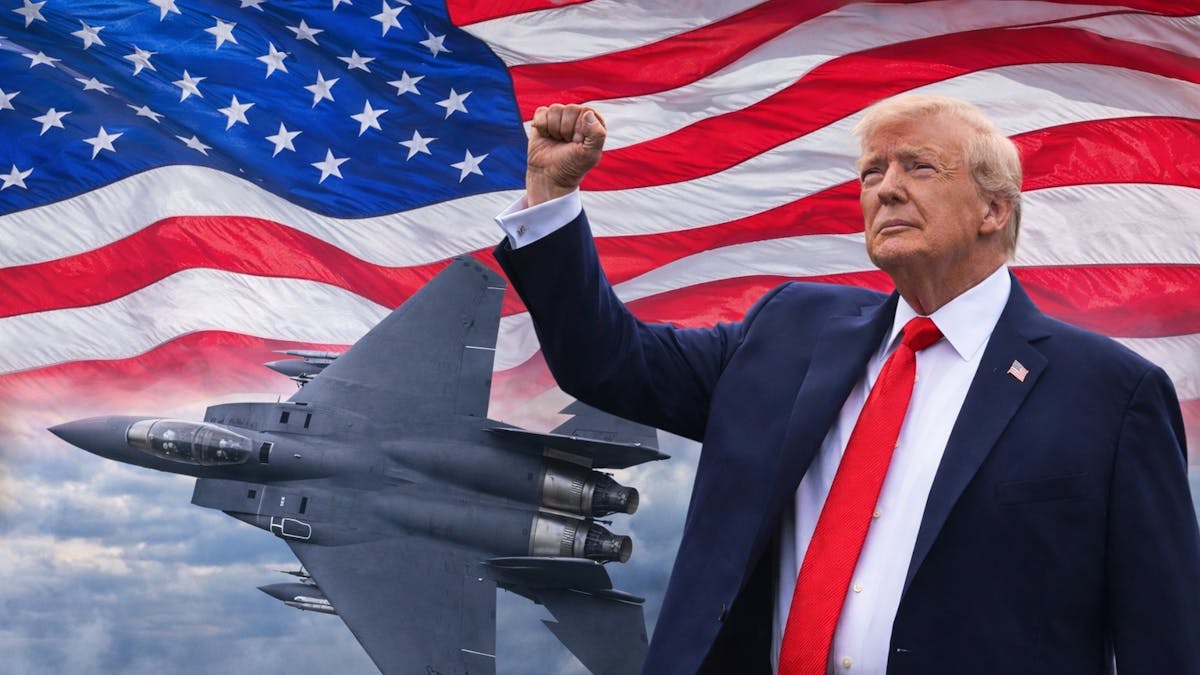
For nearly 48 hours, an American colonel evaded capture by scaling a tall ridge and hiding inside a mountain crevice, as Iranian forces — who were promised a reported bounty — worked to close in on his position.
While much about the rescue effort for the downed U.S. weapons systems officer (WSO) remains unknown, newly confirmed details from President Trump and unnamed U.S. military officials are beginning to shed light on the daring mission that quickly became the Pentagon’s top priority.
After their F-15E fighter jet was struck in southwest Iran, both the pilot and the WSO ejected. The pilot was found and rescued in “broad daylight” after U.S. forces operated over Iran for seven hours, President Donald Trump revealed in a statement Sunday morning.
The rescue of the WSO, on the other hand, proved to be more challenging.
Described as a “highly respected Colonel,” the WSO, who was “seriously wounded,” was rescued “deep inside the mountains of Iran,” while Iranian forces were looking for him “in big numbers” and “getting close,” according to Trump.
After hitting the ground, the colonel relied on his Survival, Evasion, Resistance, and Escape (SERE) training to avoid capture. The WSO, who was equipped with a beacon — a device that sends encrypted distress signals via satellite to rescue forces — was being monitored by the president, Secretary of War Pete Hegseth, and other officials during the rescue operation, Trump said. The president added that he directed “dozens of aircraft” to retrieve him.
The WSO climbed roughly 7,000 feet into mountainous terrain to conceal himself, as hundreds of special operations forces from various branches, along with dozens of warplanes and helicopters — and support from cyber, space, and intelligence assets — were mobilized to rescue him, according to The New York Times.
Israeli officials shared intelligence with the United States to aid the search-and-rescue effort, while the Israeli military paused air strikes in the area, according to Fox News. Meanwhile, the CIA launched a “deception campaign” inside Iran, spreading false information that the colonel had already been rescued — confusing Iranian forces as the operation unfolded, the outlet reported.
According to The New York Times, Iranian convoys attempting to reach the area were struck to keep them away from the extraction zone, and a senior military official described the mission as one of the most challenging and complex in U.S. special operations history. MQ-9 Reaper drones were used to create a lethal perimeter to protect the crew member from Iranians who got within three kilometers of the WSO, reported Air & Space Forces Magazine.
Reports differ on whether a firefight occurred during the operation. The New York Times reported that U.S. forces engaged Iranian units, while Fox News said no direct firefight took place. The Washington Post, citing anonymous U.S. officials, reported that Iranian forces opened fire on two helicopters searching for the weapons officer, wounding several American service members on board.
At least one aircraft involved in the extraction — possibly a C-130 Hercules — was left behind after becoming stuck in the mud and was later destroyed to prevent it from falling into enemy hands, Fox News reported.
The New York Times described a similar complication, reporting that two transport planes became disabled at a remote base in Iran after the weapons officer was rescued. Air & Space Forces Magazine claims that the two planes destroyed were MC-130J Air Force Special Operations planes.
Commanders ultimately flew in three additional aircraft to extract all U.S. personnel and destroyed the disabled planes to keep them from falling into Iranian hands.
Trump announced that he will hold a press conference on Monday at 1:00 p.m. ET with military officials, where he will likely reveal more key details of the historic rescue mission.
CENTCOM and the Department of War declined to comment on this report.

