

Estimated reading time: 0 minutes
The Bulldog Classic is Charter Arms’ most iconic revolver. Consider this review as getting reacquainted with the compact, 5-shot revolver chambered in 44 Special. It’s a small gun with a big personality. I have run several Charter Arms revolvers over the years and I always find myself coming back to the Bulldog. This latest variant of the Bulldog is the nicest looking and it performs.
Charter Arms Bulldog Pedigree
The Bulldog has been popular since it was introduced in 1973 because of its compact size and 44 Special caliber. Back in the 1970s, a 38 Special revolver was the norm for concealed carry and the 44 Special delivers almost twice as much muzzle energy than the 38 Special.

There are a few unique features about the Charter Arms Bulldog Classic and, in fact, the entire Bulldog pedigree line. One feature is the one-piece frame. Smith & Wesson, Taurus, Rossi, and Colt all use a two-piece frame that incorporates a side plate that holds the guts of the internal mechanism in place. Charter Arms Bulldog guns use the trigger guard to hold the internals in place.
The second unique feature Charter Arms used was a frame-mounted firing pin. The blow from the hammer hits a transfer bar which hits the firing pin to fire the round. The transfer bar system makes the Bulldog very safe. Back in the 1970’s and ‘80s other revolver manufacturers used a hammer-mounted firing pin.
Available on GunsAmerica Now

Origin Of The Bulldog Name
The name Bulldog originated in the late 1860s. Webley in England is credited with first using the name for their British Bull Dog revolver which was a small, compact .44 caliber revolver featuring a 2.5-inch barrel and 5-shot cylinder. It wasn’t a stretch for Charter Arms to name their compact, 5-shot, 44 Special revolver the same.
Features
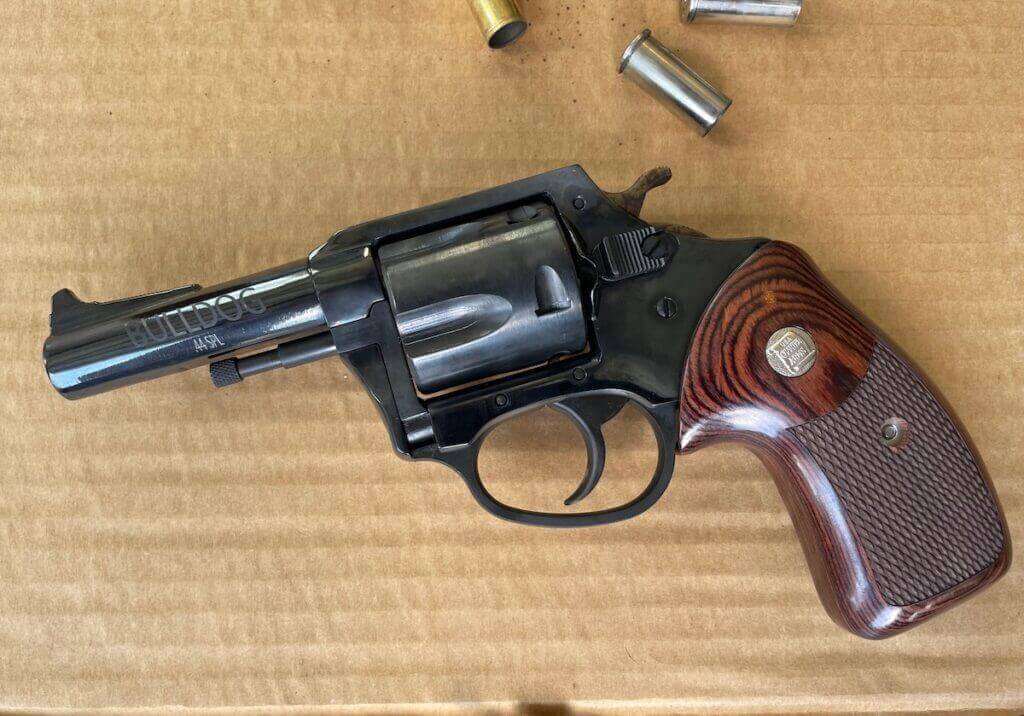
The Bulldog Classic looks 1970’s old-school with the tapered 3-inch barrel, exposed ejector rod, blued finish, and checkered laminate wood grips. The bright blue finish was nicely executed. The best bluing I’ve seen on a Charter Arms revolver. The hammer is case colored and contrasts nicely. The trigger and trigger guard are a matte black color. The Bulldog has that retro double-action revolver look to it.

In hand, the Charter Arms Bulldog is as lightweight as similar-sized 38 Special revolvers except the cylinder is fatter on the Bulldog to accommodate five 44 Special cartridges. Unloaded the Bulldog weighs 20 ounces. The laminated wood grip shape is just large enough to fill your hand yet small enough to conceal. The sides of the grips are checkered.
Trigger
It features a double-action/single-action trigger. The pull weight in double action was 12 pounds; single action was 4.8 pounds. The trigger face is smooth and the action itself was fairly smooth, so the 12-pound DA press felt lighter. In my experience, some Charter Arms actions feel gritty until they are broken in. There was a slight amount of stacking in DA, but the trigger can be staged—pulled back in DA mode and held by the trigger finger then pulled the rest of the way through to fire the revolver. Staging the trigger in DA can make the final bit of trigger pull feel like you are shooting in SA mode.

Cylinder
To open the cylinder, press the serrated cylinder latch forward or pull forward on the ejector rod. The crane locks into the frame. Ruger used this design detail in the LCR. Most other revolvers mate the crane to frame.

Sight
The ramp front sight is internal to the barrel and the rear sight is a groove machined into the top strap. These are rudimentary sights at best and very usable in close-up, defensive situations. This is not a target pistol by any means.

Barrel
The 3-inch long barrel offers a bit more sight radius and ekes out a bit more velocity and energy compared to the typical 2.5-inch snub nose revolver. The longer barrel also allows for a longer ejector rod to easily kick out spent shells, yet is still easy to conceal.
38 Special Vs 44 Special: Which Is Better?
The 44 Special caliber makes the Bulldog unique among small, compact revolvers which are typically chambered in 38 Special or 357 Magnum. So you might ask yourself: Is the 44 Special special?

Looking at the data 44 Special Hornady Custom with a 180-grain FTX bullet had a muzzle velocity/energy of 790 fps/249 ft-lb. Buffalo Bore’s Anti-Personal 44 Special cartridge loaded with a 200 grain hard cast wadcutter bullet generates 979 fps and that translates to 425 ft-lb of energy. Wadcutters are shaped like soup cans. They have no point or give. These bullets are typically used by target shooters, and at close range, like in a defensive situation, the bullet is very accurate, and flat nose hits with force and penetrates. It makes holes in the target like a hole punch.

Looking at data out of a Rossi RP63 with a 3-inch barrel 38 Special Speer Gold Dot with a 125-grain GDHP bullet has a muzzle velocity/energy was 815 fps/184 ft-lb. Aguila 357 Magnum with a 158-grain semi-jacketed HP produced a muzzle velocity/energy of 1115 fps/436 ft-lb.
Running The Charter Arms Bulldog In 44 Special
The Bulldog has enough real estate on the grip that felt recoil is spread into the palm of your hand. It is not concentrated so recoil feels lighter, and much softer shooting than a 357 Magnum J-frame or similar-sized revolvers. The exception is the hot Buffalo Bore Anti-Personnel loads. You don’t want to shoot a box of these at one time. The Bulldog Classic also feels surprisingly small and compact in hand. It is hard to believe it holds five, fat 44 Special cartridges.

Groups at 10 YD
To collect accurate data I fired in single-action using a rest at 10 yards. Five-shot groups averaged from 1.3 to 2.3 inches, which is good for a revolver meant for use at spitting distances. The Bulldog had no taste for the Hornady Custom 180-grain rounds, my best 5-shot groups measured 2.04 inches. The Bulldog seemed to prefer 200-grain loads. The best group with the 200-grain SIG ammo measured 1.1 inches. The Buffalo Bore 200-grain anti-personnel wad cutter was 1.4 inches.

Groups at 7 Yds
At close range is really where the rubber meets the road with the Bulldog Classic. I moved the target to 7 yards and shot a modified Bill Drill. Grasping the Bulldog high on the grip to better manage muzzle flip firing for speed, I was able to consistently keep shots in the 8-inch circle firing DA. My group sizes were about 2 to 3 inches on average. I admit the Buffalo Bore took control to fire fast. Recoil was not pleasant. It pounded my palm like a Bull-Dawg! Of course, the target got the worst of it. With the Hornady and SIG, recoil was very manageable. Emptied ejected fast but I did get a few cases hung up on the grip, but gravity provided an assist.

Read More: Colt Python Review: 2.5 Inch Snub-Nose Classic
Final Thoughts

If you want a classic compact revolver in a unique caliber the Charter Arms Bulldog can fill that desire. Bulldog revolvers are also affordable. I’ve carried Bulldogs off and on for years and I have never felt undergunned. I consider snub-nose revolvers as a “get away” gun, allowing me to fire at close range and get the hell out of Dodge to safety. You either like revolvers or you don’t. All you revolver xenophobes can leave a comment below. I’m going to conceal carry this new Bulldog in 44 Special for a while or at least until peer pressure shames me back to a striker-fire 9mm.
*** Buy and Sell on GunsAmerica! ***

Robert A. Sadowski is an American writer and journalist.
He has written about firearms and 2A issues for decades, and has trained with some of the country’s finest firearm instructors in handguns, rifles/carbines, shotguns and long-range shooting. He has also had the opportunity to interview numerous individuals deeply involved in protecting our 2nd Amendment.
He a is a frequent contributor to numerous gun-enthusiast publications, a few of which include:
- TheArmorylife.com
- TheTruthAboutGuns.com
- GunsAmerica.com
- GunBroker.com
- Gun-Tests.com
- Shooting Illustrated
- SHOT Business
- Gun Digest
Sadowski is also the author of numerous gun books, including: “9MM — Guide to America’s Most Popular Caliber” and “Book Of Glock,” both of which were #1 new releases on Amazon. He also wrote the popular DIY gun book series: Shooter’s Bible Guide to Firearms Assembly, Disassembly, and Cleaning Volume 1 and Volume 2. Other gun books authored by Sadowski include “50 Guns That Changed the World,” and edited “The M16A1 Rifle: Operation and Preventive Maintenance”originally published by the U.S. Department of the Army. He also edits the annual “Gun Trader’s Guide” to firearm values.
Sadowski is also the Treasurer/Secretary of the GLOCK Collectors Association, a non-profit organization with the mission to educate and preserve: Educate the public on the models, variations, and commemoratives built by GLOCK, as well as provide members with information on GLOCK serial numbers, importation, and other facts unique to GLOCK pistols.

