

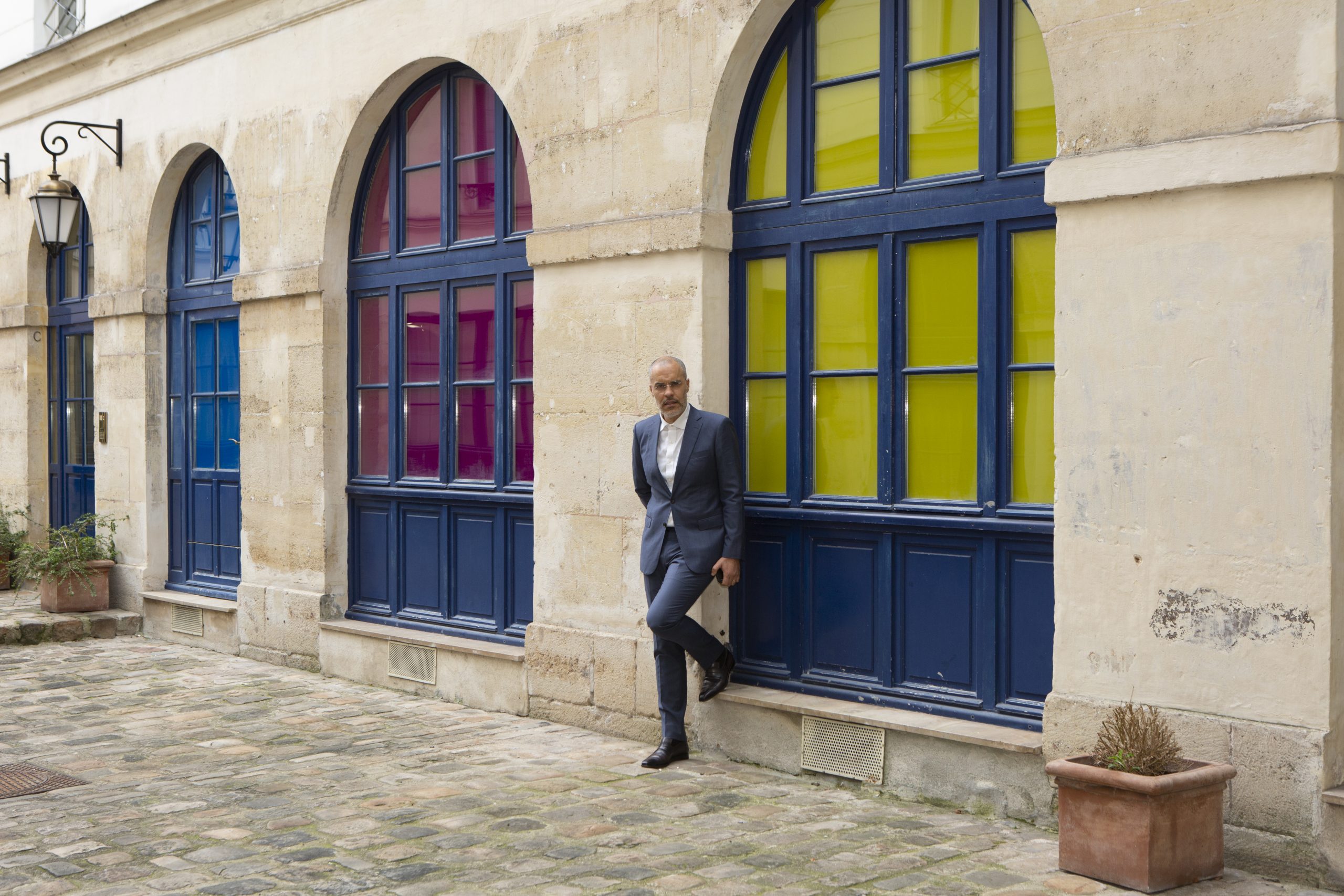
Since entering the gallery business 25 years ago, Kamel Mennour has focused his efforts on his hometown and become one of the key players in reasserting Paris’s relevance in the contemporary art world at a time when many French dealers were losing ground to London and New York. He recently solidified his geographical commitment with a major donation of 180 contemporary artworks to the Musée d’Art Moderne de Paris. On the occasion of the announcement of the gift, Observer caught up with the French-Algerian dealer to trace the evolution of his gallery and reflect on how his decision to maintain a Parisian focus—rather than pursue global expansion—has proven to be the most enduring formula for securing his international reputation without sacrificing his identity or passion.
In 1999, Kamel Mennour, with a degree in economics in hand, opened his first gallery in Saint-Germain: a modest 50 square meter space at 60 Rue Mazarine dedicated primarily to contemporary photography. Self-taught in both art and the art business, Mennour had little more than deep passion and a vision at a time when Paris had few new voices in contemporary galleries and even fewer competitors. “Paris was an old lady sleeping,” he jokes, recalling a very different city—one of grand museums focused on the past and a handful of legendary dealers from an earlier generation, Yvon Lambert and Daniel Templon among them. Even Emmanuel Perrotin, Thaddaeus Ropac and Almine Rech had only recently opened—all across the river. “I had no competition. There was nothing in front of me,” he says. “I had this vision that I wanted to make it in Paris. Paris was my city.”

Mennour trained himself by visiting every gallery and art fair he could. Not long after opening his space, he found himself presenting at FIAC, which was then considered France’s leading international fair even though it was still lacking true selectivity and global appeal. “At the time, there was a huge gap between Frieze London and FIAC in Paris—and since they were held at the same time, we were always trying to convince our colleagues, especially the Americans, to stay in Europe a bit longer and do both,” he recalls with a smile, noting how a decade later the situation had completely flipped, and Paris had begun to outshine its rival.
Keen to close that gap, Mennour became deeply involved in the fair’s growth. During its final decade at the Grand Palais, he played a key role in elevating FIAC’s quality and international standing as a member of its selection committee. Alongside fellow top-tier French dealers like Emmanuel Perrotin, Chantal Crousel, Almine Rech and Nathalie Obadia, he helped bring in a more competitive and international roster in the early 2010s, when FIAC was working hard to reclaim relevance from Art Basel. That momentum, however, came to an abrupt halt in 2022, when the global Swiss brand launched its Paris edition and FIAC was sidelined entirely.
Today, Paris has arguably reclaimed its status as Europe’s leading capital for art and culture—surpassing even London. Mennour confirms that Brexit played a role, but credits the broader renaissance the city experienced just before and after the pandemic. The opening of major private collections and foundations sparked a renewed sense of cultural pride, with institutions vying to revitalize the French scene. “Francois Pinault had a huge impact—he was buying so much from all the galleries,” Mennour says. “We used to tell our international colleagues that when they opened in Paris, a visit from Pinault was almost guaranteed if their program was strong.”
Pinault’s support, particularly throughout the pandemic, was significant—not just a matter of ego, but a deliberate effort to help rebuild the ecosystem. Then came Bernard Arnault with the Fondation Louis Vuitton, introducing a real sense of competition. The Fondation Cartier was already active, and the rise of these private institutions also pushed the public ones—like the Centre Pompidou and Palais de Tokyo—to step up their engagement with contemporary art.
This wasn’t rivalry in a negative sense, Mennour stresses, but a kind of healthy emulation that invigorated the entire scene. “We started as a French market but by the end of that chapter, we had become international. We were welcoming collectors and visitors from Asia, the U.S. and all over Europe. Paris had become the place to be.”

Mennour has, of course, firmly established his name in the contemporary art world. He now operates four spaces—all in Paris—and represents some of the most compelling artists of the past decade, while continuing to champion rising talents from the French scene. Many of these artists were exceptionally young and living and creating in Paris when he began working with them—figures like Camille Henrot, Latifa Echakhch, Ali Cherri, Kader Attia and Hicham Berrada. Notably, Mennour is one of the dealers who has brought the most nominees to the Marcel Duchamp Prize—nine in total. That visibility, combined with the gallery’s focused and ambitious program, earned him an early invitation to Art Basel in Basel. “I believe we were invited in 2006,” he recalls. “They gave us the worst possible spot, but I was just happy to be there less than a decade after opening. It was the moment when foreigners really began to look at French galleries and artists, and I was one of them.”
Mennour notes that many of the French artists who emerged at the time also came from diasporic backgrounds—Latifa Echakhch from Morocco, Petrit Halilaj from Kosovo, Kader Attia from Algeria. “They were French artists, but they brought other roots and perspectives—and that gave the scene a real injection of energy and vitality,” he explains. Mennour was among the first to support many of them, long before they became globally known household names.
From the beginning, Mennour was drawn to artists with strong institutional resonance, but his decision to represent diasporic narratives reflected his own French-Algerian identity. “I’m very French, but I’m also originally from Algiers. I studied entirely in French universities, but growing up, I moved between France and Algeria,” he explains. “I spoke to my mother in Algerian Arabic while living in France—it gave me a dual lens.” At the time, artists from similar backgrounds were rarely represented in the mainstream. “I was proud to be one of the people helping bring their work to a broader audience. It was incredibly rewarding, and the response was fantastic.”
Mennour was among the first to champion many of these artists, and while most are now represented by major international galleries, he has managed to maintain close relationships with them that often continue through co-representation.

From the outset, Mennour deliberately chose not to open in New York or Hong Kong. Instead, he chose to grow with his artists from Paris. Rather than risk losing them, he remained open to collaboration with larger galleries, frequently initiating those connections himself.
“I didn’t just allow those connections; I facilitated them,” he tells Observer. “I studied economics, so I understood early on that if you ignore what an artist needs, you’ll lose them. So I helped bring artists like Camille Henrot to Hauser & Wirth, knowing that one day she might need something I couldn’t offer, like a strong New York infrastructure.”
That foresight allowed Mennour to preserve many of those relationships even as the artists on his roster gained global visibility. But his approach didn’t just apply to emerging voices; it also extended to overlooked figures from the vibrant French scenes of the ’50s, ’60s, and ’70s. While well-established domestically, many had yet to receive the international recognition they deserved. Mennour made it a priority to help bring their work to a broader stage.
One of these artists was Daniel Buren. When he ended his long-standing relationship with Marian Goodman, instead of returning to established French dealers like Yvon Lambert, Durand-Dessert or even Daniel Templon, he chose to join Mennour. “It was a huge surprise—I was incredibly proud and happy,” Mennour recalls. That moment made him realize he had something meaningful to offer even to artists with long, celebrated careers: a chance to reframe their work in dialogue with a new generation. “I helped reposition their practices in conversation with younger voices. It was mutually beneficial—they elevated the gallery’s program, and I introduced their work to a new audience. I was selling works by Buren or François Morellet to collectors my age.”
This September, Mennour’s gallery at six rue du Pont de Lodi will present a show pairing American Light and Space pioneer Larry Bell with contemporary Californian painter Liam Everett. The exhibition, organized in collaboration with Hauser & Wirth, underscores Mennour’s continued interest in intergenerational dialogue.

At the same time, he has continued to expand his roster on the more emerging and experimental end, recently bringing in young talents like Elizabeth Jagger and Cameron Jamie. The result is a program that bridges generations strikingly without losing coherence.
Two years ago, Mennour launched the Mennour Émergence prize, a program supporting six or seven emerging artists each year, selected from some of France’s top art schools, including the École des Beaux-Arts, Arts Décoratifs and ENSAV La Cambre. The selection is made by an independent committee; Mennour himself deliberately steps back from the process. Instead, the jury includes respected figures from major institutions and foundations. Last year, curators from the Palais de Tokyo and other leading voices in the art world joined forces with the gallery’s director to choose the finalists.
“The goal is to generate energy and sustain the vitality of the scene, which I believe is essential for a gallery like mine, now 25 years old,” he explains. “I want to stay in touch with what’s being created today—with the avant-garde, with the evolving vocabulary of contemporary art. I want to stay in the race and keep understanding the time I live in.”
Crucially, even while participating in this increasingly global and fast-paced industry, Kamel Mennour has never lost sight of his original focus or passion. He remains anchored to the values that have guided his program since day one—a clarity of purpose that has helped him avoid the burnout and disorientation experienced by many of his peers.
Mennour has always been extremely close with Tim Blum, who hails from the same generation. “I think Tim ultimately became disillusioned with the art world. He was stretched between Los Angeles and Tokyo, and he was preparing to open in New York. It was simply too much. I was lucky—maybe I didn’t know it consciously, but I could sense that this model of constant global expansion wasn’t sustainable,” he says, looking back on the choices that shaped his own path. “Having galleries everywhere means having to constantly feed them, constantly push your artists and eventually, something gets lost.”
For Mennour, the profession remains deeply personal. “If an artist has a problem, I call them. We sit down for lunch. If something isn’t working with a show or an institution, I take the car—or the métro—and go fix it. That’s how I’ve always worked,” he explains. “Once your galleries are in New York, Hong Kong, Seoul… you lose your head. And more importantly, you risk losing the relationship. I knew that, and I chose to stay focused instead.”
In recent years, Mennour has also taken a strategic approach to the fair circuit—maintaining international visibility without overextending. “I don’t do all of them. I’ve always prioritized depth of commitment over ubiquity,” he says. “And now that we’re seeing the fatigue—galleries closing, burnout everywhere—I’m grateful I made that choice.”

Although a recent survey of the members of France’s Professional Committee of Art Galleries (CPGA) found that 85 percent of its 324 members were pessimistic about the economic outlook for the art sector this year, Mennour remains optimistic—both about Paris and the global art market. For him, this is simply a necessary recalibration after a boom that was neither sustainable nor realistic.
He has built something enduring—a brand that is global in visibility yet firmly rooted in Paris, defined by a clear identity and deep community ties. Those ties are something he has always valued, and now, as he begins to consider his legacy, he’s looking to affirm them even further. While his son—who shares his passion for art—is set to take over the business, Mennour’s major donation to the Musée d’Art Moderne de Paris stands as both a gift to the city and a powerful statement of his long-term commitment to nurturing its cultural and artistic life.
As to how it came about, after he donated works to the Centre Pompidou, the director of the Musée d’Art Moderne approached him—half-jokingly—saying, “With the Pompidou closing, maybe you should consider me!” Mennour took it seriously. “Over the years, I’ve accumulated a huge number of works—many from artists I’ve shown and supported,” he says. As a gallerist, he often bought pieces from each exhibition, particularly those that didn’t sell, as a way of helping his artists. “I’d usually buy two or three works myself, and often they were the most interesting ones. That was my way of showing support,” he explains. “So after 25 years, my storage became a kind of metaphor reflecting the history of the program.”
The donation includes works by more than forty-five artists who have shaped the trajectory of contemporary art in recent decades. The group spans rising voices such as Alicja Kwade, Petrit Halilaj, Mohamed Bourouissa, Camille Henrot, Latifa Echakhch and Dhewadi Hadjab, as well as seminal figures like Yona Friedman, François Morellet, Gina Pane, Bertrand Lavier, Anish Kapoor, Daniel Buren, Ugo Rondinone, Lee Ufan, Douglas Gordon, Huang Yong Ping, Tadashi Kawamata, Zineb Sedira and Philippe Parreno. Together, these works embody the diversity, ambition and critical influence that have defined Mennour’s program since its founding in 1999.

Mennour worked closely with his team to assemble the selection, with plans to display them in a way that draws connections across time, media and artistic practices—a thread that traces the evolution of the gallery’s program. The donation is a significant gift to the museum, which operates with a minimal acquisition budget and typically receives donations only after a collector passes away. “This happened while we’re both still active—he’s still building the museum’s collection, and I’m not too old yet,” Mennour notes. “So it felt timely and meaningful.”
The gift has also made a large-scale exhibition possible, set to open in 2027. “For me, it was a gift,” Mennour concludes. “I was so pleased—and in many ways, it felt like a way to truly cement and celebrate my connection with Paris. This donation is a tribute to Paris—the city that shaped me and continues to inspire my work.”
More Arts interviews


