

A Republican candidate for governor in Massachusetts is facing renewed scrutiny over his role in bringing a Chinese state-owned manufacturer into the Boston subway system, a decision that represents both a financial debacle and a potential national security risk.
Brian Shortsleeve, who is running in a three-way GOP campaign ahead of the September 1 primary election, has built much of his campaign around his tenure as chief administrator of the Massachusetts Bay Transportation Authority. But newly surfaced research obtained exclusively by The Daily Wire is casting that record in a harsher light, focusing on a $277 million contract awarded during his leadership to China Railway Rolling Stock Corporation, or CRRC.
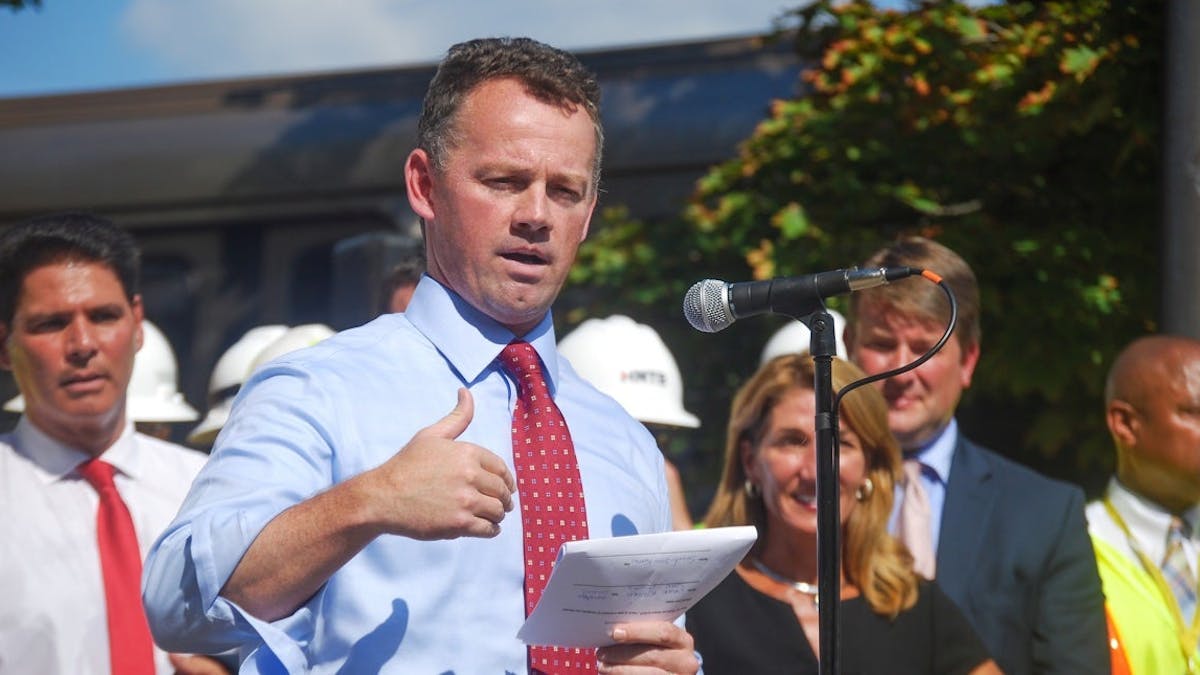
At the time, Shortsleeve defended the deal as fiscally responsible. “The decision we made today was a good business decision,” he said in December 2016, touting the new Chinese-built subway cars as a cost-saving measure for the struggling transit system. He also appeared at a 2016 ceremony marking construction at CRRC’s Springfield facility, publicly celebrating the partnership.
That relationship has since become a liability, with the project becoming plagued by delays and mechanical issues, and only a fraction of the promised cars delivered years behind schedule. In 2023, CRRC reportedly submitted unfinished cars for inspection, and in August 2025, federal agents detained several new MBTA subway car shells at the Port of Philadelphia amid an investigation into potential forced labor connections.
Security concerns surrounding CRRC have also grown over time. Lawmakers and industry experts have warned for years that Chinese state-owned rail manufacturers could pose a surveillance or sabotage threat to U.S. infrastructure. A 2019 report in The New York Times highlighted fears that subway cars built by CRRC might be equipped with technology capable of tracking passengers’ movements or communications.
Those concerns have been echoed at the federal level. In a 2019 op-ed, then Florida Senator Marco Rubio warned that CRRC is part of a broader effort by the Chinese Communist Party to expand its influence in critical infrastructure sectors, calling it “one tactic China is employing to supplant America.” Federal agencies have since classified CRRC among Chinese military-linked companies, and Congress has moved to restrict federal funding for transit projects involving such firms.
Independent research has reinforced those warnings. A report published in an industry magazine described CRRC as having “indelible ties to the Chinese Communist Party,” noting that executives often serve dual roles as corporate leaders and party officials. The company, the report found, operates in close alignment with Beijing’s industrial strategy, including efforts to dominate global transportation networks under initiatives like “Made in China 2025.”
Meanwhile, the Rail Security Alliance has called the MBTA’s contract with CRRC a “fiasco,” citing delays, alleged coverups, and mechanical failures. The group and others have argued that Chinese state-owned enterprises benefit from heavy government subsidies, allowing them to undercut competitors and win contracts that may not serve long-term U.S. interests.
All of that is now intersecting with Shortsleeve’s political ambitions; the 53-year-old Marine veteran and Harvard MBA is positioning himself as a fiscal conservative capable of fixing Massachusetts’ economic challenges.
His business background has been emphasized in local reporting, and he argues that the state needs “a chief executive … that understands how to get costs under control, provide tax and regulatory relief and get jobs growing.”
But his record complicates that message. While he is now campaigning on a more hardline conservative platform—taking tough positions on immigration and energy policy and attacking Democratic Gov. Maura Healey—Shortsleeve’s political history reflects a more moderate, establishment trajectory. He worked closely with former Gov. Mitt Romney, serving as political director for his 2002 gubernatorial campaign and fundraising for both his 2008 and 2012 presidential runs.
Shortsleeve, a self-described “Cape Cod voter” and founder of venture capital firm M33 Growth, has donated to several Democrats in recent years, including members of Congress and state officials.
He has also shifted party affiliations over time, at one point registering as a Democrat before later switching between Independent and Republican. As recently as 2021, he moved to “unenrolled” status following January 6, before rejoining the Republican Party in 2023.
Political strategist Wendy Wakeman noted that Shortsleeve is now running “a little more Republican, a little more right” than in the past, as he competes in a primary shaped by the Trump-era GOP.
That dynamic leaves him in a delicate position. To win the nomination, he must appeal to a conservative base that has grown increasingly skeptical of establishment figures and foreign economic dealings, particularly those involving China. Yet to compete in a general election in deep-blue Massachusetts, he would likely need to regain support from moderates and independents.
The controversy over the MBTA’s CRRC contract underscores the tension at the heart of his candidacy. What was once presented as a pragmatic, cost-saving decision is now being reframed as a cautionary example of the risks tied to foreign state-owned enterprises—and a potential vulnerability for a candidate trying to redefine himself in a changing Republican Party.

