

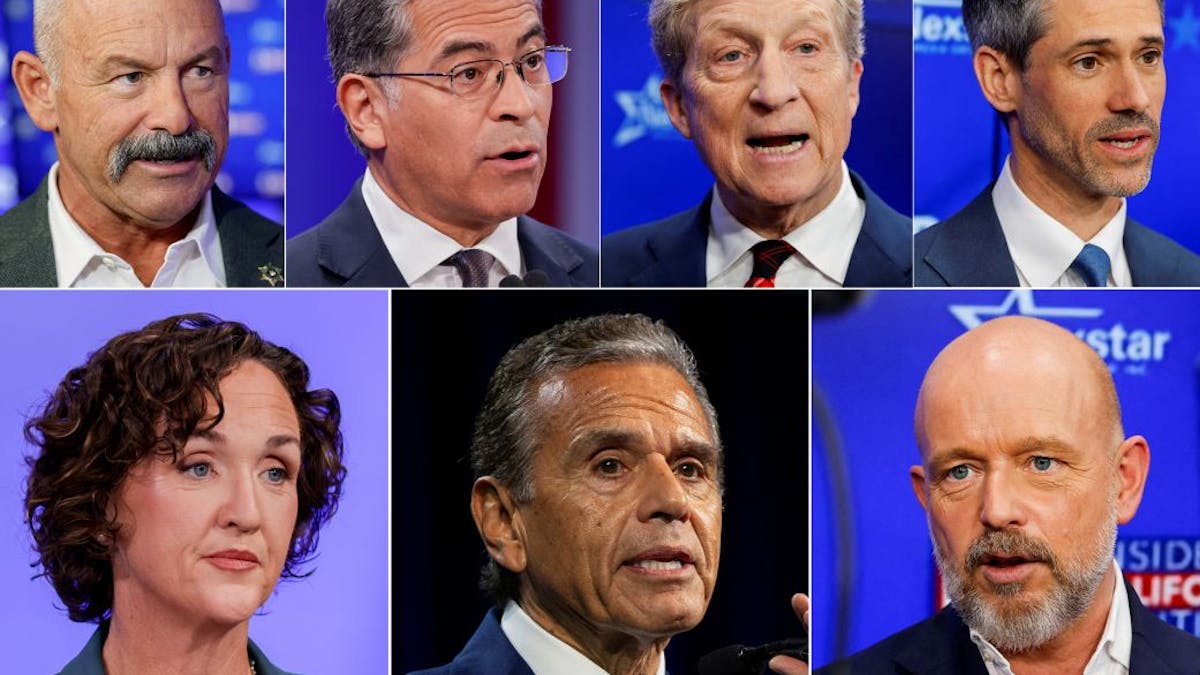
California’s already volatile race for governor took on a sharper edge Tuesday night, as a crowded field of candidates turned a nationally televised debate into a sustained exchange of attacks, cross-talk, and ideological contrasts that underscored just how unsettled the contest remains weeks before the June 2 primary.
With seven candidates on stage and no clear frontrunner, the debate quickly took on the feel of a pivotal moment in the race, less about introducing platforms than defining — and swinging at — opponents. Moderators pressed candidates on affordability, energy, immigration, and healthcare, but answers often gave way to direct clashes, particularly between Republicans and Democrats and within the Democratic field itself.
Republicans Steve Hilton and Chad Bianco framed the night around a broader indictment of Democratic governance, arguing that years of one-party control has driven up costs and worsened quality of life. The Democrats; former U.S. Health and Human Services Secretary Xavier Becerra, former Rep. Katie Porter, businessman Tom Steyer, San Jose Mayor Matt Mahan, and former Los Angeles Mayor Antonio Villaraigosa, largely countered by tying Republican critiques to President Donald Trump and defending the state’s policy direction, though not without visible fractures among themselves.
The most consistent throughline of the evening was the cost of living, particularly gas prices, which hovered above $6 per gallon statewide. Hilton argued that regulatory policy and environmental mandates were artificially inflating costs, at one point accusing Steyer of supporting policies that burden working Californians to benefit “rich friends” invested in climate initiatives. Steyer fired back, calling Hilton an “apologist for fossil fuels” and arguing that global markets, not state policy, drive fuel costs.
That exchange set the tone for much of the night: blunt, personal, and often spilling beyond the moderators’ control.
At another point, Becerra claimed that Trump is responsible for raising the cost of living in California, singling out the war in Iran and rising gas prices. Villaraigosa shot back, reminding Becerra that Californians have dealt with the highest gas prices in the country “for a very long time.”
Xavier Becerra gets OWNED by his own party:
BECERRA: “Let’s focus on who’s raising the cost of living in California…that’s Donald Trump.”
VILLARAIGOSA: “That’s not true, we’ve had the highest gas prices over $2 than the rest of the nation for a very long time…” pic.twitter.com/dM7khLVi4J
— RNC Research (@RNCResearch) May 6, 2026
Healthcare proved similarly divisive, especially around the question of a single-payer system. Porter pushed Becerra to give a direct answer on whether he supported such a system, while Villaraigosa and Mahan cast doubt on its feasibility, citing cost concerns. Steyer, by contrast, argued the system’s current strain leaves little alternative. Republicans used the moment to frame the debate itself — as Hilton put it — as a choice between “going Left or going farther Left.”
Porter and Steyer also said they want the state to provide free healthcare to illegal immigrants. Hilton shot back at that argument, saying, “The actual way we deal with healthcare in this state is to at least stop spending twenty billion dollars a year on healthcare for illegal immigrants who shouldn’t even be in the country in the first place.”
Immigration and law enforcement added another layer of intensity. Bianco positioned himself as uniquely familiar with the effects of California’s sanctuary policies, while Villaraigosa dismissed his claims outright, calling him a “bully” and referencing past affiliations that Bianco defended. The exchange highlighted not only partisan divides, but the willingness of candidates to escalate rhetoric in a crowded field competing for attention.
Candidates vying to be the next California governor clashed over a question on immigration enforcement.
Watch the California Governor Primary Debate live NOW on CNN and the CNN app: https://t.co/U9JEkCJj1E pic.twitter.com/01Cb2f3Rob
— CNN (@CNN) May 6, 2026
Within the crowded Democratic ranks, friction was difficult to ignore. Becerra and Mahan sparred over healthcare records, while Becerra and Steyer traded accusations tied to campaign funding and past business dealings. Porter, at one point attempting to police the tone, criticized the “bickering” on stage, only to be drawn back into the ongoing war of interruptions and rebuttals.
The presence of Trump loomed over the debate with Democrats repeatedly casting him as a central threat to California, while Republicans argued that fixation on Trump was a way to deflect from state-level failures. When asked how they would work with him, the divide sharpened further, with some candidates emphasizing resistance and others calling for pragmatic engagement.
Beneath the exchanges, a more structural reality remained clear: the race is still wide open. Polling has shown no dominant candidate, and Tuesday’s debate did little to consolidate the field. Instead, it reinforced the sense of fragmentation — ideologically, stylistically, and strategically — as candidates search for a path into the top two spots that will advance to the general election.
At times, the debate approached disorder, though moderators kept it from devolving into the kind of chaos seen in earlier debates in the race. Still, frequent interruptions, overlapping answers, and pointed one-liners gave the event a combative rhythm that reflected the melodrama of California politics.
With mail voting already underway and the primary less than a month away, Tuesday’s debate served less as a clarifying moment than a snapshot of a race still in flux. For now, the only clear takeaway is the absence of clarity itself.

