

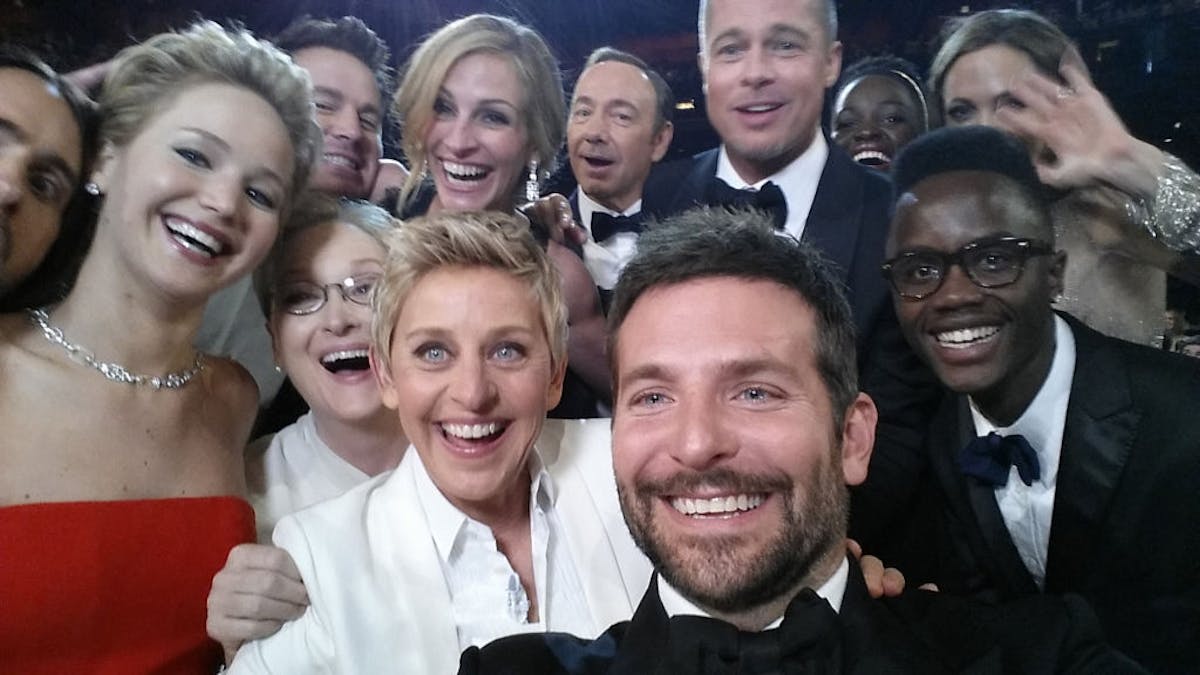
The monoculture is dead, The Hollywood Reporter claims. Its evidence? No one watches the Oscars anymore. An article over the weekend, “The Last Time Everyone Watched the Same Thing,” highlighted the last moment everyone shared: a selfie that Bradley Cooper took at the 2014 Oscars, which instantly became the most widely-shared Tweet ever.
More than 43 million people witnessed that act of elite digital solipsism. But we should be asking: Does an iPhone snapshot that includes Ellen DeGeneres and Kevin Spacey really indicate some sort of peak? Or was it so self-absorbed and off-putting that it actually hastened a cultural shift? Whether consciously or not at the time, Americans saw that moment and thought, “This is bullsh*t.” After all, the number-one show at the time was The Big Bang Theory, which had something like 23 million weekly viewers, a sitcom about geniuses, but made for dumb people, or at least people that Hollywood thought were dumb. Good riddance, and don’t let the door hit you in the bazinga on the way out.
Look at what happened when Hollywood took one last stab at uniting us all when COVID hit. That was the age of Tiger King, a terrible documentary reality show that baked its own obsolescence into its premise. Sure, everyone watched it, but only because public entities and massive peer pressure terrified them into staying indoors.
But the ultimate mask-off moment occurred with Gal Gadot’s “Imagine” video, which just celebrated its sixth birthday. It was the cringiest thing ever created: entitled celebrities singing a dated folk song while normal people grieved the losses of loved ones, their jobs, or their regular daily routines. That was just the start of the 2020 crap parade, the worst cultural period in global history, which featured charity cast “table reads” of 1980s comedies like Fast Times at Ridgemont High and a video of Katy Perry singing “Baby Mine” from Dumbo while dressed in an elephant costume. Faced with this tsunami of garbage, people watched reruns of Columbo and Friends instead and said, “Take this monoculture and shove it.”
The traditional pipeline stopped producing. Our entertainment became YouTube and Instagram videos of people cooking stuff they’d found in the garbage. And it was fine.
Then again, maybe the article’s entire premise is flawed. The “monoculture” might actually still exist. It’s just that old metrics, like Nielsen ratings and box office grosses, don’t tell the whole story. The Hollywood Reporter mentions Stranger Things, but what about Squid Game? Or Mr. Beast? The Minecraft movie was a massive cultural phenomenon, as were the Super Mario Bros. films. If the monoculture is dead, then how did KPop Demon Hunters take over the Oscars this year?
Let’s not denigrate the traditional monoculture era. It brought us Back to the Future, Raiders of the Lost Ark, The Empire Strikes Back, Cheers, the golden age of The Simpsons, Yo! MTV Raps, Seinfeld, Thriller, Legally Blonde, and many other entertainment products serving infinite pleasure. All that material is still out there, swirling around, and much of it is still watchable and good. Young people still listen to ’80s music and know what a flux capacitor is; they can still pick Donkey Kong out of a police lineup. It’s just that we’re not all watching the same thing all the time. As the title of an Oscar-winning movie — which was not part of the monoculture — goes, it’s everything, everywhere, all at once.
Besides, we don’t all need to be watching the same thing. The era when 90 million or so people saw BJ say “Goodbye” to Hawkeye on M.A.S.H. is more distant from today’s reality than V-J Day was from the 1970s. It has no relevance. Our world is more atomized, more diverse, and less dependent on traditional gatekeepers than ever. Maybe the death of the monoculture is a good thing. Imagine.
***
Neal Pollack is the author of 12 semi-bestselling books of fiction and nonfiction and is a three-time Jeopardy! champion.

