This article is part of Upstream, The Daily Wire’s new home for culture and lifestyle. Real human insight and human stories — from our featured writers to you.
***
Growing up in the early 2000s, my favorite sources of entertainment were sitcoms: “Friends,” “Frasier,” and, of course, “Seinfeld.” Alongside the wry banter and constant camaraderie, there was one obvious common denominator: the city apartment. From Monica Geller’s quaint, eclectic refuge in Greenwich Village to Jerry Seinfeld’s relaxed, minimalist Upper West Side apartment — “It kind of motivates me to work on the road,” he joked in the series pilot — these homes and their furnishings lodged themselves in my imagination.
To me, these apartments were aspirational shrines. Regardless of their size, their very idea conveyed grandeur. They were monuments to success in our modern age, placing you squarely in the crosshairs of cultural hotspots and within walking distance of wherever anything interesting was happening. Under the sway of those romantic notions, I eagerly jumped into the condo market in 2020, when the COVID-19 panic briefly wreaked havoc on demand.
And at first, it was wonderful.
We rarely dream of having “made it” in the present tense. We dream instead of the version of success we absorbed as children. That is why, when we finally acquire some disposable income, we often spend it chasing the luxuries that once signified having arrived in some earlier age. In my case, that meant hunting down the Knoll Wassily chair from the set of “Frasier” and learning far too much about designer chairs and lamps — to the point that, despite the vexation of friends and family, I will pause a movie to point out some obscure table lamp in the background and announce, “That’s a $2,000 Louis Poulsen.”
I spent endless hours tweaking things, rearranging furniture, scouring art auctions, and trying to curate the perfect little living space. There is a common internet joke about men’s apartments consisting of one chair, a television or stereo, and a bare mattress on the floor. But we do not actually have to live like this. Everyone should, at some point in life, experience having a small place of his or her own. It is less intimidating than decorating an entire house, but it still forces you to discover your style, to become curious about art and detail, and to develop some kind of taste beyond navy blue sheets and whatever flatscreen happened to be on sale at Best Buy.
I enjoyed that period immensely. And the walkability of living downtown was yet another windfall. Spending weekends at my parents’ home in the suburbs, where the nearest café or grocery store is a drive away, always felt isolating by comparison. Living downtown, I can even walk to the symphony or the opera house, where I have a season subscription, and if one tenet of conservatism is to preserve and prolong our common culture and history, then I am doing my part.
But walking home last winter after a performance of Gluck’s “Orfeo ed Euridice,” an opera about a man’s passage through the underworld, felt almost too apt as I sidestepped homeless drug addicts, stepped over heroin needles strewn about like cigarette butts, and arrived home to find a vagrant lighting a crack pipe outside my building. There is only so much reality the romance of convenience can absorb.
Over the years, I lived in several different parts of Toronto’s downtown core and viewed more than enough condos for one lifetime. At some point in the 2010s, developers appear to have reached a broad consensus that young people do not cook, and that a galley wall with a mini oven and a toy-sized sink constitutes an acceptable substitute for a kitchen. Dining rooms were apparently deemed obsolete as well, shrinking one-bedroom units to a measly 400 to 550 square feet — enough room for a sofa, a bed, and perhaps the illusion of a life.
No word has been more shamelessly abused by developers than “den,” which now seems to mean any divot, alcove, or awkward recess that cannot in good conscience be called a room. But what made this all the more absurd was the broader cultural hagiography of such cramped quarters, which somehow made them seem normal, even desirable.
And then, eventually, I came to a more profound revelation: condos are communist.
In condominium living, virtually every facet of homeownership is outsourced to a central governing body: the condo board. You enjoy the convenience of not having to worry about certain things, but only at the cost of surrendering your freedom to make decisions about them yourself.
Take heating and air conditioning. Most buildings in my city have single-coil HVAC units, which means the building can have either air conditioning or heat at any given time, but not both. The condo board and property manager decide when the seasonal changeover happens. I am writing this from my sweltering 80-degree apartment in mid-April, which cannot be cooled until the vaunted board decides that spring has properly arrived.
The drama extends well beyond thermostat tyranny. Last year, a friend lived in a building where the roof suddenly began to leak. In a house, it would ultimately be your decision when and how to fix it. But the supposed virtue of condo living — not having to worry about the foibles of homeownership — can also be its defect. The board alone decides when and how the problem will be addressed. And if the reserve fund is not adequately prepared to bear the cost, the condo issues what is called a “special assessment,” which is a polite administrative phrase meaning: surprise, your share of the problem is now a $5,000 bill.
Another drawback of this collective arrangement is that when something goes wrong in your unit, it can quickly escalate and cascade through the building like a minor Chernobyl. In our building, an HVAC leak in one apartment damaged the three consecutive units directly below it. The costs were all charged back to the poor offender at the source. In a house, your problems tend to stay on your property; in a condo, they travel.
Then there are the fees. As you get older, move in with a spouse, accumulate more things, or, in our case, somehow wedge an entire Pottery Barn showroom’s worth of furniture into 650 square feet, you naturally covet more space. You begin to imagine needing extra room for guests, a nursery, or a wood-paneled library in which to pretend you are an English lord. But the larger the condo, the larger the fees. Just like any good communist arrangement, those with more must contribute more to the apparatus.
And condo buildings are expensive apparatuses. There are the concierge, the staff, the cleaners, the elevators, the lobby furniture, the security, the underground garage, the reserve funds, and whatever emergency cleanup is required when a drug-addled vagrant soils himself in your vestibule, as happened in my building sometime last year. No one is exactly pocketing this money; it all goes toward maintaining the machine. But in most major cities, once you get beyond a two-bedroom unit, you are often paying well over $1,000 a month in perpetuity for maintenance alone — and, like a government bureau, the number only ever gets larger.
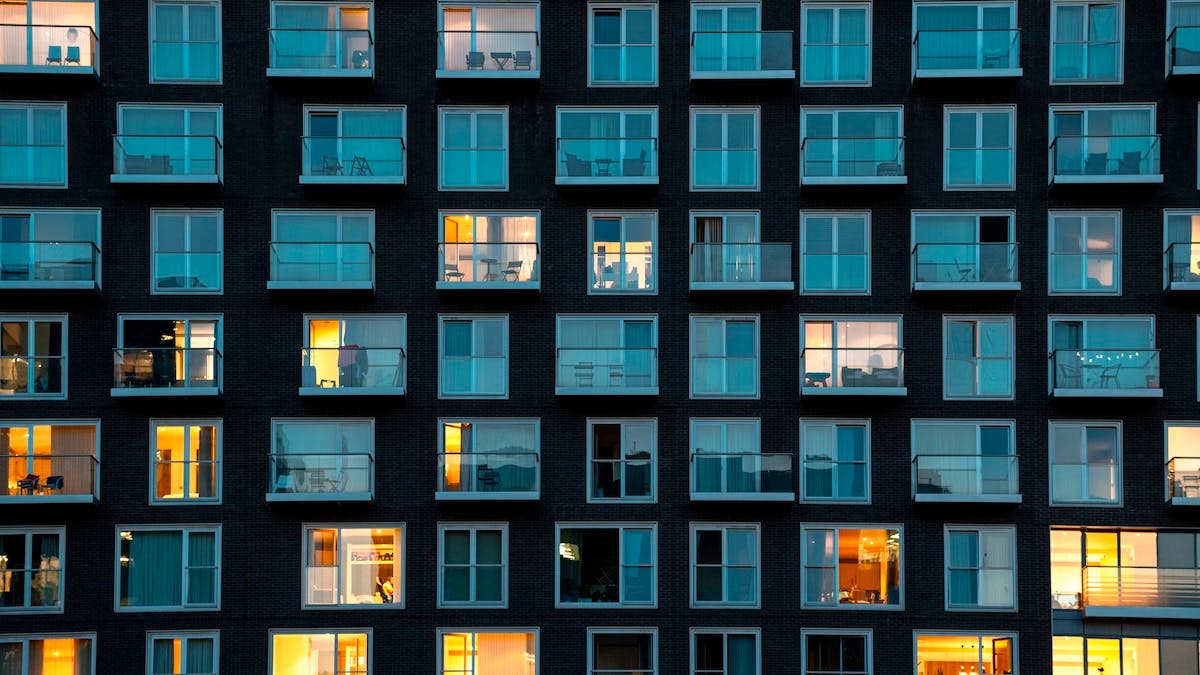
Today’s glass towers may look more glamorous than the concrete Brezhnevkas of the Soviet Union, but in ethos they are not so different. You nominally own your unit, yet you live under a regime of shared burdens, centralized decisions, rising maintenance levies, and endless bureaucratic pestering. Only at a condo board meeting can you find people capable of meandering for 20 minutes about whether the dog spotted in the elevator may have exceeded the sacred 20-pound limit. It is private property in theory, but collectivized living in practice.
There is also the problem of outdoor space. Sure, if you are a multimillionaire, perhaps you can get a lavish terrace with your stately penthouse. But even then, your children are not exactly playing soccer or throwing a baseball around on a downtown balcony. Good luck explaining to the fire department how the ball ended up through someone’s windshield 30 stories below.
So, finally, I have had enough.
Condos seemed exciting, sophisticated, and full of promise, and for a time, they were. But after years of living in them, I am ready to move on and move down into a house. A real house, with real land, where you are responsible for your own upkeep and your own decisions. It may be less fashionable and less glamorized than the downtown high-rise of my childhood imagination. But increasingly it strikes me as the only sane way to live.
***
Harry Khachatrian (@Harry1T6) is a film critic for the Washington Examiner’s Beltway Confidential blog. He is a software engineer, holds a master’s degree from the University of Toronto, and writes about wine at BetweenBottles.com.