

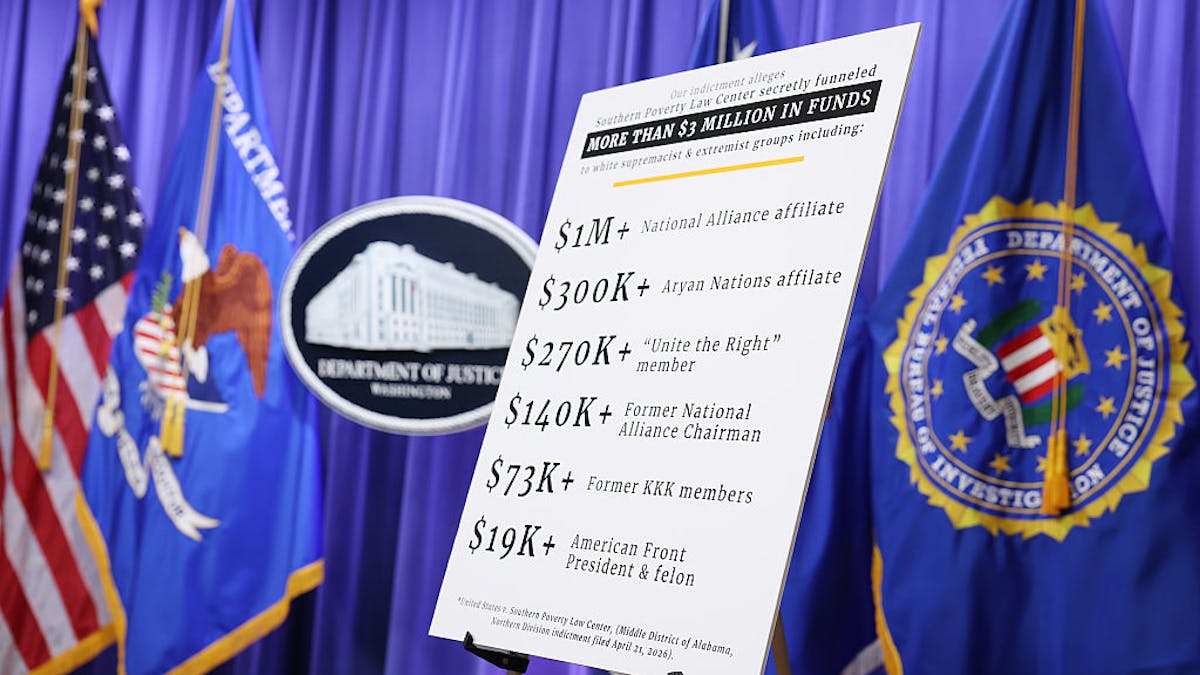
For decades, the Southern Poverty Law Center (SPLC) has had an outsized influence on American government and society, much of it malignant, but that may be coming to an end. Federal prosecutors have announced that a grand jury has indicted the SPLC for financial offenses related to its alleged funding of supposed infiltrators in various white-supremacist groups and events, most notably the infamous 2017 “Unite the Right” riotous demonstration in Charlottesville, Virginia. The government claims the SPLC took money from donors who wanted to counter organized extremism and then funneled it into support for leaders of extremist groups.
Legally, it’s a bold claim, and courts will have to decide whether the allegations constitute federal crimes. But politically, the government has a powerful claim. As Acting Attorney General Todd Blanche put it: “The SPLC is manufacturing racism to justify its existence.”
The charitable group was founded in 1971. By the end of its second decade, its lawsuits assaulting Ku Klux Klan groups had successfully bankrupted that ugly movement. Its original mission accomplished, the SPLC didn’t declare victory and shut down. Instead, it became a fundraising factory that enriched its coffers by tarring mainstream conservative and religious groups by unfair association with extremists, lumping together neo-Nazi cadres with respectable conservative groups like the Family Research Council.
Compared to other nonprofits, SPLC is lavishly funded. In 2023, the group reported almost $170 million in total revenue — more than the revenues of the Special Olympics, the United Service Organizations (USO), and the National Park Foundation. SPLC’s vast wealth totals roughly three-quarters of a billion dollars in assets, tens of millions of which are held in offshore accounts, leading to jokes that its Alabama headquarters building is the “Poverty Palace” and that the group’s motto should be “The SPLC — making hate pay.”
Other than swelling the SPLC’s domestic and Caribbean bank balances, what did donors get for all this cash? The group’s institutional donor list — which contains such left-wing luminaries of Big Philanthropy as the W.K. Kellogg Foundation and the Silicon Valley Community Foundation (a conduit for Big Tech billionaire giving) — suggests the SPLC had strong ideological motives.
Before allegations that the SPLC was funding people at the top of radical white-supremacist groups, its most notorious product was its list of “hate groups.” In addition to counting what seemed like every racist knucklehead who could afford to register a URL as a “hate group,” it also tarred as hate groups such mainstream conservative organizations as the legal advocacy group Alliance Defending Freedom, the education advocacy groups Moms for Liberty and Defending Education, and immigration-restriction groups like the Center for Immigration Studies. It also branded the conservative political group Turning Point USA an “anti-government extremist group” just months before its founder, Charlie Kirk, was assassinated, apparently by a young man who told his roommate in a text, “I had enough of his hatred.”
Ominously, Kirk had warned that SPLC’s listing of his group could lead to violence, recalling that a shooter had attacked the Family Research Council after SPLC hate-listed it. That would-be mass-murdering extremist was stopped after shooting a security guard; he later said he chose his target based on the SPLC’s hate map and planned to also kill persons at three more conservative groups.
Thanks to ideologically sympathetic tech and major media companies, as well as law enforcement authorities like the FBI, the SPLC had its “designations” treated as if they were somehow official and neutral, rather than ideological weapons that often succeeded in harming targeted mainstream groups’ ability to raise money. In 2017, GuideStar, a widely used watchdog of charities, was persuaded not to apply SPLC “hate” labels to groups. By 2019, SPLC was partnering with the Amalgamated Charitable Foundation — a donor-advised fund provider closely tied to the bank that services the Democratic National Committee and is nearly majority-owned by affiliates of the Service Employees International Union — on a pressure campaign to ban contributions from donor-advised funds to so-called “hate groups.”
Still more scandals plagued SPLC, even as its wealth ballooned. Morris Dees, its founder and longtime litigation director, was canned in 2019 amid widespread allegations of misconduct, including sexist and racist discrimination and sexual harassment. A former employee wrote a long, devastating tell-all in the New Yorker, confessing that folks on the left had known for decades that Dees was “a ‘super-salesman and master fundraiser’ who viewed civil-rights work mainly as a marketing tool for bilking gullible Northern liberals.”
It remains to be seen if the Justice Department’s indictment of the SPLC will prevail, but should the shameless operation finally meet its downfall, that downfall would be well deserved. At a minimum, the latest revelations should knock down any last support for the group’s claim to moral authority.
Scott Walter is president of the Capital Research Center.

