

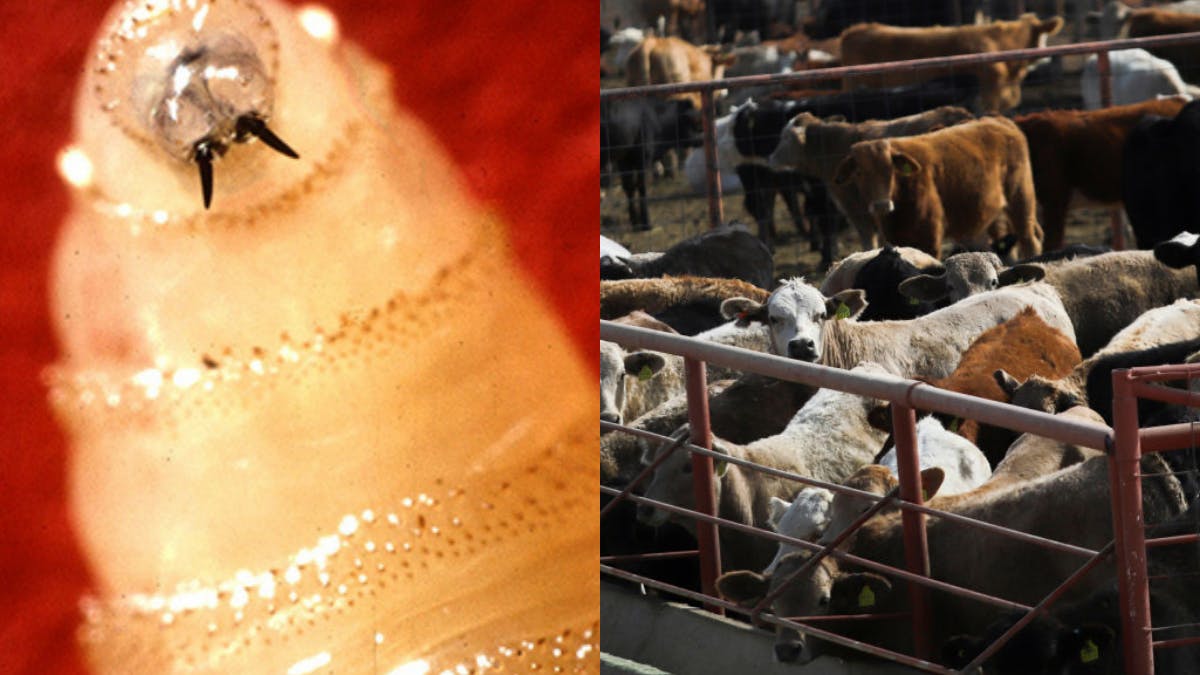
The flesh-eating New World screwworm has been confirmed in a Texas calf, marking the first detection of the parasite in U.S. livestock in decades.
The Department of Agriculture announced Wednesday that a three-week-old calf in Zavala County, Texas, tested positive for New World screwworm, a parasite whose larvae feed on the living tissues of warm-blooded animals, and yes, sometimes humans.
The confirmation comes one day after The Daily Wire reported on a suspected case in South Texas and follows a growing outbreak in Mexico that prompted federal officials to warn that the pest could eventually cross into the United States.
According to the USDA, the screwworm infestation was found in the calf’s umbilical area. The parasite typically enters animals through open wounds, where larvae burrow into the flesh and feed on living tissue. Federal officials said no additional cases have been identified in the United States.
As far as meat and produce go, the USDA noted the food supply is safe because screwworms do not infest meat, fruits, vegetables, or other food sources.
🚨 With the recent detection of New World screwworm in a 3-week-old bovine in Zavala County, TX, USDA urges residents to contact your veterinarian right away if you see any suspicious wounds, maggots, or infestations in your animals or herd.
If you see signs of maggot… pic.twitter.com/lxxsjIgDcb
— Dept. of Agriculture (@USDA) June 4, 2026
“All models showed New World screwworm entering the country in 2025; however, thanks to the hard work across the entire Trump administration and our industry, state, and local partners, we were able to buy time for this moment,” said Dudley Hoskins, Under Secretary for Marketing and Regulatory Programs.
Hoskins said protecting America’s livestock is a national security issue “of the utmost importance.”
“USDA invested heavily in the tools needed to eliminate NWS ever since cases started increasing in Central America and Mexico. The United States has defeated this pest before, and we will do it again.”
The U.S. case comes after the screwworm was found last week in a five-year-old goat in Coahuila, the Mexican state that borders southwestern Texas. A separate case was reported on Sunday of the screwworm infecting a dog in Tamaulipas, another bordering Mexican state.
The current outbreak in Mexico has persisted for some time, prompting Secretary of Agriculture Brooke Rollins to shut down livestock trade across the southern border in May 2025. There was one confirmed U.S. case last year from a person who returned to Maryland after traveling to El Salvador.
The USDA reports that screwworm maggots cause painful, foul-smelling wounds — and that maggots can sometimes be seen or felt in open wounds or in body openings, including the nose, mouth, eyes, ears, and genitals.
If the infestation isn’t caught early and treated quickly, it can lead to extensive tissue damage and sometimes death.
Adult screwworm flies are the size of a housefly, with orange eyes, a metallic blue or green body, and three dark stripes along their backs. The parasite is typically found in South America and parts of the Caribbean, but has been found farther north, in Central America and Mexico, over the last three years. While the major outbreak currently in Mexico and Central America is primarily in livestock, wildlife, and pets, there have been cases in people, according to the CDC.
If mammals or birds are found showing signs of irritated behavior, head shaking, a decaying odor, or maggots in wounds, they should be reported to an animal health official immediately.
The USDA and Texas officials are taking immediate action to eliminate the threat of screwworms in the United States through an action plan linked here.
The USDA warns that if you see signs of maggot infestations in live or very recently dead wild animals, especially in areas near the U.S.-Mexico border, call 866-487-3297 or report it to your local USDA Wildlife Services office.

